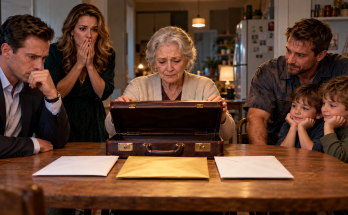
The next morning, I took Walt's briefcase out of the closet again.
I carried it to the kitchen table after Danny left for work.
The apartment was quiet.
Kayla had taken the boys to school, and the laundromat downstairs had not yet become busy.
I sat down and opened the brass latch.
The documents were arranged exactly as I had left them.
I took out the folder containing Walt's financial records and placed it beside his reading glasses.
For months, I had avoided spending too much time with those papers.
They reminded me of the conversations we had shared when he was alive.
Walt had liked to explain things.
He could sit at the kitchen table for an hour, showing me how a number had changed or why he had made a particular decision.
Sometimes I listened carefully.
Sometimes I told him he was making a simple matter unnecessarily complicated.
He usually smiled and continued anyway.
Now I wished I could hear him explain everything one more time.
I began reviewing the documents.
The sale of the transport business had been completed well before his illness.
Walt had arranged our investments and made sure that the money would support me if he died first.
He had also made provisions for the future.
The papers were clear about what he had wanted.
I didn't need to invent new arrangements or make decisions in a hurry.
I needed to understand the ones he had already made.
I worked slowly, checking the dates and figures.
When I found something I didn't understand, I wrote it in my notebook.
I would ask our financial adviser about it later.
Walt had always told me that I should never sign a document simply because someone sounded confident while explaining it.
I intended to follow that advice.
After an hour, I closed the folder.
I sat with my hands resting on the table.
The three envelopes had changed the way my children looked at me.
But the money itself had not changed.
It had been there before Walt died.
It was still there now.
The difference was that I no longer had to carry the secret alone.
I could tell the truth about our finances without turning every conversation into a discussion about what my children might receive.
That was what I wanted to protect.
My own security.
My independence.
And the chance for my family to become something more honest than it had been.
I took out a fresh sheet of paper.
At the top, I wrote three questions for our adviser.
The first concerned my long-term expenses.
The second concerned the documents Walt had prepared.
The third concerned how to keep the arrangements clear so that there would be no confusion later.
I didn't write down what I thought Michael or Stephanie deserved.
I didn't write down what Danny should receive because he had given me his bed.
I wasn't ready to turn my feelings into financial decisions.
And I didn't want gratitude to become a debt.
Danny had helped me because he loved me.
I wanted that act to remain what it was.
A gift.
Not a transaction.
I put the paper into the folder and closed the briefcase.
Then I carried it back to the closet.
As I placed it on the shelf, I noticed the worn patch near one corner.
Walt had carried that case for years, through business meetings and long drives.
He had taken it with him when he sold the company.
He had used it to protect the documents that would eventually become my responsibility.
I ran my fingers over the leather.
"I wish you were here," I whispered.
The words sounded small in the empty apartment.
But I said them anyway.
I missed him.
I missed having someone beside me who understood the whole story without needing it explained.
I missed the ordinary arguments about groceries and bills.
I missed his reading glasses on the table and his habit of tapping the clock when it ran late.
I missed the life we had built before I had to discover how my children would respond to losing it.
That afternoon, I called our financial adviser.
We arranged a meeting for the following week.
I asked what documents I should bring and made a list.
When the call ended, I felt calmer.
There were practical things I could do.
There were decisions I could make.
Grief had made everything feel uncertain, but the numbers were still there.
Walt had left me a way to manage my future.
I needed to use it wisely.
Later that week, I visited Stephanie's house.
She had prepared dinner, and the children were excited to see me.
They ran to the door when I arrived.
One hugged my legs while the other reached for my handbag.
Stephanie stood behind them, smiling.
"Come in, Mom."
I stepped inside.
The house was warm and busy.
There were school papers on the counter and shoes scattered near the stairs.
It looked like a family home.
Stephanie had cleared a place for me at the table.
She had also put a chair beside the living room window, where I could sit comfortably after dinner.
I noticed the effort.
I thanked her.
She didn't ask whether I was impressed.
She simply took my coat and hung it in the closet.
During dinner, the children told me stories about school.
One complained about a classmate.
The other described a science project that had gone wrong.
Stephanie listened, asked questions, and helped them work through their arguments.
I watched her.
I remembered the little girl she had been.
She was still there in some ways.
She still worried about what people thought.
She still wanted things to go smoothly.
But she was trying to face something uncomfortable instead of rushing away from it.
After dinner, the children went upstairs.
Stephanie and I sat in the living room.
She brought tea and placed a cup beside me.
"I've been thinking about what you said."
I looked at her.
"Which part?"
"That you didn't want to be alone."
She sat down across from me.
"I think I heard the words, but I didn't really listen to them."
I held the warm cup between my hands.
"I believe you understand more now."
She nodded.
"I want you to know that if you ever need a place to stay again, you can come here."
I looked at her.
"Thank you."
"And I don't mean that because of the money."
She seemed embarrassed to have to say it.
I understood why.
The secret had changed the meaning of ordinary offers.
Every kind word could now sound like an attempt to correct the past.
I didn't want her to feel that way forever.
"I know you want to make things right," I said. "But you don't have to prove everything in one evening."
She looked relieved.
"I just don't want you thinking I don't care about you."
"I don't think that."
I paused.
"I think you didn't understand what I needed when I asked."
She nodded slowly.
"That's fair."
We sat quietly for a while.
Then Stephanie asked whether I would consider spending a weekend with her family sometime soon.
I told her I would.
This time, I meant it.
When I returned to Danny's apartment, he was helping the boys get ready for bed.
Kayla was folding laundry near the couch.
I hung my coat beside the door.
Danny looked up.
"How was it?"
"Good."
He smiled.
"Good."
I sat at the folding table while he read a story to the boys.
His voice drifted through the bedroom doorway.
The children interrupted him every few lines to ask questions.
He answered each one patiently.
I thought about Michael's guest room and Stephanie's cleared chair.
Both of them had begun making room for me.
That mattered.
I didn't want to reject their efforts simply because they had come later than they should have.
But I also knew that rebuilding trust would take more than one dinner or one apology.
It would take repeated choices.
Calls made because they wanted to hear my voice.
Visits that weren't connected to documents or money.
Offers of help that didn't come with an expectation of praise.
And the willingness to remember that I was their mother, not a problem to be managed.
I took Walt's reading glasses from my handbag.
I had brought them with me when I left the apartment that afternoon, intending to clean them properly.
I wiped the lenses and placed them beside the briefcase.
Then I opened my notebook.
Under the questions for our adviser, I wrote one more sentence.
I would not make decisions about my children's future while I was still trying to settle the pain of their past choices.
I read the line twice.
It seemed sensible.
It also seemed difficult.
I wanted to reward Danny for his kindness.
I wanted Michael and Stephanie to understand that their actions had consequences.
I wanted to protect the family Walt and I had spent decades building.
Those wishes did not all point in the same direction.
I would have to take my time.
The money was mine to manage.
The forgiveness was mine to offer.
And the future of my family would depend on what we all chose to do next.
I closed the notebook.
From the bedroom, I heard Danny finish the story.
One of the boys asked him to read another.
Danny laughed softly.
"One more, then it's bedtime."
I sat in the quiet kitchen and listened.
The folding table stood beneath the light.
The chipped plate had been washed and put away.
The briefcase was closed.
Walt's glasses rested beside it.
For the first time in months, I didn't feel that I had to decide everything before morning.
I could take the next step when I was ready.
And I could let my children show me, one ordinary day at a time, whether they had truly understood what had happened.
Click here to continue reading: PART 13: The First Time I Returned to Our Old House Alone, I Realized That Losing Walt Had Changed More Than the Rooms We Shared
The Three Phone Calls I Made After Walt Died Began With a Lie I Thought My Children Would Never Make Me Regret
Part 12 of 28