I used to think the worst thing a person could receive in the mail was a bill they couldn't afford.
I was wrong.
Sometimes the worst thing came in a pretty envelope with gold lettering and somebody else's handwriting.
Mine arrived on a Tuesday.
I remember because Tuesday was the day I usually sorted the bills, watered the tomatoes, and called my sister if I had anything worth complaining about.
The envelope was sitting between the electric bill and a grocery advertisement.
Nothing about it looked threatening.
Cream-colored paper.
A gold border.
My name written carefully across the front.
Della.
Not Mrs. Hatchett.
Not Mrs. Garland Hatchett.
Just Della.
I stood beside the kitchen counter holding it for a moment.
There are names you don't expect to see again after a certain number of years.
His was one of them.
I opened it with the little knife I kept in the drawer beside the telephone.
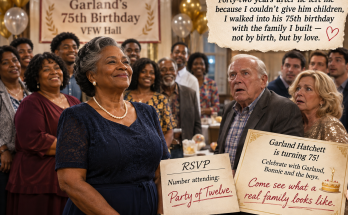
Inside was a birthday invitation.
Garland Hatchett was celebrating his seventy-fifth birthday.
The party would be held at the VFW Hall in Tupelo.
His wife, Bonnie, and their three sons would be there.
There was a photograph of a birthday cake printed in the corner.
I read the invitation twice.
Then I noticed the handwriting underneath the printed information.
It wasn't part of the invitation.
Somebody had added a personal message.
Come see what a real family looks like.
I didn't move.
I just stood there with the card between my fingers.
For a while, the refrigerator was the only thing making noise.
I knew immediately that the handwriting belonged to a woman.
The letters leaned forward.
The capital C had a little curl.
The final word ended with a flourish that seemed almost pleased with itself.
I didn't know Bonnie's handwriting personally.
But I knew enough about people to recognize when somebody wanted to hurt another person.
And that woman had chosen her words carefully.
I placed the invitation beside my landline.
I still had one.
People my age were always telling me to get rid of it.
They said nobody needed a telephone attached to a wall anymore.
I told them I had survived this long without asking their permission about my telephone.
Besides, there were things I liked about that old machine.
It rang loudly.
It never needed charging.
And when Ernestine called, I could hear her before I even picked up the receiver.
I looked at the invitation again.
Forty-two years.
That was how long it had been since Garland Hatchett had walked out of my life.
Forty-two years since I had watched his truck disappear down the road.
I had been twenty-three years old when I married him.
I was twenty-eight when he left.
Now I was sixty-five.
People sometimes said I looked younger.
I never knew what to do with that compliment.
Getting older wasn't something I had accomplished.
It was simply something that had happened while I was busy living.
But that Tuesday afternoon, looking at the invitation, I felt twenty-three again.
And I hated that feeling.
I remembered our little house in Indianola.
The kitchen had yellow curtains.
The table had one uneven leg.
Garland always complained about it, but he never fixed it.
I remembered the sound of his keys landing beside the sugar bowl when he came home from work.
I remembered his boots near the back door.
I remembered saving money in an envelope because we wanted a bigger place someday.
We had ordinary plans.
A bigger kitchen.
A little garden.
Children.
Especially children.
That was the one thing we couldn't seem to make happen.
At first, we didn't worry much.
We were young.
There would be time.
Then the years passed.
We visited doctors.
We answered questions.
We sat in waiting rooms beneath old magazines and listened to people calling other people's names.
Eventually, two different doctors in Greenville gave us the same answer.
Neither of them told me I was worthless.
Neither of them said I had failed as a woman.
But Garland heard the news differently.
He heard it as the end of the family he had imagined.
I remembered the day he left more clearly than I remembered some of my birthdays.
He stood in our kitchen with a duffel bag.
His shirt was tucked into his trousers.
His expression was serious.
I had asked him where he was going.
He looked at me as though the answer should have been obvious.
He said he wanted children.
He said he wanted a home filled with them.
Then he told me he couldn't spend his whole life waiting for something that might never happen.
I tried to explain that we could still have a life together.
We could consider adoption.
We could talk to somebody.
We could take our time.
He didn't want to hear any of it.
I still remembered the words he used.
Not because they were especially complicated.
Because they were simple enough to stay with me.
He told me I couldn't give him the family he wanted.
Then he picked up his bag.
I followed him to the doorway.
He walked toward his pickup.
I stood there waiting for him to turn around.
He didn't.
The truck started.
The tires moved over the gravel.
And then there was an empty driveway where my husband had been standing.
I was twenty-eight years old.
I thought my life was finished.
That was the embarrassing part.
I honestly believed I had lost the only future I was ever going to have.
I cried for months.
Not in front of people.
I had too much pride for that.
I cried at night.
I cried when I washed his coffee cup and realized I didn't need to keep it separate anymore.
I cried when I found one of his shirts behind the bedroom door.
And sometimes I cried in the kitchen because I couldn't understand how a person could share a bed with you for five years and leave without looking back.
Then life became busy.
It had a way of doing that.
There were bills.
There was work.
There were children waiting at bus stops.
There were people who needed somebody dependable.
And slowly, without asking my permission, the days started filling up again.
I eventually stopped checking the road for Garland's truck.
I stopped wondering whether he had changed his mind.
I stopped saving stories to tell him.
But I never forgot the way he had spoken about children.
That was something I carried.
So when I saw the words written at the bottom of his birthday invitation, I understood exactly where Bonnie had intended them to land.
She wanted me to remember.
She wanted me to compare my life with hers.
She wanted me to picture Garland surrounded by the family he had supposedly wanted all those years ago.
And she wanted me to feel that I had been the problem.
I folded the invitation.
Then I unfolded it again.
I could have thrown it away.
That would have been easy.
I could have called Ernestine and complained until supper.
I could have spent the afternoon remembering everything I had spent forty-two years trying not to remember.
Instead, I placed the card flat on the kitchen table.
I went outside and watered my tomatoes.
The plants didn't care who Garland had married.
They didn't care how many sons he had.
They needed water.
So I gave them water.
That evening, my sister came over.
And I knew from the moment she walked through my door that I wasn't going to keep the invitation a secret for long.
Click here to continue reading: PART 2: My Sister Recognized the Woman’s Handwriting Immediately, But Her Advice About Attending the Birthday Party Was Not What I Expected
The Birthday Invitation That Arrived Forty-Two Years After My Marriage Ended Had One Cruel Sentence Written at the Bottom
Part 1 of 20