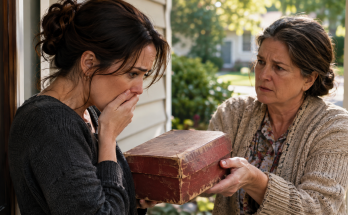
Elora looked smaller than I remembered.
She was standing near the entrance of her house when I arrived.
Her left leg was supported by a medical brace, and she held a walking aid in one hand.
A small handbag rested beside her feet.
I hurried over.
"Why are you standing? You should be sitting down."
She smiled.
"I'm perfectly fine, dear."
"You don't look perfectly fine."
She laughed softly.
It was the first time I had heard her laugh since our phone conversation.
I picked up her handbag and helped her toward the car.
The journey to my house took about twenty minutes.
Elora spent most of it looking out the window.
Every now and then, she asked whether I was sure I didn't mind having her there.
I gave her the same answer each time.
"You're welcome in my home."
Eventually, she stopped asking.
When we arrived, I helped her inside.
I had already moved a comfortable chair into the spare bedroom.
There were clean blankets on the bed and a small vase of flowers on the bedside table.
Nothing expensive.
Just a few things to make the room feel less like a temporary place to sleep.
Elora looked around.
"Oh, Claire."
She covered her mouth.
"You've done all this for me?"
I shrugged.
"It's just a bedroom."
She touched the fresh pillowcase.
"No one has made this much effort for me in a long time."
I didn't know what to say.
So I helped her sit down.
Then I brought her a glass of water.
The first few days were mostly about learning what she could and couldn't do.
She could manage some things independently.
Other things required help.
I tried to give her as much privacy as possible.
I didn't want her to feel embarrassed.
Whenever she needed assistance, I helped without making a big deal out of it.
I prepared breakfast before leaving for work.
Usually, it was toast, eggs, and tea.
Sometimes she preferred oatmeal.
I made sure there was enough food in the refrigerator for lunch.
In the evening, I cooked dinner.
Nothing fancy.
Chicken soup.
Roasted vegetables.
Pasta.
Whatever she felt like eating.
I also drove her to her medical appointments.
The hospital parking garage became part of our weekly routine.
We would sit in the waiting room, talk about ordinary things, and occasionally laugh at something on television.
For a while, it felt almost like having family again.
Not the kind of family I had lost.
Something quieter.
Something easier.
Elora was polite about everything.
She thanked me whenever I brought her food.
She apologized whenever she needed help.
And she never complained about the limitations of her recovery.
Sometimes I wished she would complain a little more.
It might have made me feel less worried.
One evening, I came home carrying two grocery bags.
Elora was sitting in the living room.
She had folded the blanket over her knees and was watching the evening news.
"How was work?" she asked.
"Busy. I think everyone decided to have problems at the same time."
She smiled.
"Well, at least you're home now."
I put the groceries away.
Then I prepared dinner.
While we ate, she asked about my workplace.
She wanted to know whether I still worked the same hours.
I told her I did.
"Do you usually leave at the same time every morning?"
I looked up.
"More or less. Around eight."
"And you're home around six?"
"Usually."
She nodded.
I didn't think much of it.
Perhaps she was simply trying to understand my routine.
After all, she was staying in someone else's house.
Knowing when I would be around probably helped her feel more comfortable.
A few days later, she asked another question.
"Do you ever work from home?"
"Only occasionally."
"What about Fridays?"
"Why?"
"Oh, nothing. I was just wondering."
She returned to her soup.
I smiled and continued eating.
There was nothing suspicious about the conversation.
Not then.
The first week passed without any problems.
Elora's condition slowly improved.
She began moving around the bedroom more comfortably.
She could make herself a cup of tea if everything was placed within reach.
She even started reading again.
I was happy to see her getting stronger.
But I noticed something else.
She had become unusually interested in my schedule.
At first, it was only small questions.
What time would I be leaving?
Was I going straight to work?
Would I be home for lunch?
Was I planning to go anywhere after work?
Sometimes she asked whether I would be away for the entire afternoon.
I answered naturally.
I didn't think there was any reason to hide my plans.
One Wednesday morning, I was putting on my coat when she appeared at the bedroom doorway.
"Claire?"
"Yes?"
"Are you going out today?"
I looked at her.
"I have work."
"All day?"
I checked my watch.
"Until around six. Why?"
She hesitated.
"Nothing. I just wanted to know."
I smiled.
"Do you need anything before I go?"
"No, sweetheart. I'm all right."
I left.
That afternoon, my manager canceled a meeting.
I finished my work earlier than expected and decided to come home.
I stopped at a bakery and bought two pastries.
I thought Elora might enjoy them.
When I opened the front door, the house was unusually quiet.
I called her name.
"Elora? I'm home."
There was a noise from the spare bedroom.
A moment later, she appeared.
Her expression was difficult to describe.
She looked startled.
Almost as if she hadn't expected me to return.
"Oh! Claire."
I held up the bakery bag.
"Finished early. I brought something for us."
She stared at the bag.
Then she smiled.
"That's lovely."
But her smile seemed forced.
I didn't understand why.
"Everything all right?"
"Of course."
She turned toward the bedroom.
"I was just resting."
I followed her with my eyes.
Something about the exchange bothered me.
Not enough to question her.
Just enough to remember it.
That evening, we ate the pastries with tea.
Elora seemed perfectly normal again.
She asked about my day.
She laughed when I told her about a difficult customer.
And she thanked me for bringing her something sweet.
I convinced myself I had imagined her earlier reaction.
The following week, a similar thing happened.
I had planned to visit the supermarket after work.
But the weather turned bad, so I came home directly.
When I entered the house, Elora was standing near the hallway.
She looked at me.
Then at the clock.
"You're home early."
"Yes. The rain is terrible."
"Oh."
She said nothing else.
I put my handbag down.
"Did you need something?"
"No, dear."
She went back into the bedroom.
I stood in the hallway for a moment.
I felt strangely uncomfortable.
I wondered whether she wanted privacy.
Perhaps she was embarrassed about needing help with personal things.
Perhaps she preferred being alone when I wasn't around.
That explanation seemed reasonable.
So I decided not to make an issue of it.
I had made a promise to help her recover.
I didn't want to turn her stay into something unpleasant.
Over the next few days, I paid more attention to her comfort.
I made sure she had everything she needed before leaving.
I placed a bottle of water beside her bed.
I kept her medication organized.
I even bought a small notebook where I wrote down her medical appointments.
She thanked me repeatedly.
One night, she reached across the dining table and placed her hand over mine.
"Claire, I hope you know how grateful I am."
I smiled.
"You don't have to keep thanking me."
"I do."
She looked directly at me.
"You've been more generous than I ever expected."
I squeezed her hand.
"You would have done the same for me."
She didn't answer immediately.
Instead, she looked down at the table.
Then she said something I found a little strange.
"I hope you never regret letting me come here."
I laughed gently.
"Why would I regret it?"
She shook her head.
"No reason."
We finished dinner.
I washed the dishes.
And the conversation disappeared from my mind.
At least, I thought it had.
Click here to continue reading: PART 3: Every Time I Came Home Earlier Than Expected, Her Face Changed, and I Finally Began Wondering What She Was Doing Alone
I Thought My Marriage Was the Only Thing My Ex-Husband’s Family Had Taken From Me, Until His Mother Needed My Help
Part 2 of 20