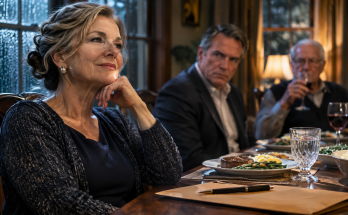
I used to believe that forty years of marriage meant something.
I thought it meant that when life became difficult, two people remembered everything they had survived together.
I was sixty-five when I discovered that I might have been the only one keeping count.
It happened on a Monday evening.
Nothing special about that night.
I had spent most of the afternoon preparing dinner, just as I had done thousands of times before.
Gerald liked his steak cooked a certain way.
He liked green beans with toasted almonds.
Not too much butter, but enough to give them flavor.
I remembered all of it without needing to ask.
That was how our marriage had worked for years.
I remembered the little things.
He forgot them.
Outside, rain was falling against the windows of our house outside Pittsburgh.
The brick patio had turned dark with water.
The television had been switched off after the evening news.
The dishwasher was empty, and the dining room was ready.
Walter, Gerald's ninety-one-year-old father, was sitting in his usual chair.
He had already placed his napkin across his lap.
He was waiting for someone to pass him the potatoes.
I carried the serving dish to the table.
Nobody thanked me.
That was not unusual.
I had reached an age when I could set an entire dinner in front of people without expecting anyone to notice how much work had gone into it.
I told myself that was simply family life.
Gerald sat across from me.
He looked comfortable.
His shirt was neatly pressed, and his steak was already cut into smaller pieces.
Walter poured himself another little amount of wine.
I sat down.
For a few minutes, everything looked exactly as it always had.
Then Gerald put down his knife.
He swallowed.
He wiped his mouth with his napkin.
And he looked directly at me.
"I filed for divorce this morning."
I didn't understand him immediately.
Not because his words were complicated.
Because they were so unexpected that my mind refused to put them together.
I was still holding the serving spoon.
A few toasted almonds fell from the green beans onto the tablecloth.
I looked down at them.
One landed near my plate.
Another stopped beside the folded edge of my napkin.
Gerald watched me.
He didn't reach for my hand.
He didn't ask whether I had heard him correctly.
He simply continued.
"You have forty-eight hours to get your belongings together and leave this house."
I looked at him.
Then I looked at Walter.
My father-in-law raised his glass.
He took a small drink before speaking.
"Don't turn this into an argument, Teresa. You've already received more than enough from this family."
I put the serving spoon down.
Carefully.
I was afraid that if I moved too quickly, my hand would betray me.
Forty years.
That was how long I had been married to Gerald.
Forty years of birthdays, hospital appointments, company problems, family obligations, and ordinary evenings when somebody needed something from me.
And now these two men were sitting across from me as if they had arranged a business meeting.
I looked at the empty space between their plates.
There was a brown envelope there.
Gerald pushed it toward me.
"There's something you need to sign."
His voice was calm.
Almost pleasant.
I looked at the envelope.
Then at the pen beside it.
It was a company pen.
Whitfield & Son Construction.
I knew exactly where those pens came from.
I had ordered them.
I had ordered hundreds of things for that company over the years.
Pens.
Paper.
Printer supplies.
Insurance documents.
Flowers when an employee died.
Things that seemed small until somebody needed them immediately.
I remembered every supplier who had called complaining about a late payment.
I remembered the employees who came to me when their paychecks were incorrect.
I remembered Gerald asking me to speak to people he didn't want to deal with himself.
But sitting at that dinner table, none of those memories seemed to belong to the woman Gerald was looking at.
He seemed to see somebody who had simply been living in his house.
Somebody who needed to be told when to leave.
I opened the envelope.
Gerald leaned back in his chair.
I recognized that expression.
It was the same one he used when a difficult business discussion had gone exactly the way he wanted.
He believed the hard part was over.
Walter folded his napkin.
"The agreement is straightforward," he said. "The prenuptial agreement settles everything. You take what you came with."
I looked at him.
He was ninety-one years old.
For years, I had driven him to appointments.
I had kept track of his prescriptions.
I knew which soup he could eat when his stomach bothered him.
I remembered the small things that made his days easier.
I had done those things because he was family.
At least, that was what I had believed.
He didn't look ashamed.
He didn't even look uncomfortable.
That hurt.
More than I wanted to admit.
I turned the first page.
There was a paragraph acknowledging that I had received the divorce documents.
I read it slowly.
Then I read it again.
The words were ordinary.
The meaning was not.
It was not an agreement accepting the settlement Gerald wanted.
It did not say I was giving up my belongings.
It did not say he could simply put me outside or change the locks.
I noticed the difference.
And I remembered something.
Not everything.
Just enough.
I picked up the pen.
Gerald watched me.
Walter reached for his wine.
I signed the acknowledgment.
Only the acknowledgment.
Then I put the remaining papers back inside the envelope.
Neither man said anything.
For the first time that evening, their movements seemed to slow.
They had expected something different.
Perhaps tears.
Perhaps anger.
Perhaps I would beg Gerald to reconsider.
I couldn't say exactly what they expected.
But I knew what they hadn't expected.
Silence.
I placed the pen beside the envelope.
My hands were cold.
But they were steady.
Gerald glanced at his father.
Walter gave him a small nod.
Then he reached for the potatoes.
As though dinner could continue.
As though nothing important had happened.
I looked at the green beans.
The almonds had scattered across the tablecloth.
I had spent time preparing them exactly the way Gerald liked.
And suddenly, I wondered how many more years I had spent making things comfortable for people who had never considered whether I was comfortable too.
I didn't cry.
Not then.
Gerald picked up his knife again.
"We can handle this without making things unpleasant, Terry."
I looked at him.
He still thought I was going to make this easy.
I almost felt sorry for him.
Almost.
Then I remembered the blue binder.
The lawyer's office.
And the Friday afternoon three years earlier when Gerald had held both my hands and asked me for help.
There were things he had forgotten.
I hadn't.
Click here to continue reading: PART 2: The Woman Who Built a Business Beside Her Husband Was Suddenly Being Treated Like a Guest
The Dinner I Thought Was Ordinary Until My Husband Put an Envelope Beside My Plate
Part 1 of 20