Mr. Darby fired me the next morning.
He didn't raise his voice.
He didn't need to.
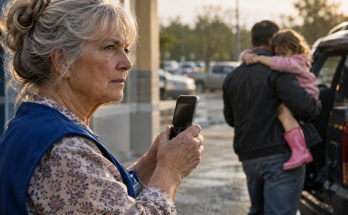
I arrived for my shift at eight, wearing my blue vest and the same comfortable shoes I'd worn for years.
My roll of smiley-face stickers was in my pocket.
I had stopped at the bakery on the way and bought a small blueberry muffin.
I never got to eat it.
Mr. Darby was standing beside the employee entrance.
"Mavis, come into my office."
I followed him down the hallway.
He closed the door.
That was when I saw the paperwork on his desk.
My name was printed across the top.
I sat down slowly.
He didn't offer coffee.
He didn't ask how I was.
He simply pushed the papers toward me.
"We've decided to end your employment."
I stared at him.
"For what?"
He rubbed his forehead.
"The situation yesterday."
I waited.
He began listing things.
Interfering with a customer.
Following someone into the parking lot.
Taking photographs without permission.
Creating a disturbance at the front entrance.
I heard each accusation.
And with every one, I felt smaller.
"The girl was terrified," I said.
Mr. Darby sighed.
"Mavis, we've been over this."
"No, we haven't."
My voice came out firmer than I expected.
"We never found out who she was."
He looked at his computer screen.
"The gentleman provided identification."
"His identification."
"Yes."
"Not hers."
He looked up.
"Please don't start again."
I folded my hands in my lap.
My wedding ring was still on my finger.
I'd never taken it off after my husband died.
I turned it once.
A habit I had when I was nervous.
"Did anyone contact the police?"
He stared at me.
"You did."
"I mean, did the store follow up?"
"That's not our responsibility."
I thought about the girl's little hand reaching for me.
"It should be somebody's responsibility."
He pushed the paperwork closer.
"The customer complained to corporate."
I looked at the page.
There were boxes with typed explanations.
Company policy.
Employee conduct.
Customer relations.
Not one word about the frightened child.
"He says you threatened him," Mr. Darby continued.
I looked up sharply.
"That's not true."
"He says you prevented him from leaving."
"I asked him to wait."
"He says you accused him of kidnapping."
"I never used that word."
Mr. Darby leaned back.
"That may be how he understood it."
I felt my throat tighten.
For nine years, I'd been early.
I'd covered shifts when other employees were sick.
I'd stayed late during holiday rushes.
I'd helped customers find lost wallets and missing keys.
I had never been written up.
Now I was being dismissed because a three-year-old girl had begged me not to let a man take her away.
"Did you watch the security video?" I asked.
Mr. Darby hesitated.
"That's being handled."
"Then you'll see I never touched him."
He said nothing.
I leaned forward.
"Please save that video."
He glanced at the paperwork again.
"Mavis, the decision is final."
That was it.
Nine years reduced to a few pages.
He asked for my vest.
I took it off.
The fabric caught against my watch.
I remember struggling with the sleeve.
Such a small thing.
But my fingers wouldn't cooperate.
When I finally placed the vest on his desk, I felt a terrible emptiness.
I reached into the pocket.
The stickers were still there.
"Those are mine," I said.
He nodded.
I took them.
I gathered my purse.
Then I walked past the break room and through the employee entrance.
A young cashier named Ellen saw me.
She opened her mouth.
Then closed it.
I gave her a little wave.
I didn't trust myself to speak.
Outside, the morning was cold.
I sat in my car for a long time.
The blueberry muffin was in its paper bag on the passenger seat.
I looked at it.
Then I cried.
Not loudly.
Just the kind of crying that leaves you tired.
I had lost my husband.
I'd survived retirement.
I'd learned to live alone.
But losing that job made me feel as though someone had closed the last door connecting me to the world.
I went home.
I put my purse on the kitchen table.
Then I took out my phone.
The three pictures were still there.
I enlarged the first one.
The man's face.
A hard expression.
Angry eyes.
Then the second.
The girl's face behind the car window.
Her cheeks were wet.
One small hand was raised.
I stared at that picture longer than I should have.
Finally, I opened the third.
The license plate.
Clear enough to read.
I copied the number onto a sheet of paper.
Then I wrote down everything I remembered.
The date.
The time.
The weather.
The pink boots.
The little girl's name.
Quinn.
I wrote down the name Miss Corliss.
Then I crossed out the word Miss Patty, which I had initially scribbled in my notes after the incident.
My memory had become confused during the argument with Mr. Darby.
I couldn't afford to pretend otherwise.
The child had said Miss Corliss.
I remembered that clearly.
So I wrote it again.
Miss Corliss.
I placed the paper in a kitchen drawer.
Then I took it out.
I didn't want to lose it.
I put it inside a folder instead.
A plain yellow folder.
My husband used to keep receipts in folders like that.
I had dozens left over.
I labeled this one with the date.
Nothing dramatic.
Just the date.
And the word Quinn.
For the next several days, I checked my phone constantly.
I thought the police might call.
I hoped someone would tell me the little girl was safe.
No one did.
I called the non-emergency police number and asked whether there was any update.
The woman who answered couldn't give me much information.
She confirmed that my call had been recorded.
She couldn't discuss an investigation.
I understood.
But understanding didn't make the waiting easier.
At night, I watched the local news.
I searched for missing-child reports.
I looked at photographs of children whose families were desperately trying to find them.
I hated myself for hoping I'd recognize a face.
And I hated myself for fearing I wouldn't.
Three weeks passed.
I started looking for another job.
At sixty-seven, that wasn't easy.
One place wanted someone who could stand for ten hours.
Another required computer skills I didn't have.
A third told me they'd keep my application on file.
I knew what that meant.
One afternoon, I came home from the grocery store and found a large envelope in my mailbox.
My name was printed neatly across the front.
There was a law firm's return address.
At first, I thought it was a mistake.
I opened it at the kitchen table.
Inside were several pages of legal language.
My eyes moved across the first paragraph.
Then the next.
I read the name.
Wayne Haller.
The man from the store.
He was suing me.
For two hundred and fifty thousand dollars.
I read the amount twice.
Then a third time.
I had never seen that much money in one place.
Not in my savings.
Not in my retirement account.
Not anywhere.
The complaint said I'd caused him emotional distress.
It said I'd damaged his reputation.
It said I'd physically interfered with him and made false accusations in public.
One sentence claimed I'd seized his arm.
I stared at those words.
I had never laid a finger on him.
I remembered exactly where my hands had been.
One held a yellow sticker.
The other stayed near my side until the little girl grabbed my vest.
That was all.
But the document made me sound like a violent woman who had attacked an innocent father.
I read the accusations again.
My heart started pounding.
The kitchen seemed unusually quiet.
I reached for my husband's old coffee mug.
It was still sitting on the shelf above the sink.
I hadn't used it in years.
I touched the handle.
Then I sat back down.
I looked at the amount again.
$250,000.
I couldn't pay it.
Not even close.
If Wayne Haller won, I could lose the little house my husband and I had spent most of our lives paying for.
I could lose my savings.
I could lose whatever peace I had left.
For the first time since that Tuesday afternoon, I wondered whether I had made a terrible mistake.
Then my phone lit up.
The photograph of Quinn was still on the screen.
I looked at her frightened face.
At the hand raised against the glass.
At those bright pink boots.
And I knew one thing.
I might have been wrong about the man.
But I wasn't wrong about what I had heard.
That little girl had been afraid.
And no lawyer was going to make me deny it.
Click here to continue reading: PART 3: The Man Who Demanded My Savings Claimed I Had Attacked Him, but I Still Had the Pictures He Didn’t Know About
I Was Just Supposed to Smile at Customers Until a Little Girl in Pink Boots Grabbed My Vest and Begged Me Not to Let Him Leave
Part 2 of 20