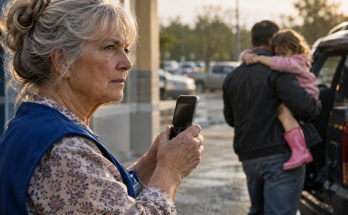
The hardest thing about waiting was having nothing left to do.
For months, I'd gathered papers.
Answered questions.
Met with lawyers.
Practiced explaining myself.
Now the jury had the case.
My work was finished.
I sat in a courthouse hallway with my hands folded around a paper cup of water.
The water had grown warm.
I hadn't taken a sip in nearly an hour.
Mr. Mercer sat a few chairs away, reviewing something on his phone.
Rachel was beside Melissa.
Miss Patty had brought a small packet of crackers from home.
She offered them to everyone.
Nobody wanted one.
So she opened the packet and ate one herself.
"Somebody has to keep their strength up," she said.
I smiled.
That was Miss Patty.
Even after everything, she still thought about feeding people.
I watched her brush crumbs from her skirt.
Then I looked toward the courtroom doors.
I wondered what the jurors were discussing.
Had they watched the video again?
Were they arguing about whether I'd blocked Wayne's path?
Were they thinking about the photograph?
The little girl?
The money?
I had no way to know.
Melissa noticed me staring.
She moved to the empty chair beside me.
"Are you all right?"
I nodded.
"Just thinking."
"About the verdict?"
"Yes."
She folded her hands.
"Me too."
For a while, we sat quietly.
Then she asked whether I missed the store.
I looked at her.
"More than I thought I would."
She nodded.
"I can understand that."
I thought about my last morning there.
The termination papers.
Mr. Darby's office.
The blueberry muffin I'd bought and never eaten.
I still remembered it sitting in the passenger seat.
Such a small thing.
But grief often attaches itself to small things.
A cup left on a shelf.
A chair nobody uses.
A muffin in a paper bag.
I looked toward Melissa.
"I didn't realize how much that job meant to me."
She listened.
I told her about my husband.
How quiet the house had become after he died.
How retirement had left me feeling unnecessary.
How the store gave me a place to go.
People to speak with.
Children who remembered me.
Melissa smiled softly.
"Quinn remembers you."
I looked down.
"That means a lot."
She reached into her handbag.
Then she stopped.
"I brought something, but I wasn't sure whether to show you."
My heart tightened.
"Is it about Quinn?"
She nodded.
I waited.
Melissa took out her phone.
She opened a photograph.
Then turned the screen toward me.
Quinn was sitting on a kitchen floor.
Her dark curls were pulled into two small pigtails.
She wore pajamas covered in tiny stars.
Her stuffed rabbit sat beside her.
And on her feet were the pink rain boots.
I laughed.
"Still wearing them."
Melissa nodded.
"She refuses to give them up."
I looked at the picture again.
Quinn was smiling.
Really smiling.
Not frightened.
Not crying.
Just a little girl sitting on a kitchen floor with a toy.
I felt tears gathering.
"She's beautiful."
Melissa smiled.
"Thank you."
Then she put the phone away.
I was grateful.
I didn't want to turn Quinn into a symbol or a story everybody could claim.
She was a child.
A real child.
With ordinary days ahead of her.
That mattered more than anything happening in court.
Melissa looked toward the window.
"I've been thinking about what you said."
"What did I say?"
"That you didn't know whether you could go back to the store."
I nodded.
She paused.
"Maybe you don't have to."
I looked at her.
She continued.
"Maybe you could do something else."
I laughed softly.
"At sixty-seven?"
She smiled.
"You're only sixty-seven."
I shook my head.
"That sounds different when you're twenty-something."
She laughed.
Then she became serious.
"Miss Patty really wants you to visit the children."
I thought about the invitation.
Reading stories.
Handing out stickers.
Helping with simple activities.
It sounded pleasant.
But I was afraid.
Afraid I'd make another mistake.
Afraid someone would misunderstand me.
Afraid I'd lost whatever confidence I'd once had.
Melissa seemed to understand.
"You don't have to decide today."
I nodded.
"Thank you."
She looked toward the courtroom.
"Neither of us has to decide everything today."
We sat quietly.
Then she told me more about the months after Quinn came home.
Not the frightening details.
The ordinary recovery.
How Quinn had wanted the hallway light left on.
How she asked the same questions before bedtime.
How Melissa had learned to answer calmly.
Again and again.
How Miss Patty had helped Quinn feel comfortable returning to childcare.
How Rachel had spent afternoons playing with her when Melissa needed rest.
I listened carefully.
Recovery wasn't one dramatic moment.
It was repetition.
Breakfast.
Bedtime.
A familiar voice.
The same stuffed rabbit waiting on the pillow.
It was a mother saying she'd come back.
And then coming back.
Over and over.
I thought about my own life after my husband died.
How I'd learned to live alone.
One ordinary morning at a time.
Maybe healing worked that way for everyone.
Not quickly.
Not neatly.
But slowly enough that you sometimes didn't notice it happening.
Melissa looked at me.
"Quinn doesn't talk about Wayne very much now."
I nodded.
"Maybe that's good."
"Maybe."
She paused.
"I don't want her whole childhood to be about what happened."
I looked at her.
"It shouldn't be."
She nodded.
Then she said something that stayed with me.
"I want her to remember that people helped."
I swallowed.
I looked toward the yellow folder beside my chair.
All those papers.
All those arguments.
All the time spent defending a decision I'd made in a few frightening minutes.
I hoped Quinn remembered more than that.
I hoped she remembered birthday cakes.
Trips to the park.
Miss Patty's cats.
Rachel's laughter.
And the yellow sticker.
Especially the sticker.
Mr. Mercer approached.
He had received a message from the court staff.
The jury had asked to review portions of the evidence.
My stomach tightened.
"What portions?"
He explained that they wanted to examine the security footage and certain written materials relevant to the claims.
I looked toward the courtroom doors.
"The video?"
"Yes."
I felt a small rush of relief.
Then fear.
What if they saw something differently?
What if they thought I'd stood too close?
What if they decided that blocking the door was enough to make me liable?
Mr. Mercer seemed to read my face.
"Mrs. Keller, asking to review evidence is a normal part of careful deliberation."
I nodded.
"I know."
But my hands were shaking again.
He reminded me that the jury would receive the evidence through the court's procedures.
Then he returned to his seat.
I looked at Melissa.
She squeezed my hand.
We waited.
An hour passed.
Then another.
Miss Patty went to the restroom.
Rachel made a phone call.
Mr. Mercer bought another coffee.
I sat.
Sometimes I closed my eyes.
Sometimes I watched people walk past.
A young man carrying a stack of folders.
An older couple speaking quietly.
A woman with a stroller.
Their lives were moving forward.
Mine seemed trapped in the hallway.
Eventually, Mr. Darby appeared.
He had been sitting farther down the corridor.
Now he walked toward us.
I stiffened.
He stopped a respectful distance away.
"Mavis?"
I looked up.
"Yes?"
He held something in his hands.
A small envelope.
He didn't offer it immediately.
"I wanted to give you this."
Mr. Mercer stood and came closer.
Mr. Darby glanced at him.
"It's not about the legal case."
Mr. Mercer asked what it was.
Mr. Darby explained that several employees had written messages after hearing I'd been fired.
He had collected them.
Then he'd hesitated to send them.
I stared.
"Messages?"
He nodded.
"From the staff."
I looked at the envelope.
It was thick.
The edges were worn.
I wondered how long he'd been carrying it.
Mr. Mercer said I could accept personal correspondence, though anything related to the case should be reviewed before discussion.
I nodded.
Mr. Darby handed me the envelope.
His hands were shaking slightly.
"I'm sorry I didn't give it to you sooner."
I looked at him.
"Thank you."
He stood there for a moment.
Then he said something quietly.
"I never meant to hurt you."
I thought about that.
Maybe he hadn't.
But he'd hurt me anyway.
I didn't know how to explain that without sounding cruel.
So I said, "I know you wanted the problem to go away."
He looked down.
"Yes."
I nodded.
"It didn't."
He swallowed.
"No."
For a moment, we stood facing each other.
Then he said, "I hope things work out."
I looked at him.
"Me too."
He walked away.
I watched him go.
Then I opened the envelope.
Inside were folded pieces of paper.
Some written on notebook pages.
Some on small cards.
A few on scraps of receipt paper.
I recognized several names.
Ellen.
A woman from customer service.
A young man who stocked shelves overnight.
Another cashier who'd worked Saturdays with me.
I read the first note.
It said the entrance felt strange without me.
I swallowed.
The second thanked me for helping an elderly customer during a winter storm.
I remembered that day.
The woman had forgotten where she'd parked.
I'd walked outside with her until we found her car.
The third note mentioned the stickers.
A cashier wrote that children still asked about the lady who handed them out.
I pressed the paper against my chest.
Then I read a note from Ellen.
She said I'd made new employees feel welcome.
She said I remembered birthdays.
She said I always asked how people were doing and actually waited for the answer.
I started crying.
Melissa put an arm around my shoulders.
I let her.
For seven months, I'd felt reduced to one afternoon.
One argument.
One lawsuit.
But the people I'd worked beside remembered nine years.
They remembered the ordinary days.
The thousands of small things I'd forgotten.
I wiped my face.
Then I folded the notes carefully.
I didn't read every one.
Not there.
I wanted to take them home.
Read them slowly.
Maybe over coffee.
Maybe with my husband's photograph nearby.
I put the envelope into my bag.
Then I looked toward the courtroom.
I wondered whether Wayne had ever thought about what he'd taken from me.
Not just money.
Not just employment.
A place where people knew my name.
A place where I'd felt useful.
But then I looked at the envelope.
And I understood something.
He hadn't taken every part of it.
The memories were still there.
The kindness was still there.
The people still remembered.
The afternoon grew late.
The courthouse lights came on.
I was beginning to wonder whether we'd be sent home when a court officer appeared.
He spoke quietly to Mr. Mercer.
Mr. Mercer stood.
Then he turned toward me.
"Mrs. Keller."
I looked up.
My heart started pounding.
"The jury has reached a verdict."
For a moment, I couldn't move.
Melissa squeezed my hand.
Rachel stood.
Miss Patty gathered her bag.
Mr. Mercer waited.
I picked up the yellow folder.
Then I reached into my purse.
My fingers touched the blue vest.
And the small envelope of notes.
I stood.
My knees felt weak.
But they held.
We walked toward the courtroom doors.
I didn't know what the jury had decided.
I didn't know whether I'd be able to pay my bills.
I didn't know whether my home was safe.
All I knew was that the waiting was finally ending.
Click here to continue reading: PART 19: The Jury Returned With Its Verdict on Wayne Haller’s $250,000 Lawsuit, and I Could Barely Stand When the Judge Asked Me to Rise
I Was Just Supposed to Smile at Customers Until a Little Girl in Pink Boots Grabbed My Vest and Begged Me Not to Let Him Leave
Part 18 of 20