My Parents Left Two Empty Chairs At My Wedding Because I Married Before My “Perfect” Sister, Then Told Everyone I Never Invited Them. I Had Every Receipt, But I Stayed Quiet Until Their Polished Family Story Began To Crack Around Sienna’s Expensive Wedding, And One Sentence From My Aunt Made The Whole Room Start Asking Questions.
I didn’t think my parents would ever bluntly say, “Everly, you’re just number two.”
But they didn’t need to say it.
Every action over the past twenty years had already screamed it loud and clear. My sister, Sienna, was the center of our family and, somehow, the center of everyone around us. And me? I was the empty space no one wanted to acknowledge.
If you’ve ever been treated like a shadow in your own family, you understand that feeling. Cold. Silent. Never-ending. I used to think I was just overly sensitive, until I noticed every framed photo in our living room was of Sienna, while mine were stuffed somewhere in an old drawer. And that was only the beginning of an ocean of unfairness.
I’m Everly. I’m twenty-nine years old, and I grew up in a small town in Oregon, the kind of place where Friday night football, church bake sales, and Fourth of July parades made everyone feel like they knew everyone else’s business. My entire childhood revolved around one word.
Comparison.
Sienna, my older sister, is two years older than me. To my parents, she was the embodiment of the perfect American dream. Tall, blonde, smart, beautiful, and always smiling at exactly the right moments.
Since first grade, she had won statewide poetry recitation contests, while I was praised for having neat handwriting. But that praise came from my teacher, not my parents.
When Sienna landed the lead role in the school’s spring musical, my parents printed fifty posters and plastered them all over the neighborhood. They even hired a private photographer to take behind-the-scenes photos. That same year, I won second place in the county science fair. My dad simply said, “Good, but don’t rest on your laurels.”
I remember that night clearly.
I was standing in the kitchen, excitedly showing off my certificate, while my mom was too busy ordering a custom cake with a picture of Sienna in her princess costume. The certificate felt warm in my hands at first. Then, slowly, it went cold.
By the time we got to high school, the gap between us wasn’t just a feeling anymore. It became an undeniable fact.
Sienna was the school’s beauty queen, cheer captain, and the girl every parent in town seemed to mention with admiration. Then she earned a full ride to Stanford. My parents acted like she had personally raised the flag over the Golden Gate Bridge.
And me?
I got a partial scholarship to Oregon State for graphic design, and no one mentioned it at dinner that night.
I tried so many ways to be seen. I joined the volleyball team. I entered art contests. I even took piano lessons because my mom once said she liked girls who could play an instrument. But every time I tried to rise up, my parents brought up Sienna as the standard I could never reach.
In our living room, there was a large photo displayed above the fireplace. It was Sienna on the cover of a local fashion magazine right after she graduated. And me? I once sent my mom a photo of me receiving my first design certificate. She glanced at it on her phone, then immediately started talking about how Sienna’s new boyfriend was a medical resident.
I can’t remember the last time my parents hugged me.
But I remember clearly how it felt to watch them hug Sienna in her spotless white graduation dress while I stood a few steps away holding a camera, waiting to be asked to take a photo.
I’m not the kind of person who hates her sister. Sienna never went out of her way to hurt me. Not directly. But she knew she was the center, and she never did anything to change that.
To me, Sienna wasn’t a bad person. She just got used to being loved too much, while I got used to being overlooked too easily.
The worst part wasn’t that they didn’t love me. It was that they never thought I needed to be loved the way she was.
The celebration parties. The special vacations. The endless praise my parents posted on social media about Sienna, while I got a token like or a short comment at best. Every time I tried to take a step forward, I was pulled back by my dad’s cold stare or my mom’s half-hearted smile as she found another way to compare me to my sister.
I grew up constantly wondering if things would have been different if I had been an only child.
What I’m about to share isn’t meant to be a complaint. It’s so I can finally speak in my own voice, the one I buried for nearly three decades.
Because one day, I did something my parents never expected.
And everything they had built around the image of a perfect family started to crack.
It all began with my wedding.
I met Aiden at a graphic design conference in Seattle when we both raised our hands to speak right as the moderator spilled coffee all over my laptop. While I was scrambling to wipe the screen, he handed me a napkin and gently said, “If you need a backup presentation, I’ve got a USB.”
That was the first time in a long while I didn’t feel invisible.
We dated for four years. Nothing flashy. Nothing loud. Aiden was the kind of man who hated the spotlight but always stood beside you, quietly shielding you from every little hurt. He loved me like I was the most natural thing he had ever waited for.
He liked my messy morning hair, the way I focused when I designed, even the body my mom had always called awkward and ungraceful.
Aiden proposed on a Friday night while we were eating cold pizza and rewatching an old animated film we had seen together on the day we first met. Outside, Oregon rain tapped softly against the apartment windows. He didn’t kneel in some restaurant or hire a photographer to hide behind a tree. He just pulled out a small ring hidden in a cookie tin and asked, “Everly, would you like to help me design the rest of our lives together?”
I laughed through tears.
“Yes,” I said.
I thought maybe this would be the moment my parents would finally be happy for me.
But their reaction was silence.
I called to share the good news. On the other end of the line, my mom simply said, “Are you sure you shouldn’t lose a few more pounds before wearing a wedding dress?”
My dad said nothing. He only mumbled something about Mom having a dentist appointment, then ended the call.
I tried not to let it crush me.
I told myself, They just need time.
We sent out wedding invitations, both digital and custom-designed paper versions. I personally went to the post office to make sure everything was sent correctly. My parents’ invitation even had an RSVP tracking code. The result was nothing. No response. No calls. Not a single message.
I texted my mom.
“Mom, I just want to make sure you got the invitation.”
She replied three days later.
“Been busy. I’ll check.”
After that, nothing.
I was exhausted, but I still held on to hope. I sent a few more texts. I made a few more calls. Still the same result.
Silence.
Then I heard from a family friend that my mom was busy working on a wedding mood board for Sienna, even though Sienna wasn’t even engaged.
I couldn’t tell if I was more hurt or angry. I had always believed that no matter how much favoritism existed, they wouldn’t turn their backs on their daughter’s wedding day.
But they did.
They really did.
When I found my wedding dress, a simple ivory A-line design with light lace sleeves, my mom looked at the photo and sighed.
“At least that cut hides your hips.”
I gave a dry smile. I was used to comments like that from her. But this time, it cut deeper because I had hoped for something different. A hug. A tear of joy. An “I’m proud of you.”
Things Sienna always got.
Things I never did.
In the end, the person who helped me prepare for the wedding was Aiden’s mother, Margaret. She went over every flower sample. She gave input on the seating chart. She even fixed the veil netting on my dress herself when I couldn’t get it right. She did it all without reminders, without complaints, without comparisons.
Our engagement party was held in a cozy wooden house Aiden and I rented in the suburbs of Eugene, not far from a quiet street lined with Douglas fir trees and older ranch-style homes. Nothing fancy. We didn’t need fancy. But it was warm and sincere enough for anyone present to feel the love.
Anyone except my parents.
They showed up late, almost when the party was over. No hugs. No congratulations.
My mom wore a shimmering cream-colored dress like she was attending a high-end gala, while everyone else was dressed simply. My dad spent the whole time on his phone, said a few polite words to Aiden’s relatives, then retreated into a corner.
I was talking to Aiden’s aunt when I caught sight of my mom leaning close to my dad, whispering into her phone. Her face was tense. Her eyes glanced at me like I had done something terrible.
Then I heard a faint crying voice from the phone. A woman sobbing with hurt and frustration.
I didn’t need to hear more to know who it was.
Sienna.
My mom whispered, “I know. I know you didn’t expect her to rush like this. No, it’s not your fault.”
Her voice sounded like she was comforting a child who had just had her favorite toy taken away.
Then I heard her say, “It should have been you first.”
I turned away.
My heart felt heavy.
No one asked why I stayed quiet for the rest of the party. Maybe because they already knew. Or maybe because everyone was pretending not to. They didn’t want to ruin the mood.
But I was already ruined inside.
That night, back home, I sat in the living room, gripping a wine glass with a little red left at the bottom. Aiden walked in and gently placed a hand on my shoulder.
“I heard everything,” he said, his voice slow. “You’re not imagining it.”
I just nodded. I couldn’t say a word.
“Your parents can’t stand the fact that you’re getting married before Sienna, can they?”
I closed my eyes and swallowed the truth like a bitter pill stuck in my throat.
Yes. They couldn’t stand the fact that the second-tier daughter had found happiness first.
They had spent their whole lives building a family script where Sienna was the star and I was the supporting role, not allowed to shine too brightly. And now I had dared to stand up. Dared to wear a wedding dress before Sienna. Dared to smile in happiness without needing their approval.
To them, that was an unforgivable sin.
In the weeks that followed, while Aiden and I were busy with the final preparations for the wedding, I stopped expecting anything from my parents. I stopped texting. I stopped checking in. I simply didn’t have it in me anymore.
Each time I laughed during cake tastings with Margaret, I swallowed the bitter truth that my own mother would never do those things with me.
When I put on my wedding dress, Margaret said I looked radiant, like morning sunlight over a misty Oregon forest.
My mother saw the same photo and sent one line.
“It’s okay. Don’t wear heels that are too high. Your legs are already thick.”
It didn’t hurt anymore. Not the way it used to.
I felt numb.
And in that numbness, I began to realize I didn’t need them the way I once thought I did.
The wedding was held in a small garden on the outskirts of Portland. That summer, the sun was gentle. Flowers bloomed along the fences, and wooden chairs were lined in two rows, draped in white silk. Somewhere beyond the garden, traffic hummed faintly along the road, and a small American flag stirred near the porch of the old house we had rented for the ceremony.
There were friends, Aiden’s relatives, and the people who chose to stand by me.
The people who chose to see me.
Aiden walked me down the aisle as soft violin music played. He didn’t take his eyes off me, as if every light that day came from one person.
Me.
We exchanged vows while the garden air smelled faintly of roses, grass, and summer rain still lingering in the soil. I stood in front of Aiden and watched him hold my hands. His eyes never left mine for a second. I saw in him a love that was whole.
But I couldn’t ignore the emptiness in front of me.
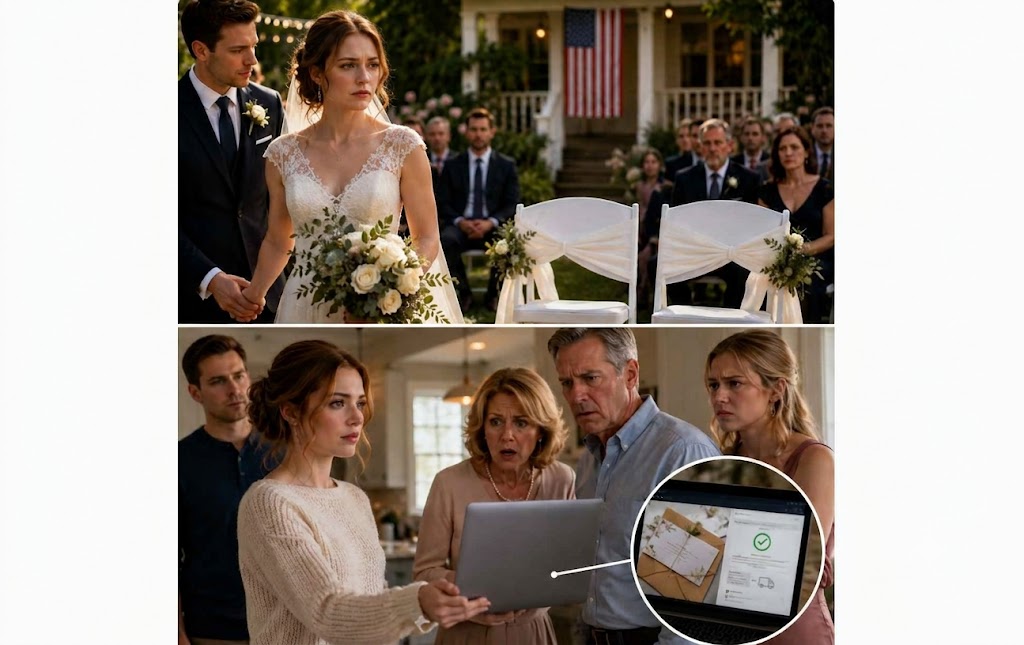
The two front-row seats for my parents were empty.
No flowers. No one. No father to walk me down the aisle. No mother to hug me before the ceremony.
Seats for the people who gave birth to me, raised me, then abandoned me with silence and lopsided affection.
I had prepared for their absence, but it still made my heart ache.
I didn’t cry.
I smiled.
But I could feel it.
Something inside me broke.
And in my heart, there was a quiet farewell.
Goodbye, Mom and Dad.
Goodbye to the role of the good daughter in the family play I had never been given a line in.
After the wedding, Aiden and I went to Santa Barbara for our honeymoon. The days were soft and bright. We walked along the beach at sunset, ate fish tacos from a small place near the pier, and held hands like we had stepped into a different life.
One evening, as the sun melted orange over the Pacific, Aiden whispered, “Do you feel like we’ve just stepped into another life?”
I smiled and nodded.
At that moment, I truly believed all the bad things had been left behind.
I thought I had let go.
But my family had not let go of me.
Three days after returning to Portland, my phone rang while I was unpacking. It was my mother.
“Everly.”
Her voice was cold as steel.
“I can’t believe how ungrateful you’ve become.”
I froze.
“What?”
“You never sent the invitations. Your father and I received nothing. You cut your family out of your big day and acted like nothing happened. Is this how you repay the people who gave you life?”
It took me a few seconds to gather myself.
“What are you talking about? I sent the invitations two months ago. I even checked the confirmation codes. Both email and printed copies were successfully delivered.”
“You’re making up stories to avoid responsibility,” she snapped. “You wanted to embarrass us. You wanted to create a narrative where your parents are the villains and you’re the poor little victim.”
My hands trembled, but I tried to keep my voice steady.
“I have proof. I kept every receipt. I even saved the system email confirming the invitation was opened.”
I heard a scoff through the phone.
“Where did you learn this blame game? From your in-laws? Or are you trying to polish over the fact that you pushed your sister out of the spotlight?”
It felt like something heavy had landed in my chest.
Now I understood.
All the coldness. The blame. The cutting tone. None of it came from being left out. It all came from one single truth.
I got married before Sienna.
And that was unforgivable.
“I never wanted the spotlight,” I said. “I just wanted my parents to be there. I don’t understand why that simple wish turned into a crime.”
“You know exactly why,” my mother said, her voice sharp and deliberate. “You’ve always been jealous of your sister. Since you were little. And now you’re using your wedding to polish your own image and make this family look like a joke.”
I was speechless.
Each word from her landed like acid on my heart.
“I’m not trying to hurt anyone,” I said, my voice breaking. “I just had my own wedding, and you’re punishing me because I’m not Sienna.”
“No one’s punishing you,” my father cut in from the other end of the line.
His voice was flat. Indifferent.
“But if you choose to go your own way, don’t expect the family to stand still while you make things up.”
I hung up.
No screaming. No throwing things.
I just sat there in the quiet room, still in my pajamas. Outside the window, the rain had started to fall, thin and steady against the glass.
Then I opened my laptop and pulled up everything I had saved.
The USPS delivery receipts. A screenshot of the RSVP confirmation code. The automatic read notification from the email address my mother still used. The texts I had sent, left unanswered.
I sent all of it in an email again, CCing Aiden.
Not to convince them.
To remind myself.
I wasn’t crazy.
I wasn’t imagining things.
I had done everything right.
And they were twisting the truth like they always had my entire life.
That evening, Aiden came home to find me sitting silently. He didn’t ask anything at first. He just sat beside me and held my hand.
A while later, he said, “They don’t have to say you’re not good enough anymore, because they’ve shown it in everything they’ve done.”
I rested my head on his shoulder.
“I’m so tired, Aiden,” I whispered. “They always find a way to make everything my fault. Ever since I was a kid.”
“It’s not your fault,” he said. “They just can’t handle the fact that you’re no longer living in someone else’s shadow.”
The next morning, I got a text from Aunt Emma, my mother’s younger sister.
“Everly, I know you sent the invitation. I saw your mom open it. They just pretended they didn’t. I’m sorry.”
My heart clenched.
A cold shiver ran down my spine.
They knew.
They had received the invitation.
They had made a choice not to come.
Then they lied, made me question myself, and painted me as the jealous, disrespectful daughter stirring up trouble.
I wasn’t angry anymore.
I just felt disgusted. Disgusted at how smoothly they could lie. How effortlessly they could twist reality and make a person question her own memory.
I looked at Aiden.
“I think maybe it’s time I walk away from this family play for good.”
He just said, “No one deserves to drown for trying to live honestly.”
I hadn’t even taken down all the wedding invitations from the bulletin board in my office when news of Sienna’s wedding flooded the family group chat.
A photo was posted on Facebook by my mom. She was standing beside Sienna, both of them glowing under the lights of a fancy bridal boutique in downtown Seattle. The caption that came with it was a knife straight to the heart.
“Finally getting to walk with my beloved daughter on her special day. Moments that can never be replaced.”
Moments that can never be replaced.
It was like she was shouting in my face.
Your wedding meant nothing.
My dad wasn’t any more subtle. He posted a photo of them touring a luxury resort by Lake Chelan, scouting for wedding venues, with a proud caption.
“Wedding plans are coming together for our perfect daughter. Happiness is seeing your child shine where she truly belongs.”
They hadn’t forgotten me.
No.
They were deliberately erasing me from the story.
I hadn’t planned to say anything. I really hadn’t. I tried to stay silent.
But then Aunt Emma called. She whispered like she was afraid someone might overhear.
“Everly, I need to tell you. They’re telling the relatives that you made it all up. That you never sent the invitations. That you’re speaking badly about the family out of jealousy toward Sienna.”
I sat frozen by the window. The wind outside howled, but it couldn’t match the cold I felt inside.
“Do you believe me?” I asked.
“Of course I do,” she said. “But some people don’t need proof. They just need someone to speak louder.”
I wasn’t making things up.
I was just telling the truth.
But the truth has a way of stripping people bare, and not everyone can handle the light.
A week later, I got a message from my cousin Jake, the one who had come to my wedding and cried during the ceremony because he said he had never seen two people love each other so genuinely.
“Aunt and Uncle are mad at me for not going to Sienna’s wedding,” he wrote. “I can’t stand how they treat you. Don’t think everyone believes them, Everly. Some of us see it.”
I didn’t expect support. But when it came, it felt like warmth in the middle of a cold winter.
And I started to realize I wasn’t alone.
At a gathering with Aiden’s side of the family, my Aunt June said bluntly, “Do your parents really think people will forget they didn’t show up to your wedding? They’re wrong. Everyone remembers, and no one agrees with what they did.”
It seemed the more my parents tried to cover things up, the more absurd it all became. Each wedding dress photo, every glowing caption, every cheerful status only made the emptiness inside them more obvious.
I didn’t need to say much.
When someone asked why my parents didn’t come to my wedding, I gave the same answer every time.
“Because I got married before Sienna.”
No dramatics. No complaints.
Just one bare truth.
And whoever heard it understood a hundred things behind it.
But the truth makes people uncomfortable.
My mom called after hearing that some relatives had declined to attend Sienna’s wedding. She didn’t check in. She didn’t try to make peace. She attacked.
“You’re destroying this family, Everly. You’re turning people against your sister with your selfishness.”
I sighed.
“You’re blaming me because you chose not to come to your own daughter’s wedding.”
“Don’t play the martyr,” my mom snapped, her voice full of fury. “You’ve always been jealous of your sister. Now you’re trying to make everyone think I’m a bad mother.”
I clenched the phone so tightly my knuckles turned white. But I kept my voice steady.
“Mom, I don’t have to make anyone think anything. They see it for themselves.”
“You,” she hissed, “are going to regret tearing this family apart.”
I looked over at Aiden, who was in the kitchen pouring coffee into two mugs. He looked at me and said nothing, but his eyes were full of quiet strength.
I turned back to the phone.
“No, Mom. The only thing I regret is believing family love was unconditional.”
Then I hung up.
I never thought I would reach the day when I stood up to my parents. Not in my imagination. Not in all the scripted speeches I had rehearsed in my head while crying alone.
But it was real.
My voice trembled. My hands shook. And all the wounds I had spent my whole life swallowing finally rose to the surface.
The next call came from my mom again.
No sugarcoating this time. She went straight to the point.
“You need to stop, Everly, before you completely ruin this family’s reputation.”
I heard my father’s voice on the line, too. He was probably sitting next to her.
“Unbelievable how shameless this girl has become,” he muttered.
I pressed my lips together. My palms were sweaty, but I no longer wanted to stay silent.
“I’m not ruining anything,” I said. “I’m just telling the truth. People are distancing themselves from you, not because of what I said, but because of what they saw you do.”
“Oh, here we go again with the pity act,” my mom snapped. “You’ve always loved playing the victim.”
I let out a dry laugh.
“Well, then today I’ll speak as a real victim, Mom. And I want you and Dad to hear me out without cutting me off. Without brushing me aside.”
Silence on the other end.
I took a deep breath.
“Do you remember when I was ten? On my birthday, I invited four friends over to our house. You said yes. But on the day of the party, you canceled everything because Sienna had a last-minute kids’ modeling shoot. You told me birthdays come every year, but photo shoots don’t happen every day.”
No response.
“And in twelfth grade, I invited you to my graduation ceremony. I was the only one in my friend group without a family member there because you were taking Sienna to try on her prom dress. You said, ‘Who schedules two things on the same day? That’s the school’s fault, not mine.’”
My dad’s voice cut in.
“What’s the point of bringing all that up now?”
“To let you know how it felt for me,” I burst out, my voice cracking. “To let you understand what it was like to grow up in Sienna’s shadow.”
I couldn’t stop now.
Memories rushed back like a flood breaking through a dam.
“When I made the scholarship list for the state university, Mom, you just said, ‘Well, that saves us money.’ Meanwhile, when Sienna got her Stanford acceptance letter, you threw a buffet party. When I landed my first job at a design firm, you said, ‘How are you going to live on that salary? That tuition money was wasted.’ But when Sienna quit her third job in a year, you said she needed time to find her passion.”
My mom finally spoke, her voice cold and sharp.
“So what? You’re trying to say we’re terrible parents?”
“No,” I said clearly, word by word. “I’m saying you never truly saw me. You never loved me the way you loved Sienna.”
I heard a sharp exhale on the other end, followed by my mother’s bitter laugh.
“You know what, Everly? Your father and I always tried to treat you fairly, but you chose to feel left out. Maybe because you’re not as talented, not as remarkable as your sister, so this is how you get attention.”
My heart clenched.
“This is why I never spoke up before,” I whispered. “Because every time I did, you made me feel like I was crazy. Like I was just too sensitive. But no. I’ve had enough.”
My dad cut in, his voice heavy.
“You should be ashamed. We gave you life, raised you, and this is how you repay us? By humiliating the family in front of our relatives?”
I let out a painful laugh.
“No, Dad. I’m not humiliating anyone. I’m just done being the backdrop for Sienna to shine. I’m done staying silent.”
A long silence followed.
Then my mother spoke again, her voice sharp and cold.
“Maybe you just can’t handle not being the center. You’ve always been the loser, Everly, and now you’re losing your mind because your sister is about to have a perfect wedding and all you had was some backyard party no one remembers.”
I felt something inside me crack.
But this time, instead of breaking, I felt free.
“You’re right about one thing,” I said. “You raised me. But you also taught me a lesson I don’t think you ever intended. I deserve respect, even if I’m not your idea of the perfect daughter.”
“Then don’t come back when everything falls apart,” my mother hissed. “We have nothing left to say.”
“You’re right,” I replied. “And I don’t need anything more.”
I hung up.
And for the first time in years, I didn’t cry.
Not for them.
Not for the things they couldn’t give me.
I just felt light.
I thought that after such a fiery conversation with my parents, things would quiet down. Or at least they would understand that I was no longer the girl who blindly obeyed, stayed silent, and swallowed the pain.
But I had underestimated Sienna.
Three days after I cut ties with my parents, I got her first message.
Long, flowery, dripping with fake righteousness.
“Everly, I feel sorry for you. You’ve let jealousy cloud your judgment so badly that you’ve damaged the relationships in our family. This was supposed to be a time for unity, for celebration. But you chose resentment.”
I read every line like I was reading a public indictment written by someone playing the holy victim.
“You’ve always wanted to be the center. Even during my wedding, you couldn’t stay out of it. Do you know how many times Mom has cried because of you?”
I laughed. Not because it was funny, but because the performance was so ridiculous it was almost theatrical.
“You should know I’ve always loved you, even when you constantly tried to prove you were better than me. But doing that doesn’t elevate you, Everly. It only makes you smaller.”
No check-in. No attempt at understanding.
Just carefully crafted blame, smugness, and condescension.
She was still the same Sienna, standing on her moral pedestal, always looking down on me.
I didn’t respond.
I had no words left to waste.
I quietly blocked her number.
But Sienna wasn’t done.
That evening, while I was in the kitchen cooking, Aiden called out from the living room, his voice oddly amused.
“Ev, you need to see this.”
I wiped my hands and walked out. He was holding his phone, half surprised and half entertained.
“Sienna messaged me.”
He held up the screen. The message opened in the most formal tone imaginable.
“As Everly’s older sister and someone who has always cared deeply about the well-being of our family, I feel compelled to speak up.”
I rolled my eyes.
Aiden nodded. “Oh, there’s more.”
The message continued.
“Aiden, I believe that as her husband, it’s your responsibility to help Everly reflect on her behavior. Family is foundational, and if someone is tearing it apart, their partner should help guide them back.”
Aiden chuckled, tilting his head at me.
“She’s basically telling me to fix you.”
I shook my head.
“Who does she think you are?”
He pulled me down beside him and kept reading.
“Everly tends to be emotionally reactive and extreme. She doesn’t understand that I’ve never competed with her. I’ve simply done my best. If that makes her feel inferior, then that’s something she needs to work on internally.”
My jaw dropped.
“That level of self-congratulation is almost artistic.”
Aiden shrugged.
“This is my favorite part.”
He pointed to the final paragraph.
“You may not realize it, but maintaining good relationships with successful family members like myself can be beneficial long-term. Career, networking, opportunities. Don’t let Everly sabotage that for both of you.”
I was stunned.
“She’s trying to bribe you with her status.”
Aiden nodded, eyes full of sarcasm.
“She thinks I’d trade my marriage for a couple of networking events.”
He laughed.
“She really doesn’t get me at all.”
I looked at him, the one man who had ever seen me, not as a flawed version of Sienna, but as myself. A warm, certain feeling rose in my chest.
“So, you’re not tempted?” I teased, my eyes gleaming.
Aiden wrapped his arm around me and kissed my forehead.
“She just made me love you more.”
That night, we sat on the porch, sharing a glass of wine and reading the messages again like they were scenes from a bad comedy. But deep down, I felt peaceful.
Sienna had played her final card and lost.
She used to be able to make me doubt myself. But now her manipulation no longer worked. No one in my life was affected by that polished mask anymore.
Aiden didn’t reply to Sienna with anything dramatic.
He simply sent one line.
“Thank you for your concern. I will always support Everly’s happiness, not control it. For anything related to her, please speak with her directly. Have a good day.”
A few minutes later, Sienna sent one last message.
“I knew she’d turned you against us. When it all falls apart, don’t say I didn’t warn you.”
I hit delete.
And for the first time in a long while, I looked up at the night sky and felt like there was no shadow clinging to my back anymore.
Not long after Sienna’s failed attempt to manipulate Aiden, I started to feel subtle shifts within the extended family.
But this time, they weren’t coming from me.
Aunt Emma called me on a Tuesday morning, her voice low, like she was trying to avoid being overheard.
“Everly, it looks like your family is launching a counterattack.”
I frowned.
“What do you mean, counterattack?”
“They’re calling relatives one by one. They’re telling them you deliberately didn’t send wedding invitations. That you made everything up to play the victim. They’re labeling you and Aiden as the ones who tried to ruin the family’s image. Your mom is rewriting the whole story.”
I wasn’t surprised.
But I wasn’t hurt anymore either.
At that point, all I felt was cold.
“Do you believe me?” I asked, my voice so soft it felt unfamiliar even to me.
“I don’t need to believe you,” Aunt Emma replied immediately. “I saw it. I’ve seen it for years. And it wasn’t just me.”
Within a week, I got messages from relatives I thought would stay silent forever.
Aunt Martha, who never liked conflict, wrote, “Everly, I want you to know your parents favoring Sienna wasn’t something only you noticed. We all saw it. No one dared to say anything.”
Uncle Rick, my dad’s younger brother, texted, “Your father did the same thing at my daughter’s wedding. Tried to push Sienna as the maid of honor without even asking my kid. They’re used to Sienna being the center of everything.”
A cousin of mine, someone I used to be close with in middle school, messaged to apologize for staying silent at a family party years ago when she saw me being dismissed just because I didn’t wear the dress my mom wanted.
I felt like I was standing in the middle of a storm, but for once, I wasn’t at the center of it.
For the first time in my life, the truth was speaking on its own through many different voices.
I didn’t have to shout anymore.
And as for my family, they started scrambling.
I heard my parents called Uncle Barry, who had been assigned to be the MC at Sienna’s wedding, to clear things up and assure everyone it was all a misunderstanding.
But Uncle Barry, who had witnessed my mom humiliate me at Christmas dinner four years earlier because I refused to go on a strict diet before a family photo, flatly refused.
“Don’t ask me to say something I don’t believe,” he said. “I’m not going to that wedding. I’m not playing a part in another performance.”
The word spread fast.
Some guests canceled their RSVPs. Others messaged me privately saying they wouldn’t take part in what they called a champagne-soaked charade dressed in designer gowns.
I didn’t ask anyone to take my side.
I didn’t need to.
The truth, once seen clearly, chooses its own allies.
Aiden walked into the room while I was reading a message from my aunt, who said she was canceling her anniversary party because she didn’t want to share the venue weekend with Sienna’s wedding.
He looked at me and asked gently, “Are you okay?”
I nodded, then shook my head, then gave a half smile.
“I’m okay in a strange way. I thought I’d feel vindicated, but I don’t. I just feel relieved.”
He gave my hand a gentle squeeze.
“You don’t need revenge. They’re exposing themselves.”
A few days later, at a small gathering with Aiden’s paternal family, I was told a story that made me laugh out loud.
At a pre-wedding dinner, someone apparently asked, “Where’s Everly? Why wasn’t she invited?”
My mom lost it.
“Don’t mention that girl again. She chose to walk away from this family.”
My mother snapped those words in front of twenty people.
The silence afterward was described as heavy as lead.
For a woman obsessed with appearances, my mother had now become a topic of gossip. Not for her glamour. Not for her perfect daughter. But for the anger she could no longer hide.
My father tried to shift the blame to a misunderstanding with the email address, claiming I had sent the wedding invitation to the wrong place.
But the relatives scoffed.
My mother had used the same email since 2003.
The more they tried to cover it up, the more they exposed themselves.
The more they tried to paint Sienna in gold, the more they highlighted the other daughter, the one they had ignored, excluded, and denied.
Sienna might still have her extravagant wedding, but it would be missing genuine glances, real hugs, and heartfelt blessings.
I already had those in a small garden wedding with the man who saw me not for who I was supposed to be, but for who I was.
That afternoon, I stood in front of the mirror in our little kitchen, holding a steaming cup of tea. Through the glass door, sunlight filtered through the trees, casting a warm glow on the corner of the table where Aiden sat, flipping through the pages of a book with calm eyes.
I looked at him.
The only person who never asked me to be a better version of someone else.
And I realized I had come home a long time ago.
It just took walking through all that pain to know it.
In the days that followed the storm, everything began to quiet down.
Not because my parents apologized.
Not because they changed.
But because I stopped waiting for them to.
It was the first silence I had ever chosen, and it felt so light it was almost unfamiliar.
I no longer needed to prove anything.
No need to say I sent the invitation.
No need to scream just to be heard.
No need to recount the past again and again just to get someone to admit I had been treated unfairly.
The truth had spoken for itself.
And I no longer had to be its keeper.
My parents still lived in the same house with that fireplace lined with framed photos of Sienna. I don’t know how many people still believed them or how many excuses still held up.
But I knew one thing for sure.
I had stepped off the stage they had built for me long ago.
I remembered the last conversation I had with my mother, her voice tense, clinging to the last threads of pride.
“You can hate me, Everly, but I raised you with everything I knew.”
I didn’t respond.
Because I understood something by then.
Sometimes people can love, but they love in a way that hurts you for life.
I didn’t hate her.
I just didn’t need her anymore.
I started spending more time with the people who truly wanted to be there for me.
Weekend coffees with Aunt Emma, who still called me Little E like when I was a kid, without comparing me to anyone. Evenings cooking with Aiden, telling each other silly stories from our day and laughing until tears came over something trivial. Quiet Sunday mornings when we drove through Portland neighborhoods just to look at old houses, maple trees, porch swings, and little yards with American flags tucked beside mailboxes.
I started writing again, something I had given up because my mom once said, “No one makes a living off words.”
The pages were no longer soaked in tears.
They were filled with peace.
Aiden printed my first piece, framed it, and hung it by my desk.
He said, “This is where you really belong. Not in anyone’s shadow.”
I looked at him, smiled, and said, “For the first time, I feel enough.”
He didn’t say anything.
He just held my hand.
But in his eyes, there was a world of love that needed no explanation.
From what I heard, Sienna still had her wedding. Still grand. Still picture-perfect.
But more seats were empty than expected.
People said my mom didn’t smile as much as usual.
And Uncle Barry pulled out as MC at the last minute because of a “sore throat.”
I didn’t care.
I didn’t follow up. I didn’t look into it.
I wasn’t part of that story anymore.
I wasn’t the little sister chasing after a crown that had never been meant for me.
I am Everly.
Aiden’s wife.
A regular woman. Flawed. Unglamorous. Real.
And for the first time in my life, I don’t need love from people who don’t know how to love me. I only need the people who truly see me.
Aiden has done that since day one, back when I was wiping coffee off my keyboard in Seattle and he quietly handed me a napkin.
That evening, as I leaned on his shoulder on our porch, Aiden asked, “If you could go back, would you do anything differently?”
I thought for a moment, then shook my head.
“No. Because if I hadn’t gone through all of it, I wouldn’t know who was real. And I wouldn’t have realized I could love myself, too.”
I looked up at the starry night sky, the cool wind brushing my shoulders. For the first time, my chest didn’t feel hollow.
Not because someone had filled it for me.
But because I had stopped trying to become someone else just to be loved.
And that was true freedom.
My story isn’t just about being abandoned at my wedding. It’s about walking out of the shadow of favoritism and lifelong hurt. I learned to let go of expectations that were never going to be met and to love myself in the way my family never did.
The truth doesn’t need to be shouted.
It speaks for itself over time.
And sometimes freedom doesn’t come from forgiveness.
Sometimes it comes from no longer begging for love where it doesn’t exist.