I read my father's message again.
The bank was asking questions.
He had not said which bank.
He had not said what account was involved.
And neither of my parents had asked whether the burn on my face had healed.
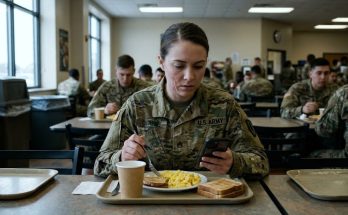
I sat in the Fort Carson dining area with my lunch cooling in front of me.
Around me, people were talking about work, weekend plans, and things that seemed ordinary enough to take for granted.
I looked at my phone.
My mother's message was still there.
Britney needed to speak to me immediately.
I wondered whether my sister had finally decided to apologize.
Then I looked at my father's words again.
The bank was asking questions.
I knew that was the part that mattered to them.
I called my mother first.
She answered before the second ring finished.
"Finally. I've been trying to get you to respond."
"I just saw your messages."
"Your sister is in trouble."
I waited.
My mother took a breath.
She started explaining that Britney had been trying to arrange financing and that something had gone wrong.
I asked her what had happened.
She said the bank had contacted them.
I asked why the bank would contact them about my sister's finances.
There was a pause.
Then she said Britney would explain everything.
"Put her on the phone."
"She's very upset."
"Then she can tell me why."
My mother did not like that answer.
I could hear her moving around, followed by a muffled conversation.
A moment later, Britney came on the line.
Her voice sounded different from the one I remembered at breakfast.
It was smaller.
Not softer in any meaningful way.
Smaller, as if she had run out of room to make demands.
"What did you do?"
I leaned back in my chair.
There it was.
Not an apology.
Not a question about my cheek.
An accusation.
"I froze my credit."
"You didn't have to do that."
"Yes, I did."
"You made everything difficult."
I looked at the table in front of me.
I had heard those words in different forms for years.
Every time I declined to solve one of Britney's problems, I became the person making her life harder.
I asked what the bank had said.
She told me they had questions about information connected to her application.
I asked what information.
She said she did not know exactly.
I asked whether my name had been used.
Another pause.
Then she said the bank had asked about a connection between our financial records.
That was all she would give me.
I did not fill the silence for her.
Finally, she said she needed me to call the bank.
I asked why.
"Because they won't listen to me."
"Then you need to answer their questions."
"You know how these places are."
I did.
I knew institutions cared about records, dates, permissions, and whether the information in front of them matched the answers they received.
I also knew that a person who wanted something fixed quickly did not always want the facts examined carefully.
"What exactly are you asking me to tell them?"
"Just explain that we're sisters."
I waited for the rest.
She did not offer it.
"Being sisters doesn't answer a financial question."
Her breathing changed.
"You always do this."
I almost asked what she meant.
Instead, I told her I would not make statements about an account or application I had not seen.
She said I was abandoning her.
I told her I was not going to speak to a bank on her behalf without knowing what had happened.
Then she ended the call.
I sat there with the phone in my hand.
My lunch had gone cold.
I put the phone down and took a breath.
I was not surprised that Britney wanted my help.
I was surprised by how quickly she had moved from asking for my credit card to accusing me of causing her trouble.
I thought about the morning she had thrown coffee at me.
I remembered standing in the kitchen while my father asked everyone to calm down.
I remembered my mother's towel.
I remembered the mug in the sink.
At the time, I had thought the worst thing about that morning was how easily my family had accepted what Britney did.
Now I wondered whether they had also assumed I would keep protecting them from the consequences of their choices.
My phone rang again.
This time, it was my father.
I answered.
"Your mother tells me you spoke to Britney."
"I did."
"She's very upset."
"So am I."
He ignored that.
He said the bank was making the situation more complicated than it needed to be.
I asked him what the bank had actually told him.
He said they wanted clarification about information Britney had provided.
I asked whether he had seen the application.
"No."
"Then how do you know what the problem is?"
He went quiet.
I heard a chair move on his end of the call.
He told me I should come home and help the family sort this out.
I looked at the time.
I was back at work.
I had responsibilities waiting for me.
And I was not going to drive across several states because my family had decided that a financial question required my immediate presence.
"I can't come home."
"You're making this harder than it needs to be."
I closed my eyes.
I had heard that sentence in the kitchen, although the words had been slightly different.
It was the same idea.
My refusal was the problem.
The original action was somehow less important.
I told him that if the bank had questions about my information, I would answer them truthfully.
But I would not invent an explanation to make Britney's situation easier.
He said I was being cold.
I told him I was being careful.
Then I ended the call.
For the rest of that afternoon, I struggled to concentrate.
I checked my messages more often than I should have.
Nothing came from Britney.
My mother sent a short text saying she hoped I understood how frightened everyone was.
I read it and set the phone aside.
Nobody had been frightened when I sat in urgent care.
Nobody had asked me to come home so they could make sure I was all right.
Now there was a bank involved, and suddenly everyone needed me.
I went back to work.
That evening, I reviewed the records I had saved after leaving Colorado.
The medical paperwork was there.
The photographs were there.
The messages from the morning of the incident were there.
I also had the information from the earlier store card problem and the transfer I had made to help Britney with rent in 2019.
I did not know whether any of those records had a direct connection to the bank's questions.
I was not going to assume they did.
But I wanted them preserved.
I organized the files and checked that the copies were readable.
Then I returned to the financial accounts I had secured.
The alerts were still active.
The freeze was still in place.
Nothing in the records gave me a reason to remove those protections.
I closed the folder and sat back.
For six weeks, I had been trying to put the kitchen behind me.
Now I understood that leaving the house had not ended the problem.
It had only stopped me from being the person who quietly handled it.
And that difference mattered more than I had realized.
Click here to continue reading: PART 6: The More My Sister Demanded That I Fix the Bank’s Questions, the More I Remembered Why I Had Frozen Everything
I Thought Ten Days at Home Would Fix My Exhaustion, Until My Sister Asked for Something I Had Already Learned Never to Give
Part 5 of 24