I drove back to my parents' house after leaving urgent care.
I could have gone straight to the highway.
Part of me wanted to.
But my belongings were still in the bedroom, and I was not going to leave my things behind because Britney had decided she could not accept an answer.
I parked in the driveway.
The little flag near the porch shifted in the breeze.
I looked at it for a moment before getting out.
It had been there for years.
I had walked past it as a teenager carrying schoolbooks.
I had walked past it when I left for the Army.
I had walked past it when I returned home for holidays and short visits.
It had never meant much beyond being something my parents kept near the front door.
That morning, it seemed to belong to a house I no longer understood.
I went inside.
My mother was in the kitchen.
She had cleaned the table.
The mugs were back near the sink.
The television was still on.
For a second, I wondered whether she had cleaned because she wanted the kitchen to look normal again or because she could not stand seeing evidence of what had happened.
She looked at my face.
"Oh, honey."
I waited.
She did not ask whether the nurse had treated the burn.
She did not ask what the medical record said.
Instead, she told me Britney had been upset.
I stood near the doorway with my keys in my hand.
"She threw coffee at me."
"I know."
"Then why are you explaining her feelings to me?"
My mother looked down at the towel she was holding.
She said Britney had been frustrated about the car loan.
She said the conversation had gotten out of hand.
She said nobody wanted the morning to end like that.
I listened until she stopped.
Then I went upstairs.
I packed my clothes into the same bag I had brought with me.
I folded the shirts I had not worn.
I gathered my charger, toiletries, and the few things I had left on the dresser.
The room looked almost untouched when I finished.
I checked the drawers.
I checked the bathroom shelf.
I checked the outlet beside the bed for my charging cable.
It was the same habit I used at work.
Before leaving a location, I made sure I had accounted for everything.
I did not want to have to return because I had forgotten something small.
When I came downstairs, my father was standing near the dining table.
He looked at my bag.
"You're leaving?"
"Yes."
"You have several more days."
"I know."
He rubbed his forehead.
He looked tired, but he also looked irritated, as if my decision had created another problem for him to manage.
"We shouldn't let one bad morning ruin the whole visit."
I set my bag down long enough to look at him properly.
"One bad morning?"
He did not answer immediately.
I told him I had gone to urgent care.
I told him I had photographs of the burn and paperwork from the visit.
His expression changed slightly when I mentioned the record.
Not enough to make me feel understood.
Enough to tell me he had not expected me to document anything.
He said there was no need to turn this into an official matter.
I asked him what he thought I should have done instead.
He looked toward the kitchen.
"We're family."
There it was again.
The same phrase.
The same expectation that our relationship should erase the details of what had happened.
I wanted to ask whether being family meant I was required to accept whatever Britney did when she became angry.
I wanted to ask why nobody had stopped her.
I wanted to ask why the first concern in that house was keeping the peace rather than acknowledging that I had been hurt.
But I was tired.
I had spent enough years trying to make people understand things they had no interest in understanding.
I picked up my bag.
My mother followed me toward the front door.
"Maybe give her a little time."
I turned around.
"Time for what?"
"To calm down."
I looked at my mother for a long moment.
She was asking me to wait until the person who had thrown coffee at me felt better about the situation.
Nobody had asked Britney to apologize before I left.
Nobody had asked her to take responsibility.
The only thing anyone wanted was for me to remain available until the house felt peaceful again.
I opened the door.
My father stood behind us.
He said we should not let a disagreement divide the family.
I told him I was not the one who had thrown anything.
Then I stepped outside.
I put the bag in the car and sat behind the wheel.
I could see the kitchen through the window.
My mother had gone back inside.
My father was still standing near the doorway.
I did not see Britney.
She had not come out to apologize.
She had not even come downstairs to say goodbye.
I started the engine and backed out of the driveway.
I left six days earlier than planned.
The road away from the house felt familiar.
I knew the turns.
I knew where the traffic usually slowed.
I knew the stretches where the mountains came into view.
But I did not feel the relief I had expected when I finally got away from the kitchen.
I felt disappointed.
Not only in Britney.
In myself, too.
I had known for years that she treated my help as something she could count on.
I had known my parents often defended her before asking what had happened.
I had known that keeping the peace usually meant giving up something I wanted or accepting something I should not have accepted.
Still, I had returned home expecting things to be different.
I had believed that ten quiet days might remind us how to be a family without turning every problem into a demand.
That belief had cost me more than the visit.
By the time Denver was disappearing behind me, I had made several decisions.
The first was to freeze my credit.
I was not going to leave an opening for anyone to use my information while I was away.
The second was to remove Britney from my phone plan.
I had been paying for her line, and I no longer saw a reason to continue.
The third was to save the messages connected to the dispute.
I downloaded the medical paperwork and kept the photographs.
I also gathered the records I had from the earlier financial problems, including the payments I had made and the information tied to the store card incident.
I wanted everything in one place.
Not because I was planning to punish my sister.
Because I knew how quickly people could change their version of a conversation once the consequences reached them.
At work, a missing signature could matter more than somebody's memory of what they had agreed to do.
I had learned to keep records for that reason.
Now I needed the same discipline at home.
I did not tell my parents what I was doing.
I did not send Britney a long message explaining why I had left.
I did not ask anyone to agree with me.
I simply secured my accounts and drove back toward Fort Carson.
For the first few days, I concentrated on getting settled into my routine again.
Work gave me things I could understand.
There were records to check, responsibilities to handle, and tasks that did not depend on whether somebody felt I had been fair.
I followed the instructions in front of me.
I kept my paperwork organized.
I went to sleep at the usual time.
The burn on my cheek remained a reminder that the visit had not gone the way I expected.
But the injury was only part of it.
The larger change was that I no longer felt obligated to repair every problem my family created.
I had not blocked my parents from contacting me.
I had not decided I would never speak to Britney again.
I had simply stopped offering my finances as a solution to whatever she wanted next.
For the first time, I was willing to let the consequences belong to the person who caused them.
Six weeks passed.
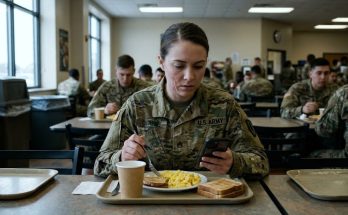
Then, one afternoon, I sat down for lunch at Fort Carson.
I had barely started eating when my phone lit up.
The time on the screen read 12:43 p.m.
The first message was from my mother.
She said Britney needed to speak with me immediately.
She said the situation was serious.
I read the message twice.
Before I could answer, another text appeared.
It was from my father.
He told me to call home.
The bank was asking questions.
I put my fork down.
Until that moment, I had thought the worst part of the visit was behind me.
Now I was looking at my parents' messages, remembering the credit freeze, the records I had saved, and the financial history my family had hoped I would continue to manage quietly.
Whatever was happening, it had reached a bank.
And this time, I had kept the paperwork.
Click here to continue reading: PART 5: My Parents Wanted an Immediate Phone Call, but I Had Spent Six Weeks Making Sure My Name Could Not Be Used Without My Permission
I Thought Ten Days at Home Would Fix My Exhaustion, Until My Sister Asked for Something I Had Already Learned Never to Give
Part 4 of 24