The next week passed without another urgent message from my parents.
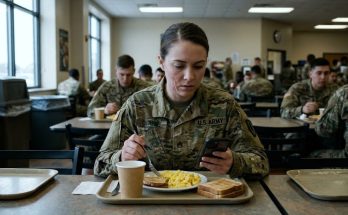
I continued working at Fort Carson.
I kept my financial protections in place.
I did not contact Britney's bank because there was no reason for me to do so.
If anyone needed information about my own accounts, I would deal with that request when it came.
Until then, I was not going to invent a role for myself in a process I did not understand.
I had learned that lesson the hard way.
On Saturday, my mother called while I was folding laundry.
I nearly let it go unanswered.
Then I picked up.
She asked what I was doing.
I told her I was catching up on chores.
She said she had been thinking about our last conversation.
I sat on the edge of the bed with a clean shirt in my hands.
"About what?"
"About that morning."
I waited.
My mother said she had not handled it well.
She said everything had happened quickly and that she had been shocked.
I remembered her standing beside the counter.
I remembered her reaching for a towel.
I remembered how she had looked at me as if she wanted to help but also wanted the whole thing to disappear.
I told her I had been shocked, too.
She said she knew.
Then she began explaining that Britney had been under pressure for a long time.
I felt my shoulders tighten.
There it was again.
The explanation that always arrived before the acknowledgment.
I did not interrupt her.
I let her finish.
When she stopped, I said I could understand that Britney was stressed without accepting what she had done.
My mother said she knew that now.
I wanted to believe her.
Then she asked whether I was still angry.
I looked at the shirt in my hands.
I thought about the burn.
I thought about the medical visit.
I thought about the six days I had lost from my trip.
I thought about the messages from my parents after I had returned to Colorado, when the bank's questions became more urgent than my injury.
"Yes," I said.
My mother was quiet.
I did not soften the answer.
I had spent too long making my feelings smaller so other people could remain comfortable.
I was angry.
I was disappointed.
I was still trying to understand how a family could watch something like that happen and then ask the injured person to help everyone move on.
My mother said she hoped I would forgive Britney.
I told her forgiveness was not something I could schedule.
She said she did not mean to pressure me.
I believed she wanted to believe that.
But the pressure was there anyway.
I told her I could not promise when I would feel differently.
Then I asked whether Britney had apologized to her.
My mother said Britney had admitted she should not have thrown the coffee.
That was more than I had heard before.
I asked whether Britney had said it directly to me.
My mother said she had not.
I did not feel triumphant.
I felt tired.
An apology passed through another person was not the same as hearing it from the person who had hurt me.
Still, I was glad Britney had at least admitted the action was wrong.
It meant there was something to build on, if she chose to build it.
My mother asked whether I would consider coming home for a short visit.
I told her I was not ready.
She did not argue.
Instead, she asked whether I wanted her to send me some of the food she had made.
I smiled despite myself.
That was my mother.
When she could not find the right words, she returned to cooking.
I told her I appreciated the offer, but she did not need to send anything.
We talked about ordinary things for a while.
Then we hung up.
I returned to the laundry.
The shirt I had been folding was one I had brought home to Colorado for my visit.
It had been in the bag when I left early.
I had washed it after returning to Fort Carson, but a faint mark remained near the front where the coffee had soaked through.
I had considered throwing it away.
Instead, I had kept it at the back of the drawer.
I held it up and looked at the mark.
It was small now.
The fabric had dried long ago.
The memory had not.
I did not want to keep the shirt because I wanted to remember the pain.
I did not want to use it as proof against my sister.
I only wanted to understand why I had hesitated to throw it away.
Maybe part of me was afraid that, without something tangible, the whole incident would become another family story in which everyone remembered a different version.
I had the medical paperwork.
I had the photographs.
I had the saved messages.
I did not need the shirt to establish what had happened.
I folded it and placed it in a separate bag with clothes I planned to donate.
Then I closed the drawer.
It felt like a small decision.
It was also a reminder that I could keep the facts without keeping every object that carried the memory.
That evening, I received a message from my father.
He said he was glad my mother and I had spoken.
He hoped we were beginning to make progress.
I replied that we had talked.
I did not say everything was fine.
I did not say I had forgiven Britney.
I did not promise to come home.
I was learning to let a good conversation be a good conversation without turning it into a commitment.
A few hours later, Britney sent me a message.
It was short.
She said she knew I was still angry.
She said things had become complicated and that she wished I would talk to her.
I read it several times.
There was no direct apology.
There was no mention of the coffee.
There was no explanation of what the bank had asked her.
But there was no accusation, either.
I decided not to answer that night.
I wanted to respond because I missed my sister.
I wanted to believe we could return to the easy parts of our relationship without pretending the difficult parts had never happened.
But I knew how quickly I could slip back into solving her problems if I responded before I understood what she was asking.
So I put the phone down.
I went to bed.
The next morning, I woke without feeling that I had failed anyone.
That was new, too.
Click here to continue reading: PART 12: I Could Not Repair My Family With One Phone Call, So I Stopped Trying to Turn Every Unfinished Conversation Into a Promise
I Thought Ten Days at Home Would Fix My Exhaustion, Until My Sister Asked for Something I Had Already Learned Never to Give
Part 11 of 24