
Charles tried to contact me again.
This time, I saw his name and felt no urge to answer.
I still felt nervous.
My hand even moved toward the phone before I stopped myself.
But I remembered what had happened the last time I had stood in front of him and refused to obey.
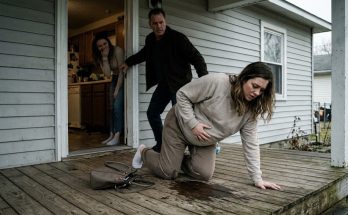
I remembered the pain in my scalp.
The cold porch.
The warmth running down my legs.
I let the call go unanswered.
A message arrived a few minutes later.
He said I was being unreasonable.
He said Samantha was turning me against my own family.
He said the situation could be settled if I would stop listening to people who had no personal interest in us.
I read the message carefully.
There was no acknowledgment of what he had done.
No concern about the baby.
No apology.
Only another explanation for why I was responsible for the problem.
I placed the phone on the table.
For years, I would have answered immediately.
I would have tried to explain why I was hurt.
He would have interrupted.
I would have become emotional.
He would have pointed to my emotions as proof that I wasn't thinking clearly.
Then I would have apologized for the way the conversation had gone.
That pattern had become so familiar that I had mistaken it for an ordinary family disagreement.
It wasn't ordinary.
And I didn't have to repeat it.
I forwarded the message to Samantha.
She advised me to keep the communication and avoid discussing the estate directly with Charles.
I agreed.
Then I returned to the kitchen and made myself something to eat.
It was a small task.
I had to stop halfway through because my back began to ache.
But I finished.
I was tired of every part of my life becoming an argument about what I could or couldn't handle.
I could ask for help without giving up control.
I could rest without surrendering my decisions.
And I could refuse a conversation without being cruel.
Later that day, Samantha called to discuss the next steps.
“We're continuing to review the claims your father made and whether any unauthorized action was attempted,” she said.
“Has he given you any explanation?”
“He has made claims about your supposed authorization. We still need to verify the documents and the extent of what he attempted.”
I looked at the phone.
“He keeps saying I should talk to him privately.”
“You're not required to do that. If there are estate matters to resolve, they can be handled through the appropriate channels.”
I felt something loosen in my chest.
I had always believed that refusing a private conversation meant I was avoiding responsibility.
But there was no reason to discuss ownership documents with someone who had already ignored my refusal to let him take control.
“Can you tell him to contact your office?”
“Yes.”
I thanked her.
After we hung up, I walked into Lucas's office.
I stood by the desk without touching anything.
I thought about the way my father had moved through the room.
He had not asked permission.
He had not considered that Lucas's papers might contain private information.
He had behaved as if the entire house had become available to him the moment Lucas died.
I wondered whether he had ever seen me as a separate person with my own rights.
Perhaps he had always believed that being my father meant he would eventually have the final say.
That was a painful thought.
But it explained why I had struggled for so long to establish boundaries with him.
He had treated my adulthood as something he could overrule.
I had allowed myself to believe that challenging him meant I was ungrateful.
Now I knew better.
I could appreciate the things my father had done for me in the past without excusing what he had done that morning.
I could acknowledge that he was my father without allowing him to control my home.
And I could leave his messages unanswered.
That evening, I sat at the kitchen table with Lucas's chair beside me.
I didn't move it.
I didn't try to make the room look different.
I let it remain where it had always been.
Then I turned my phone facedown and ate my dinner.
No argument.
No explanation.
No apology for protecting myself.
It was the quietest decision I had made in years.
Click here to continue reading: PART 20: When Samantha Explained the Consequences of Unauthorized Claims, I Began to Understand Why Lucas Had Insisted on Putting Everything in Writing
Three Weeks After My Husband Died, My Father Walked Into My Kitchen and Told Me I No Longer Belonged There
Part 19 of 24

One Comment on “PART 19 – My Father Wanted a Private Conversation, but the More He Avoided the Facts, the Less I Wanted to Hear His Explanation”