By the time the legal review had progressed, I no longer woke each morning wondering whether my father could simply take my home away from me.
The deed supported my ownership interest.
The trust documents established protections for the assets intended for my benefit.
The company records governed Lucas's shares and the authority connected to them.
Those facts did not erase what had happened.
They did, however, give the situation boundaries.
My father could make claims.
He could demand conversations.
He could insist that he had been trying to help.
But his words could not replace the documents.
And his relationship to me could not give him authority he did not possess.
Samantha continued handling the estate questions.
She reviewed the relevant records and addressed any claims that required a response.
I did not try to decide the outcome before the evidence was examined.
I had learned to wait for facts rather than fill every silence with fear.
When Samantha explained that the protections in Lucas's arrangements had to be applied according to their actual terms, I understood why she had been careful from the beginning.
The fraud clause was not a magic phrase that automatically settled every dispute.
It was a provision whose consequences depended on the conduct established and the language of the documents.
If Charles had knowingly used false authorization or attempted to interfere with protected assets, that conduct could have serious consequences.
He could not avoid those consequences simply by saying he was my father.
I never learned every private thought that had brought him into my kitchen that morning.
I could not know exactly what he believed when he carried the folder through the front door.
But I knew what he had told me.
He had claimed that Lucas's debts required the house to be sold.
He had claimed that he was taking care of the situation.
He had refused to accept my answer.
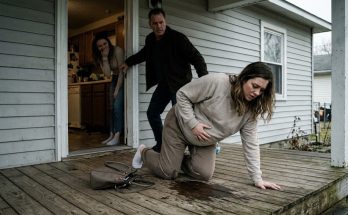
And when I would not cooperate, he had dragged me outside.
Nothing that happened afterward changed those facts.
The legal questions were one part of the matter.
The personal consequences were another.
I had been forced to see my father without the excuses I had spent years making for him.
That was a loss of its own.
I had wanted a father I could trust.
I had wanted him to be happy about the baby.
I had wanted him to come into my home and ask how I was managing without Lucas.
Instead, he had treated my grief as an opening.
I couldn't repair that by pretending it hadn't happened.
Nor could I make him understand simply by explaining my feelings one more time.
I had explained myself enough.
I began making plans for the baby.
I organized the things Lucas and I had prepared before the accident.
I kept the small clothes folded in their drawer.
I checked the list of items we still needed.
Some days I could work for an hour.
Other days, I sat on the bed holding Lucas's T-shirt and did nothing at all.
I stopped treating those days as failures.
I was grieving.
I was recovering.
I was preparing to become a mother without the person I had expected to stand beside me.
I didn't need to pretend that was easy.
The house gradually became familiar again.
The kitchen was still the kitchen.
The porch was still the porch.
I could not erase the memory of what had happened there, but I could decide what happened next.
I took care of the practical security arrangements.
I kept the relevant messages.
I made sure that estate-related communications went through Samantha rather than through private arguments with my father.
I did not allow Charles to decide when he could enter my home.
I did not allow Courtney's messages to pull me into another confrontation.
And I did not sign anything simply because someone told me it was necessary.
The emergency key had once represented trust.
Now it reminded me that trust needed boundaries.
A key could open a door.
It could not establish ownership.
It could not grant authority over an estate.
And it could not make a person entitled to control someone else's future.
One afternoon, I sat at the kitchen table and looked at the chair beside mine.
Lucas had once sat there with his paperwork spread across the table.
I remembered teasing him about the number of folders he kept.
He had smiled and told me that careful planning was a way of looking after the people you loved.
I had not understood how deeply those words would matter.
Now I did.
His arrangements had not prevented my father from hurting me.
No document could promise that nobody would ever behave cruelly.
But they had provided a way to protect the assets Lucas wanted safeguarded and to challenge attempts to take control without proper authority.
They gave me something to stand on when I was too exhausted to stand up for myself alone.
I would always wish Lucas had been there that morning.
I would always wish I could have called him instead of Samantha.
But I could not change the accident.
I could not bring him back.
I could only decide what to do with the life he had worked so hard to protect.
As for Charles, I did not rush to forgive him.
I did not promise that we would return to the relationship we had before.
I also did not make revenge the purpose of my life.
I wanted accountability.
I wanted my home protected.
I wanted the estate handled properly.
And I wanted to raise my child without teaching them that a parent was entitled to cause harm simply because of the title they carried.
Whether my father ever understood that was no longer something I could control.
The day my water broke, he had stood in the doorway and told me to call whoever I wanted.
I had called Samantha.
I had also called for medical help.
Those calls had not made me powerful in the way my father understood power.
They had not given me control over every outcome.
They had connected me to people who could help, records that could be checked, and procedures that did not depend on his permission.
That was enough.
When I thought about that morning now, I no longer remembered only the porch.
I remembered the phone in my hand.
I remembered telling the truth about what had happened.
I remembered refusing to pretend that a violent act was a family disagreement.
And I remembered the first moment I understood that Lucas had left me more than memories.
He had left me a home, a future to protect, and arrangements designed to preserve my interests after he was gone.
The rest was mine to decide.
I folded his T-shirt and placed it beneath my pillow again.
Then I turned off the light.
My husband was gone.
My father had shown me a side of himself I could never unsee.
And the child I was carrying would arrive in a world that was already different from the one I had imagined.
But the house was still my home.
The future was still mine to build.
And I would no longer mistake another person's control for love.
The End
Read more original stories on Feel Every Story.
Three Weeks After My Husband Died, My Father Walked Into My Kitchen and Told Me I No Longer Belonged There
Part 24 of 24