Stephanie called the following Monday.
She asked whether I would meet her for lunch.
I nearly said I was busy.
Not because I didn't want to see her, but because I wasn't sure what kind of conversation she expected us to have.
Since Thanksgiving, she had sent a few messages asking how I was doing.
She had also called to speak to the boys when they were visiting.
Her tone was warmer than it had been before, but I still remembered the moment her crying stopped when I said I had no money left.
That memory was not going away simply because she had apologized.
I told her I would meet her.
She chose a small restaurant near the shopping center.
I arrived a little early and took a table beside the window.
The restaurant smelled of coffee and toasted bread.
A waitress brought me water, and I sat looking at the people passing outside.
I had spent many years meeting Stephanie for lunch.
When she was younger, we would go shopping and stop somewhere to eat afterward.
She liked ordering something different each time.
I usually chose soup or a sandwich.
She used to tease me about being predictable.
I thought about that as I waited.
I had been predictable in many ways.
I had always been there.
I had always found a way to help.
I had always made sure my children knew they could come home when life became difficult.
Perhaps they had come to believe that I would never need the same thing from them.
Stephanie arrived ten minutes late.
She apologized and sat down.
"I'm sorry. The traffic was terrible."
"That's all right."
She put her handbag on the chair beside her.
For a few moments, we talked about ordinary things.
The boys were doing well.
Danny was working hard.
Michael had called her after Thanksgiving.
Then the waitress came to take our order.
Stephanie chose a salad and soup.
I ordered a sandwich.
When the waitress left, Stephanie folded her napkin in her lap.
"I've been thinking about that phone call."
I looked at her.
"So have I."
She nodded.
"I keep remembering how you sounded."
I didn't interrupt.
"You were frightened, and I could hear it. I knew you were upset."
She looked down at the table.
"But I was thinking about myself."
I felt a sadness I couldn't quite name.
It wasn't the same as anger.
It was the sadness of hearing someone finally describe what you had already suspected.
Stephanie continued.
"I started thinking about how much it would cost to have you stay with us. I thought about the children's routines, the house, everything we already had planned."
She took a breath.
"And then I asked how much money you had left."
I held my water glass.
She looked up at me.
"I don't know why I asked that first."
I wanted to tell her I knew why.
Money made people feel secure.
It gave them a way to measure risk.
It made it easier to decide whether a problem could be managed.
But I didn't want to give her an excuse before she had finished explaining.
"I think I was afraid," she said. "I didn't want to imagine that you might really need us for a long time."
I listened.
She went on.
"I told myself you would find somewhere else. I told myself there were programs and places that could help. I made it sound practical because I didn't want to feel guilty."
Her voice trembled.
"I knew you needed more than advice. I just didn't want to face what that meant for me."
I looked out the window for a moment.
There were people carrying shopping bags toward their cars.
A woman held the hand of a little boy who was trying to walk faster than she could.
The world continued around us, even when a family was struggling with something painful.
I turned back to Stephanie.
"Thank you for telling me the truth."
She wiped her eyes.
"I'm sorry, Mom."
I reached across the table and touched her hand.
"I love you."
She nodded.
"I love you, too."
Our food arrived.
We ate a little before speaking again.
The conversation was not easy, but it was honest.
Stephanie told me she had been embarrassed by the thought of me living in a shelter.
She had imagined people asking questions.
She had imagined having to explain why her mother wasn't staying with her.
She had been more worried about how the situation would look than about how I would feel.
Hearing that hurt.
But it was better than hearing another excuse.
I told her that I had been wrong to create the situation without telling her what I was doing.
I told her that I should have asked for help directly rather than using a lie to discover what she would offer.
She listened.
Then she said something I hadn't expected.
"I think I've spent years believing that you and Dad would always be fine because you never asked us for much."
I nodded.
"We didn't want you to worry about us."
"I know. But maybe that made it easier for me to forget that you could need help."
I considered that.
Parents often try to protect their children from worry.
We hide our bills, our arguments, and our fears.
We say we're fine when we're not.
We do it because we want our children to feel safe.
Then, years later, we wonder why they don't know how to help us.
I had never thought about that before.
"I may have helped create that problem," I admitted.
Stephanie shook her head.
"You didn't make me tell you to look for a shelter."
"No. I didn't."
She looked down at her plate.
We didn't need to pretend that one truth erased the other.
After lunch, Stephanie asked whether I would come to her house the following weekend.
She wanted me to spend time with the children.
She said she would prepare dinner and make sure there was a comfortable place for me to sit.
I told her I would think about it.
She nodded.
"I understand."
We walked outside together.
Before she got into her car, she hugged me.
She held on longer than usual.
I let her.
I could feel how much she wanted the moment to repair everything.
I wanted that, too.
But I had learned that healing was not something a person could demand from another.
It took time.
When I returned to Danny's apartment, Kayla was helping the boys with their homework.
Danny had not yet come home.
I sat at the table and told her that Stephanie had apologized.
Kayla smiled.
"That's good."
I nodded.
"Yes. It is."
She didn't ask whether I had forgiven her.
She didn't tell me what I should do next.
She simply returned to helping the boys.
I appreciated that.
That evening, Danny arrived home with a small bag of groceries.
He placed it on the counter and washed his hands.
"How was lunch?"
I told him that Stephanie had spoken honestly about what had happened.
He listened without interrupting.
Then he nodded.
"Maybe she needed time to understand it."
"Maybe."
He sat down and rubbed his hands together.
"Are you going to visit her?"
"I think I will."
He smiled.
"Good."
I looked at him.
"You make everything sound so simple."
He shrugged.
"Sometimes it is simple. People just make it hard."
I laughed.
Then I looked at the little table where he ate dinner every night.
The surface was scratched.
One leg still wobbled slightly unless a folded piece of cardboard was tucked beneath it.
It wasn't an impressive piece of furniture.
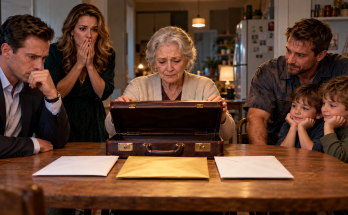
But it had held our Thanksgiving dinner, the envelopes, the letters, and the conversation that had begun to change my family.
I ran my fingers over the edge.
I thought about all the things I had once believed mattered most.
A successful career.
A large house.
A comfortable retirement.
Those things were not bad.
But none of them could tell me whether somebody would stay beside me when I was afraid.
I was beginning to understand that the answer had to come from what people did.
Not what they owned.
Not what they promised.
What they did.
Click here to continue reading: PART 12: I Returned to Walt’s Briefcase to Understand His Final Wishes, and I Realized That Forgiving My Children Would Not Mean Forgetting What They Had Done
The Three Phone Calls I Made After Walt Died Began With a Lie I Thought My Children Would Never Make Me Regret
Part 11 of 28