I spent the rest of the morning trying to make sense of Marla's last words.
You don't know what you're getting yourself into.
I repeated them silently while washing dishes.
I thought about them while folding towels.
I even caught myself whispering them when I passed the kitchen table.
The sentence sounded like a warning.
But a warning about what?
I had no answer.
I considered calling another family member, but I stopped myself.
I didn't want to turn a private argument into a family dispute based on something I didn't understand.
I didn't even know what I would say.
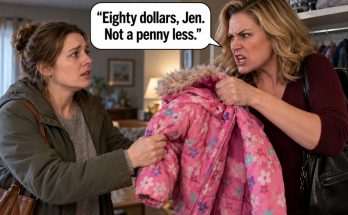
My sister had sold me a jacket.
My daughter had found something inside it.
My sister wanted it back.
Those were the facts.
Everything else was a question.
I had learned during Tom's illness that fear could make ordinary details feel enormous.
A phone ringing late at night.
A doctor pausing before answering.
A closed door.
I knew what it was like to imagine the worst when I had no information.
I didn't want to do that again.
But I also couldn't ignore what was happening.
I returned to the table and picked up the jacket.
I turned it over in my hands.
The sleeves were neatly stitched.
The zipper worked.
The lining appeared intact.
Nothing about the outside gave me a reason to be afraid.
I remembered how carefully Marla had held it before naming the price.
She had looked at me as though she were waiting to see whether I would pay.
At the time, I thought she was simply enjoying having the upper hand.
Now I wondered whether she had wanted the jacket gone for reasons she hadn't told me.
I placed it down.
I wasn't going to tear it apart.
I wasn't going to invent a story to fill the silence.
I needed to know what Abby had found, and I needed to understand why it mattered.
That afternoon, I picked Abby up from school.
She walked beside me with her hands tucked inside the sleeves of her old coat.
The wind was cold enough to make her hurry.
I watched her shoulders rise as she tried to keep warm.
I felt guilty all over again.
She had been excited about the jacket.
I had promised her she could wear it.
And now I was asking her to wait because the adults in her family couldn't tell the truth to one another.
When we reached home, she went straight to the kitchen.
"Did Aunt Marla call?"
I shook my head.
"I called her."
Abby looked at me.
"What did she say?"
"Not much."
She seemed to think about that.
Then she asked whether she had to return the jacket.
I pulled out a chair for her.
"Not right now."
She sat down.
I told her she could ask me anything that was worrying her.
She looked at the table, then at me.
"I don't like it when people get mad because I tell the truth."
I felt those words deep in my chest.
She wasn't talking only about the jacket.
She was talking about the way Marla had looked at her, and the way I had been speaking in a low voice whenever her aunt came up.
I reached across the table and took her hand.
"You did the right thing by telling me what you found."
Abby squeezed my fingers.
I wanted to tell her that honesty always made things better.
But I had lived long enough to know that wasn't true.
Sometimes the truth made people angry.
Sometimes it exposed things they wanted to hide.
Still, that didn't make honesty wrong.
I told her that much.
Then I made us something to eat.
We kept the conversation simple after that.
She told me about a spelling exercise.
I asked whether she needed help with her homework.
We sat together until the evening light faded from the window.
Later, when she went to bed, I returned to the kitchen.
The jacket was still on the chair.
I had spent two days trying to decide whether my sister deserved the benefit of the doubt.
I realized I had been asking the wrong question.
This wasn't about whether Marla deserved my trust.
It was about whether I could trust her with Abby's safety when she refused to explain what had frightened her.
I didn't know the answer.
But I knew I wasn't going to let guilt decide it for me.
I folded the jacket carefully and set it aside.
Then I took out a piece of paper and wrote down the facts as I remembered them.
The price.
The phone call.
The sudden demand.
The question about the pocket.
I didn't know whether the list would help.
I only knew that writing things down kept me from changing the details in my head every time I remembered Marla's voice.
When I finished, I folded the paper and placed it beneath the bills on the counter.
For the first time since the morning of the phone call, I felt a little steadier.
Not because I had found an answer.
Because I had stopped pretending I could solve the problem by ignoring it.
Click here to continue reading: PART 12: I Had Finally Stopped Apologizing for Asking Questions, but My Sister’s Silence Left Me Facing a Truth I Was Not Ready to Name
I Thought the Hardest Thing After My Husband’s Death Was Learning to Live Without Him, Until My Sister Put a Price on My Daughter’s Warmth
Part 11 of 24