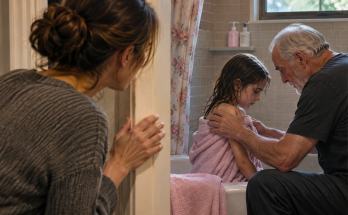
I didn't understand everything that happened that birthday until much later.
At the time, I was only a child.
I knew my cheek hurt.
I knew my wrists were wrapped.
I knew my father didn't want me in his photographs.
And I knew I was frightened.
I didn't understand how much one small decision could change the way a family behaved.
I only knew that Grandma had heard my shoe scrape the floor.
And she had turned around.
Years later, I still remembered that sound.
A small movement.
A little noise behind a chair.
Nothing important to anyone else.
But Grandma had noticed.
She had been willing to stop what she was doing and look.
That was the part I remembered most.
Not the cake.
Not the guests.
Not even the photographs.
Her turning around.
After that birthday, my life didn't become perfect overnight.
There were difficult conversations.
There were appointments.
There were decisions that took time.
My father had to accept that being a parent meant more than providing a house and arranging birthdays.
He had to learn that my feelings mattered even when they made him uncomfortable.
He had to learn that protecting a family's reputation was not the same as protecting a child.
And I had to learn that I wasn't responsible for making adults comfortable.
That took longer.
There were days when I still apologized too quickly.
There were moments when I became nervous if someone raised a camera.
Sometimes I still remembered the curtain when I walked into a crowded room.
But Grandma was patient.
She never told me to forget.
She helped me understand that I could remember something without allowing it to control every day afterward.
Dad's relationship with me changed slowly.
He continued working through the arrangements that had been put in place.
He learned to listen before answering.
He stopped insisting that every difficult conversation happen on his terms.
He also learned that an apology did not automatically give him back the trust he had lost.
I didn't punish him.
I didn't make promises I wasn't ready to keep.
I simply watched what he did.
Over time, some things improved.
He began asking whether I wanted to join family activities instead of deciding for me.
He stopped commenting on how I looked in photographs.
When I was upset, he learned to wait until I was ready to talk.
He wasn't suddenly a perfect father.
But he started making different choices.
That mattered.
My grandmother remained the person who taught me that love didn't require silence.
She kept the wooden picture frame.
The photograph of us in the garden stayed on her shelf.
Beside it was the family photograph from the lunch.
And inside the album was the picture from the day I dropped the cake.
She never removed it because my hair was messy or my dress was covered in frosting.
She liked it exactly as it was.
One afternoon, I found the old birthday photograph.
It was still inside the envelope.
Dad was standing beside the cake.
The relatives were arranged behind him.
Everyone looked happy.
But the space near the staircase was empty.
I stared at it.
For years, I had wondered what that photograph would have looked like if I had been allowed to stand with everyone.
I imagined myself holding Lily.
I imagined Grandma standing beside me.
I imagined my father smiling.
Then I realized something.
The photograph wasn't the important thing anymore.
I didn't need to be added to that picture to prove I belonged.
I already belonged.
I put the photograph back inside the envelope.
Then I went downstairs.
Grandma was sitting near the window.
She had become slower over the years.
Her hands were still gentle.
Her voice was still calm.
I sat beside her.
She looked at me.
"What are you thinking about?"
I smiled.
"That birthday."
She reached for my hand.
"Me too."
I told her I still remembered the sound my shoe had made against the floor.
She laughed softly.
"I almost thought someone had moved the chair."
I smiled.
"But you looked."
She nodded.
"Of course I looked."
I rested my head against her shoulder.
Then I asked whether she had known something was wrong before she pulled the curtain aside.
She shook her head.
"No. I only knew I heard something."
I thought about that.
She hadn't needed to know everything.
She hadn't needed proof before deciding that I deserved attention.
She had simply looked.
That was enough to begin.
A little later, Dad came to visit.
He greeted Grandma.
Then he sat across from us.
He noticed the old family album.
He opened it.
He found the birthday photograph.
For a moment, nobody spoke.
Then he closed the envelope and put it back.
"I'm sorry about that day," he said.
I looked at him.
"I know."
He nodded.
He didn't ask me to say anything else.
We spent the afternoon talking about ordinary things.
When it was time for a photograph, Dad asked whether I wanted to stand beside him.
I smiled.
"Yes."
Grandma joined us.
I held Lily.
Her repaired arm was still attached.
There was a small mark near the shoulder where the piece had been fixed.
I had never replaced her.
I never wanted to.
The camera flashed.
Everyone laughed because my uncle had forgotten to turn off the timer and nearly missed the picture.
We took another.
This time, everyone was ready.
When the photographs were printed, Grandma placed one inside the old album.
She chose the picture where I was laughing.
My father was beside me.
My aunt was behind us.
Grandma was smiling.
Nobody looked perfect.
And that was why I loved it.
I still had Lily.
I still had the photograph of Grandma and me in the garden.
And I still remembered the little wooden frame.
But the thing I carried most carefully was something nobody could put inside a picture.
The knowledge that I didn't have to disappear to make other people happy.
My father once hid me because he thought my injuries would spoil his birthday photographs.
Grandma found me because she heard a small sound that everyone else had missed.
She didn't need a perfect explanation.
She didn't need a perfect child.
She only needed to turn around.
And when she did, she changed what happened next.
I used to think being loved meant being easy to look after.
Now I understood something different.
Being loved meant being allowed to tell the truth.
It meant being protected when I was frightened.
It meant having a place at the table even when my clothes were wrinkled and my face wasn't perfect.
And it meant never having to stand behind a curtain just because someone wanted the family photograph to look beautiful.
I looked at Grandma.
She smiled.
I smiled back.
For the first time, I didn't wonder whether I belonged in the picture.
I knew I did.
The End
Read more original stories on Feel Every Story.
My Father Wanted a Perfect Birthday Photograph, but He Had Forgotten That One Person in the Room Always Noticed the Things Everyone Else Ignored
Part 20 of 20