I woke before six the next morning.
For a few seconds, I forgot what day it was.
Then I saw Daniel's empty side of the bed and remembered the card on the dining room table.
Christmas was over.
The food was in containers.
My son had not called.
I lay still for another minute, listening to the furnace start downstairs.
Daniel used to wake before me.
He would make coffee and carry his first cup into the backyard, even in winter.
He liked watching the birds gather around the feeder he had built near the garden.
He had made it twenty years earlier from leftover wood in the garage.
It was slightly crooked.
He knew it was crooked.
He refused to fix it.
Whenever I mentioned the uneven post, he said the birds had never complained.
That morning, I put on his old gray cardigan over my pajamas and went downstairs.
I made coffee.
I took my mug outside.
The cold reached through my slippers almost immediately, but I stayed on the patio.
The lawn was covered in frost.
Bare branches stretched above the fence.
The bird feeder stood near the edge of the garden, leaning just enough to make me smile despite myself.
For years, Daniel had insisted that the crooked feeder was perfectly functional.
He was right about that, at least.
Several small birds were already waiting nearby.
I walked toward it to check whether there was enough seed.
That was when I noticed something tucked behind one of the wooden supports.
At first, I thought it was a piece of paper that had blown into the garden.
Then I saw the corner of an envelope.
It had been pushed into a narrow space between the support beam and the back panel.
I reached for it.
The paper felt stiff from the cold.
Someone had written my first name across the front.
Helen.
I stopped moving.
I knew the handwriting.
I had seen it on birthday cards, grocery lists, anniversary notes, and the countless small reminders Daniel used to leave around the house.
His capital H always leaned slightly to the right.
His lowercase letters were narrow and close together.
Even after forty-six years, I could recognize his writing without reading a single word.
I stood beside the feeder holding the envelope.
My coffee sat forgotten on the patio.
For a moment, I could not make myself open it.
It had been nine months since Daniel died.
I had kept his papers.
I had sorted his clothes.
I had packed away the medical equipment that had filled our bedroom during his final weeks.
I had even learned to sleep without reaching across the bed to check whether he was breathing.
But finding his handwriting unexpectedly was different.
It felt like hearing his voice from another room.
I finally opened the envelope.
Inside was a small piece of paper.
There were only a few words.
Go to the desk. Open the bottom drawer. Check underneath.
No greeting.
No explanation.
No signature.
He had not needed one.
I read the instructions twice.
Then I looked back toward the house.
The coffee was growing cold.
I carried the envelope inside and went straight to the study.
Daniel's oak desk stood beside the window.
It was the same desk he had used for years to manage our bills, write letters, and sort the paperwork from his business.
I had barely touched it since the funeral.
His reading glasses remained beside a yellow legal pad.
A mechanical pencil lay across the top sheet.
There was a small indentation in the wood where he used to rest his wrist while writing.
I stopped beside the chair.
I could almost picture him sitting there, turning pages with one hand while holding his coffee in the other.
For a moment, I wanted to leave everything exactly as it was.
Then I remembered the envelope.
I pulled open the bottom drawer.
It was full of ordinary things.
Tax documents.
Insurance policies.
Old manuals for appliances we no longer owned.
A folder containing receipts from a roof repair years earlier.
I moved the papers aside and searched the corners.
Nothing.
I checked the back of the drawer.
Nothing there either.
The instructions had been very specific.
Check underneath.
I crouched beside the desk and ran my fingers along the underside of the drawer.
My fingertips brushed something rough.
Tape.
I felt along the edge until I found the corner of a small envelope secured beneath the wood.
I carefully peeled it free.
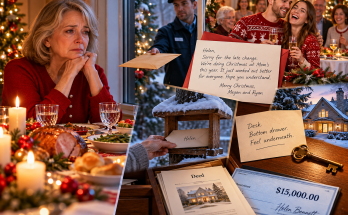
A brass key was attached to the front with a short piece of string.
It was heavier than I expected.
The metal had darkened with age, though the teeth looked clean.
I placed it on the desk and opened the envelope.
Daniel had written another note.
This one was longer.
He told me to use the key if I ever reached a point where our son made me feel that I no longer had a place in my own life.
The property it opened belonged to me.
I simply had not been told about it.
I read the note again.
Then I sat down.
I had never known Daniel to keep a secret about something as important as property.
We had discussed every major purchase during our marriage.
Our first house.
Our second car.
The renovation that had cost more than we expected because Daniel insisted on replacing the old wiring.
Even our retirement savings had been discussed over the kitchen table, usually with a calculator and two cups of coffee.
Yet here was a key to something I apparently owned without knowing it.
I looked at the note.
The words about Ryan bothered me most.
Why had Daniel connected the key to our son?
Had he expected Ryan to treat me badly?
Had he noticed something I had refused to see?
I felt a familiar urge to defend my son, even though he was not in the room.
Ryan had disappointed me.
He had ignored me on Christmas.
But he was still my child.
I could not imagine Daniel deliberately turning me against him.
That was not how my husband worked.
He preferred to prepare for problems quietly rather than make accusations he could not prove.
I picked up the brass key.
Then I examined the papers beneath the note.
There was a photocopy of a recorded deed.
The document identified a property in the Laurel Highlands, east of Pittsburgh.
I read the address.
I did not recognize it.
The name listed as the owner was Helen Marie Bennett.
I read it again.
Helen Marie Bennett.
My full name.
I checked the date on the document.
It had been recorded three years earlier.
Three years.
I had been living with Daniel then.
We had celebrated our forty-third anniversary.
We had taken a short trip to the coast and spent an entire afternoon arguing about whether we should replace the kitchen table.
He had never mentioned buying another property.
I leaned back in the chair.
There had to be an explanation.
Perhaps it had been a business arrangement.
Perhaps he had purchased it for some purpose connected to his work.
Perhaps I had forgotten a conversation from years earlier.
But I knew how Daniel discussed money.
He did not casually buy property and leave me to discover it after his death.
I held the deed closer to the window.
The legal language was difficult to follow, but the ownership line was unmistakable.
The property had been transferred to me.
Not to a company.
Not to a trust bearing an unfamiliar name.
To me.
I placed the document on the desk and looked at the brass key again.
“What were you planning, Daniel?”
I said it aloud.
The study remained quiet.
I had spent nine months learning to live without answers to ordinary questions.
Why had he insisted on keeping certain papers in the office?
Why had he asked me to make copies of our insurance documents?
Why had he told me that I should never sign anything important when I felt pressured?
At the time, I thought he was being cautious.
Now I wondered whether he had been preparing for something specific.
I gathered the papers and placed them in a folder.
I did not put the key away.
I carried it downstairs and set it beside my coffee mug.
Then I returned to the study to look through the drawer once more.
I checked every folder.
I examined the back panel.
I even looked inside the old manuals, though I had no reason to think anything else was hidden there.
There was nothing more.
The two envelopes and the deed were all he had left me.
Or all he had chosen to leave in that place.
I made another cup of coffee.
This time, I sat at the kitchen table and spread the documents in front of me.
The house was quiet enough that I could hear the refrigerator running.
I thought about the previous evening.
About the three plates.
About the message from Megan.
About Ryan standing beside her at her parents' table while I sat alone in my red dress.
Then I looked down at Daniel's note.
He had written it before he died.
He had known I might eventually feel excluded.
He had known there might come a time when I would need something he had arranged without my knowledge.
The thought frightened me.
Not because I believed Daniel had done something wrong.
Because I began to suspect he had seen a problem coming long before I had.
I checked the clock.
It was nearly eight.
I could spend the morning calling a real estate office and asking someone to explain the deed.
I could contact our regular attorney.
I could put the key away and wait until I felt less emotional.
Instead, I went upstairs and packed an overnight bag.
I included a sweater, a change of clothes, my medication, and the folder containing the deed.
Before leaving, I returned to the study.
Daniel's glasses were still beside the yellow pad.
I picked them up, folded them, and placed them neatly on the desk.
Then I stood in the doorway.
For the first time since his death, I felt that he had left me something more than memories and paperwork.
He had left me a decision.
I could continue sitting in the house, waiting for Ryan to explain why he had treated me as an afterthought.
Or I could find out what Daniel had been trying to show me.
I took the brass key from the kitchen table.
I put it in my coat pocket.
Then I locked the front door behind me.
Click here to continue reading: PART 3: I Drove Into the Laurel Highlands With a Deed Bearing My Own Name, Only to Find a House Filled With Memories I Thought I Had Lost
I Had Prepared Christmas Dinner for Two People Who Never Came, and the Message They Sent Instead Told Me Exactly Where I Stood
Part 2 of 20