The family conversation happened after the people handling the case had provided guidance about what could be discussed.
I had been dreading it.
I knew some relatives would be angry with me.
I knew others would want the entire situation resolved before anyone had time to sit with the uncomfortable facts.
I also knew my brother would be there.
I prepared myself by writing down what I had personally witnessed.
I wasn't going to argue about things I didn't know.
I wasn't going to repeat rumors.
And I wasn't going to let the discussion become a contest over who loved my brother most.
When the conversation began, one relative asked why I had called emergency services instead of talking to him privately.
I answered plainly.
"His son was injured, and I believed he needed help."
Another relative said the broken phone had caused the argument.
I agreed that the phone had been part of the situation.
Then I explained that it did not justify what I had witnessed.
My brother sat with his arms crossed.
He looked tired.
He also looked angry.
When someone asked him to explain his actions, he said he had lost his temper.
He admitted that he should not have used the pliers.
I watched the others react.
Some looked relieved that he had acknowledged it.
Others seemed ready to move on immediately.
One relative said that every parent made mistakes.
I nodded.
"Yes. But this was not an ordinary mistake."
The room grew quiet.
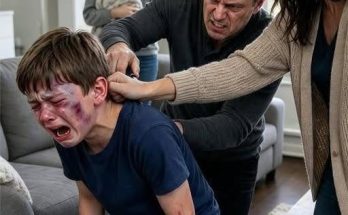
I described what I had seen when I entered the kitchen.
I described the injury.
I explained how my nephew had watched his father before moving.
I told them what he had whispered when my brother claimed the injury was accidental.
I also explained what the girl had said when the officer asked whether she had seen anything similar before.
I repeated her question as accurately as I could.
"Which time?"
Nobody spoke for a moment.
My brother lowered his eyes.
One relative said the girl might have been confused.
I replied that I couldn't tell them what she meant by every word.
That was for her to explain with appropriate support.
But I could tell them that she had said it.
And I could tell them that my brother had tried to stop her from speaking.
Those were facts I had witnessed.
The conversation became uncomfortable.
That was unavoidable.
My brother said he had already admitted he was wrong.
I told him that acknowledgment mattered.
But the children still needed safety, time, and support.
He said he understood.
I hoped he did.
Another relative asked whether I thought he was a bad father.
I didn't answer the question in the form it had been asked.
I wasn't there to assign him a permanent label.
I was there because a child had been hurt.
"What matters now is what he does to make sure it never happens again," I said.
My brother looked at me.
For once, he didn't interrupt.
The family discussed practical matters.
We talked about respecting the arrangements being made for the children.
We agreed not to pressure either child to speak before they were ready.
We agreed not to spread details of their conversations around the family.
And we agreed that nobody would tell my nephew he had caused the injury by breaking the phone.
That last point mattered most to me.
A broken phone was an accident or a mistake that could be addressed.
The child did not deserve to carry the blame for the way an adult had reacted.
After the conversation, my brother asked to speak with me privately.
I agreed, provided we kept the discussion calm.
He looked at the floor.
"I didn't think everyone would hear it like that."
I waited.
"When you describe it, it sounds worse."
I felt a familiar frustration rise.
"It was bad when it happened, too."
He nodded slowly.
I couldn't tell whether he was finally understanding or simply tired of arguing.
Then he said he had never wanted his son to be afraid of him.
I believed that might be true.
But wanting something and creating it were different things.
I told him that his son had been afraid.
The girl's answer had raised further concerns.
Those facts could not be erased by saying he hadn't intended them.
My brother rubbed his forehead.
"I don't know how to fix it."
I told him he couldn't repair it all at once.
He would need to follow the guidance he had been given.
He would need to accept responsibility without demanding immediate forgiveness.
He would need to show the children, through his behavior over time, that they could be safe around him.
He listened without interrupting.
Then he said he was willing to try.
I didn't congratulate him.
Trying was important, but it was only a beginning.
I told him I hoped he meant it.
We left the conversation without resolving everything between us.
I drove away feeling exhausted.
I had spent years believing that family unity meant keeping difficult truths inside the house.
Now I understood that a family could look united while the people inside it were afraid to speak.
I didn't know whether the family would ever agree about what had happened.
I didn't need everyone to agree on every detail.
I needed the children to be heard.
I needed the injury to be taken seriously.
And I needed my brother to understand that being loved did not mean being protected from the consequences of hurting someone.
That evening, I checked on my nephew.
He asked whether everyone had been talking about him.
I told him the adults had discussed how to help keep him safe.
He looked worried.
"Are they mad at me?"
"No."
I sat beside him.
"You are not responsible for the adults' feelings about what happened."
He looked at the green dinosaur.
Then he nodded.
I stayed with him until he began talking about something else.
It was a small change.
But he was learning that the truth could be spoken without making him the person who had done something wrong.
I wanted that lesson to stay with him longer than the fear.
Click here to continue reading: PART 20: The Pliers Were Put Away, the Phone Was Replaced, and I Finally Learned What It Meant to Protect the Children Without Pretending Everything Was Fixed
I Thought I Was Walking Into an Ordinary Family Argument Until I Saw the Pliers in My Brother’s Hand
Part 19 of 20