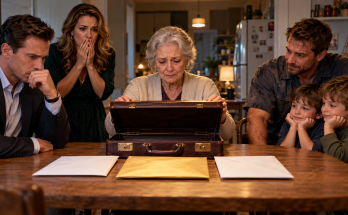
I learned something about my children the week I became homeless.
At least, that was the story I told them.
My name is Dolores, and for most of my life, I believed I knew exactly what kind of people my children were.
I had raised them. Fed them. Stayed awake when they were sick. Worked through headaches, bills, and nights when there wasn't enough money left for anything extra.
I thought those years meant something.
Then my husband, Walt, died.
And I found out that knowing your children for forty years doesn't mean you know what they'll do when helping you costs them something.
Walt had been gone for a week when I made the first phone call.
His reading glasses were still on the kitchen table, folded beside a grocery receipt and a little stack of coupons I'd been meaning to sort.
I picked them up that morning.
The frames were worn at the hinges. One lens had a faint scratch near the edge.
He'd worn those glasses every evening for years, usually while reading the newspaper or checking the figures from our household budget.
I set them back down.
Then I picked up the telephone.
Walt had always believed money made people show their true selves.
He never said it like a lecture. He'd say it while balancing the checkbook or putting gas in our old sedan.
We had lived simply even after he sold his transport business.
The sale had happened two years before he became ill. It brought us far more money than our children ever imagined, but we never changed the way we lived.
We kept our little house.
We kept our dependable car.
I still compared grocery prices and saved coupons for the things we used every week.
Walt liked it that way.
He said money could make a person comfortable, but it could also make people around that person behave differently.
So we kept quiet.
Not about everything. Just the money.
Our children knew their father had sold his business, but they believed most of the proceeds had gone toward taxes, retirement, and his medical care.
We let them believe that because we wanted to know whether their love for us would remain the same without the promise of an inheritance.
Looking back, I can admit that was a dangerous game.
Walt and I had made a decision about our children without asking them whether they wanted to be part of it.
Still, after his death, I found myself reaching for the same test.
I wanted to know what would happen if I had nothing left to offer.
The first person I called was Michael, our oldest.
He had done well for himself. He worked as an executive, lived in a large five-bedroom house, and seemed to spend half his life attending meetings or arranging business trips.
His wife, Jenna, had a home office, a housekeeper twice a week, and enough space that I had once gotten lost looking for the guest bathroom.
Michael answered after several rings.
"Hi, Mom. Everything okay?"
I looked at Walt's glasses.
"No, sweetheart. Not really."
I told him the medical bills had drained our savings. I said the bank was preparing to take the house, and I didn't have anywhere to go.
I kept my voice steady.
I didn't want him to think I was asking for money.
I wanted to see what he would offer without being asked.
Michael didn't speak for a while.
I could hear faint voices in the background, followed by the sound of a door closing.
"Mom, that's terrible."
I waited.
He sighed.
"Things are pretty complicated here right now."
I glanced toward the living room, where Walt's favorite chair still sat beside the window.
"Complicated how?"
"Jenna's mother is coming to stay with us in the spring. And the guest room has pretty much become Jenna's office."
I knew that room.
It had a desk, a computer, a sofa, and a large window overlooking their garden.
There was enough space in it for a bed.
But Michael continued before I could answer.
"I don't know where we'd put another person, Mom. You understand."
I looked around my own house.
There were two bedrooms upstairs and a narrow room downstairs that Walt used for storage.
I could have slept almost anywhere.
Michael had five bedrooms.
I said nothing about that.
He cleared his throat.
"I can send you some websites for senior housing. There are places that work with people on limited incomes."
"That would be kind of you."
"Of course. We'll figure something out."
He sounded relieved to have reached a solution.
We said goodbye.
I sat at the kitchen table for several minutes afterward.
The telephone was still warm in my hand.
Then I put it down beside Walt's glasses.
Michael emailed the links later that afternoon.
Three websites.
No message asking whether I'd eaten lunch.
No offer to drive over.
No question about whether I was frightened to be alone in the house where his father had died.
Just three links.
I printed them anyway and placed them beneath the grocery coupons.
That was the first answer.
I wasn't ready for the second.
Click here to continue reading: PART 2: My Daughter Cried When I Said I Had No Money Left, but One Simple Question Made Her Tears Disappear Almost at Once
I Told My Three Children I Had Lost Everything, and Their Answers Revealed Something My Husband Had Warned Me About for Years
Part 1 of 20