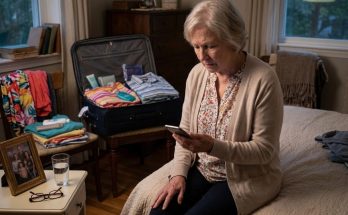
A few days later, I took the printed emails out of the folder where I had stored them.
I hadn't looked at them since the celebration.
The pages were still folded at the corners.
My mother's message was near the middle of the stack.
I knew the words before I read them.
She had suggested that the family maintain some contact with me in case the ranch became valuable someday.
At the time, I had read that sentence as an explanation for years of strange behavior.
Now I saw something else.
The email had not created the distance between us.
It had simply put that distance into words.
My mother had been thinking about the ranch when she considered whether to remain connected to me.
I had been thinking about the family I thought I had.
We had not been thinking about the same thing.
I placed the page beside Daniel's old photograph.
He was standing in front of the barn, one hand resting on the fence, his expression caught between a smile and a squint against the sunlight.
He had believed that people could work through hard things if they were willing to be honest.
I had believed it, too.
After he died, I spent years trying to understand how my own parents could leave me outside their home.
I wondered whether I had asked for too much.
Whether I should have called sooner.
Whether my mother had been tired or frightened or overwhelmed.
I had made room for every possible explanation except the simplest one.
She had chosen not to help me.
That didn't mean she had never loved me.
It meant that whatever love she felt had not been enough to make her open the door that night.
I could hold both truths without pretending one erased the other.
I put the email back into the folder.
Then I carried the folder to the cabinet where I kept Daniel's records.
The business papers were still there, including the first breeding notes he had written by hand.
His figures were uneven.
Some pages had coffee rings.
A few had little drawings in the margins where he had tried to explain a plan for the barn.
Those papers reminded me of the years before the ranch became successful.
Back then, there had been no hundred-million-dollar offer.
There had been broken fences, difficult seasons, and more bills than money.
Daniel and I had worked because we believed in what we were building.
His parents had helped us because they believed in us.
When he died, they continued helping because they loved him and because they loved me and the children.
They hadn't waited to see whether the ranch would become valuable.
They had come to the gas station when I had almost nothing.
That difference was the answer I had spent years searching for.
I didn't need the email to tell me who my parents were in every part of their lives.
I only needed to understand what their choices had shown me.
Later that day, Travis called.
I nearly let the phone ring out.
Then I answered.
“Hey,” I said.
“Mom told me you two talked.”
“She called me.”
“She says you still won't admit you embarrassed her.”
I leaned against the kitchen counter.
“Did she tell you what she said to me?”
“She said you brought up the porch again.”
“Because she brought it up.”
Travis made a frustrated sound.
“Beth, you have to understand that she feels like you attacked the whole family.”
“I told the truth about one night.”
“You could have left that part out.”
I thought about the reporters he had spoken to at the celebration.
I remembered him describing the sacrifices our family had supposedly made.
“Did you tell the reporters about the night she shut the door?” I asked.
“No.”
“Did you tell them about Ruth driving forty-one minutes to reach me?”
He didn't answer.
“Did you tell them about the casserole she brought because I hadn't eaten?”
“That's different.”
“Why?”
“Because that's not what the celebration was about.”
I looked through the window at the yard where the twins were playing.
“They were talking about the ranch,” I said. “And the people who helped me keep it.”
Travis was quiet.
I knew he wanted me to make this easier for everyone.
He wanted me to say that the family had made mistakes, that the past was complicated, and that we should all move forward.
Those words would have allowed him to avoid looking closely at his own part in the story.
“I don't want to fight with you,” I told him.
“Then stop making everything about what happened years ago.”
“I didn't make it happen, Travis.”
He exhaled.
For a moment, neither of us spoke.
Then he asked whether I had reconsidered the ninety-thousand-dollar loan.
I felt the old familiar pressure return.
It was the same pressure I had felt when he first called, as if saying no to him meant I was choosing to punish the family.
“No,” I said.
“You're really not going to help me?”
“Not with that loan.”
“Even after everything that's happened?”
“Especially after everything that's happened. I need to know that if I say no, you'll still speak to me like my brother.”
He didn't answer immediately.
I couldn't tell whether he was angry or embarrassed.
Finally, he said he had to go.
I told him goodbye.
When I hung up, I didn't feel victorious.
I felt tired.
A boundary doesn't always feel strong when you first set it.
Sometimes it feels like standing in the same doorway where you've spent years trying to make someone understand you.
The difference is that you stop begging them to come through.
That evening, Ruth sat beside me on the porch.
The air had cooled, and the twins were inside getting ready for bed.
I told her about the call.
She listened without interrupting.
“Do you think I should have done something differently?” I asked.
Ruth considered the question.
“I think you should be able to live without answering the same accusation forever.”
I looked down at my hands.
“I don't want to become bitter.”
“Then don't let bitterness make your decisions,” she said. “But don't confuse being kind with pretending you weren't hurt.”
I thought about that for a long time.
The email had explained why my mother might have wanted to keep some connection to me.
It hadn't explained away the porch light.
Travis's anger didn't change the words I had spoken.
And the deed I had given Ruth and Walt didn't need to become a weapon against my parents.
It was a choice I had made because I knew who had stood beside me when I needed help.
That was enough.
I put the emails away again.
This time, I didn't feel the need to read them twice.
Click here to continue reading: PART 23: My Children Asked What Family Meant, and I Gave Them the Answer I Had Needed at Their Age
Eleven Days After the Funeral, I Stood Outside My Mother’s House With Two Babies and Almost Nothing Left
Part 22 of 24