The first letter from Julian's attorney arrived on a Tuesday.
It was brief.
It requested that we arrange a meeting to discuss the marriage, finances, and the proposed caregiving arrangement.
I forwarded it to Ms. Patel.
She told me not to respond directly.
I didn't.
For the first time, I allowed someone else to handle the arguments Julian had created.
The bank review was still underway.
The records showed that money had moved from our joint account into the separate account Julian had described as temporary.
Some transfers had been connected to travel and other expenses.
Others had no supporting documents.
The bank could confirm the transactions.
It could not explain why Julian had made them.
That was a question he would have to answer.
Ms. Patel asked me to prepare a written timeline.
I began with the first unexplained transfer.
Then I added the business trips.
I included the Chicago trip and the dates Sophie had confirmed.
I included the anniversary dinner.
I included the night Julian had told me we would keep trying for a child.
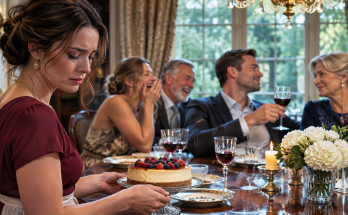
I included the family dinner where Helga said they would make me raise the baby.
I included the meeting where Sophie refused to sign.
I wrote down Marta's admission.
I kept the timeline factual.
I did not write what I thought Julian had intended.
I wrote what happened.
That distinction mattered.
The spare bedroom remained untouched.
The white dresser stood against the wall.
The bookshelf was still empty.
The rocking chair stayed near the window.
One afternoon, I found the receipt from the crib and changing table tucked inside a drawer.
I held it for a moment.
Then I placed it in the folder with the other nursery documents.
I wasn't going to destroy it.
It was evidence of what they had planned.
It was also a reminder of what I had imagined.
Both things could be true.
A week later, Sophie asked if I could meet her for coffee.
We chose a small café near her apartment.
She arrived with a notebook and a bottle of water.
She looked more comfortable than she had at the restaurant.
Not happy exactly.
But less frightened.
“My lawyer sent a letter,” she said.
“To Julian?”
“To his lawyer.”
She opened her notebook.
“She made it clear that I haven't agreed to any transfer of custody or caregiving arrangement.”
I nodded.
“Good.”
“She also told him that he needs to stop contacting me about the document directly.”
I took a sip of coffee.
“How did he respond?”
“He said he was disappointed.”
She gave a small, tired smile.
“I told him disappointment isn't a legal agreement.”
I almost smiled.
It was the kind of sentence I wished I had learned years earlier.
Sophie looked at me.
“I want to say something.”
I waited.
“I know I hurt you.”
I looked down at my cup.
“I know you were told things that weren't true. But I still had to live with what happened.”
“I understand.”
“I don't want us to pretend we are friends because Julian lied to both of us.”
She nodded.
“I don't expect that.”
“But I don't want the baby caught in the middle of a fight between adults.”
“Neither do I.”
She placed her notebook on the table.
“I've made my decision. I'm going to raise my child.”
“Then I hope you have the support you need.”
“I have my sister. She's helping me prepare.”
I was glad she had someone.
She asked whether I had decided what I would do about Julian.
I looked through the window.
A man was helping a little girl zip her jacket.
The child kept pulling the zipper down again.
He laughed and started over.
It was an ordinary moment.
It made me think about the kind of family I had wanted.
“I don't think I can stay married to him,” I said.
Sophie didn't react.
She simply nodded.
“I understand.”
I looked back at her.
“I haven't finished the legal process. But I know I can't go back to pretending.”
She rested her hand on her notebook.
“That's probably the first honest decision any of us has made.”
I didn't disagree.
After coffee, we said goodbye.
There was no promise to stay in touch.
There was no sudden friendship.
We had a shared problem, and we had both made choices about it.
That was enough.
At home, Julian was waiting in the living room.
He had taken the family photographs off the mantel.
They were stacked on the coffee table.
I looked at them.
There was our wedding picture.
A vacation photo from the coast.
A picture of us standing beside the Christmas tree.
And one from a summer barbecue at his parents' house.
He picked up the wedding photograph.
“Do you remember this day?”
“Yes.”
“You were happy.”
“I was.”
He put it down.
“I was happy too.”
I believed that he had been.
That was one of the hardest things to accept.
The marriage had not been false every day.
There had been real laughter.
There had been kindness.
There had been mornings when he made coffee before I woke up.
There had been nights when we sat on the floor and talked about our future.
But those memories could not erase what he had done.
He asked me to sit.
I remained standing.
“I heard from my attorney,” he said.
“So did I.”
“He says we should try mediation.”
“I'm willing to discuss the separation through the attorneys.”
He looked up.
“Separation?”
I nodded.
He stared at me.
“You're serious.”
“Yes.”
He looked down at the wedding photograph again.
“Because of Sophie?”
“No.”
“Because of the baby?”
“No.”
“Then why?”
I thought about the answer.
Because he had lied.
Because he had used our money.
Because he had planned my responsibilities without asking.
Because he had treated my desire for a child as something he could manipulate.
Because he had expected me to accept a decision once it became difficult to refuse.
But the simplest answer was the most accurate.
“Because I don't trust you anymore.”
He put the photograph down.
“I can earn that back.”
“Maybe you can become trustworthy again. But I don't know whether I want to stay married while you try.”
He looked at me for a long time.
Then he said, “I thought we could still have a family.”
I glanced toward the hallway.
The spare bedroom door was open.
“You wanted a family that I would help build without knowing the truth.”
“I thought it could work.”
“It didn't.”
He stood.
“What about the ten years?”
“They happened.”
“What about everything we planned?”
I felt my throat tighten.
“I remember it.”
He looked like he wanted me to say something else.
Something reassuring.
Something that would give him another chance without requiring him to change anything.
I couldn't do that.
I went upstairs and closed the bedroom door.
The next morning, I packed a small suitcase.
I wasn't moving out permanently.
Ms. Patel had advised me to understand my housing position before making any major change.
I was going to stay with Denise for two nights while Julian and I arranged separate sleeping spaces.
Denise had offered.
I accepted.
I packed clothes, toiletries, work shoes, and the blue notebook with my timeline.
I left the wedding photographs where they were.
I didn't want to take anything just because I was angry.
Before leaving, I walked into the spare room.
I stood beside the rocking chair.
The pale yellow walls were still the same.
The white dresser still had an empty top.
I touched the edge of the bookshelf.
For years, I had believed that an empty room meant something was missing from my life.
Now I understood that it could simply be an empty room.
I didn't need to fill it with a child to prove that I was worthy of love.
I didn't need to raise someone else's baby to prove that I could be a mother.
And I didn't need to remain married to a man who had mistaken my patience for permission.
I closed the door.
At Denise's house, I slept in the guest room.
She left clean towels on the bed and a glass of water on the nightstand.
She didn't ask me to explain everything.
The following afternoon, Ms. Patel called.
She had received a response from Julian's attorney.
They were willing to discuss financial disclosure and a separation agreement.
The caregiving arrangement would be treated separately.
I asked whether that meant Julian had agreed not to pursue it.
She said it meant his attorney had acknowledged that it was not something he could impose on me.
That was enough for the moment.
I asked about the money.
She said they would request full records for the destination account and supporting documents for the transfers.
I wrote down the next steps.
Then I went back to work.
A few days later, Julian sent me a message.
“Sophie is due in several weeks. I hope you understand I still want to be involved with my child.”
I read it twice.
I replied:
“You should discuss parenting arrangements with Sophie through the appropriate legal process. I will not be part of the caregiving plan you created without my consent.”
He answered:
“I never wanted you to feel excluded.”
I put the phone down.
He had never understood the difference between being included and being assigned a role.
I didn't reply.
Weeks passed.
The separation discussions continued.
There were difficult conversations about the house, the joint account, and the records.
There were delays.
There were forms.
There were moments when I wanted to give up and let Julian tell the story however he wanted.
But I kept copies.
I kept dates.
I kept the bank statements.
I kept the original worksheet with my name beside the expenses.
I didn't sign anything without advice.
Sophie eventually sent me a short message.
“The baby is here. A healthy girl.”
I stared at the screen.
Then I replied:
“I'm glad she's healthy. I hope you are doing well too.”
She sent a photograph.
The baby was wrapped in a pale blanket.
Her face was turned slightly toward the camera.
I looked at the picture for a long time.
I felt sadness.
I felt relief.
I felt something close to tenderness.
But I did not feel that the baby belonged in my spare room.
She had a mother.
Sophie had made that choice.
I had made mine.
I put the phone down and went to the window.
Outside, the afternoon light fell across the pavement.
I thought about the rocking chair.
I thought about the pale yellow walls.
I thought about the years I had spent believing that the only way to have a family was to keep trying with Julian.
I no longer believed that.
I didn't know what my future would look like.
I didn't know whether I would ever become a mother.
I didn't know whether I would marry again.
But I knew I could build a life without allowing someone else to decide what I owed them.
The following weekend, I returned to the house to collect more belongings.
Julian wasn't there.
The kitchen was quiet.
The chipped blue mug sat beside the sink.
I washed it and dried it.
Then I placed it in a box with my books and a few photographs.
I walked past the spare bedroom one last time.
The rocking chair was still near the window.
I left it there for now.
I didn't know what I would do with it later.
I only knew I wasn't going to let anyone turn it into a symbol of what I had failed to become.
When I closed the front door, I checked the lock.
The small habit remained.
But this time, I wasn't locking the door because I was afraid of what Julian might say.
I was leaving because I had finally decided what I would no longer accept.
And that decision belonged to me.
The End
Read more original stories on Feel Every Story.
My Husband Thought I Was Too Clueless to Understand His Family’s Secret Language, Until One Dinner Changed Everything
Part 20 of 20