
The days after the bank meeting were uncomfortable.
I didn't hear from Dad for a while.
Mom sent a few messages.
Some were about the mortgage.
Others were about ordinary things.
She asked whether I was working the following weekend.
She mentioned that Dad needed something from the hardware store.
Then she asked whether I had changed my mind about the bank.
I answered the ordinary questions.
I ignored the loan question.
I didn't want every conversation to become another attempt to make me feel responsible.
The folder remained in the kitchen drawer.
I occasionally took it out.
Not because I wanted to upset myself.
Because I wanted to remember why I had said no.
The trust photographs were clear.
The property was assigned to Nick.
The loan application listed me as a potential co-borrower.
The signature line was empty.
Those facts didn't change.
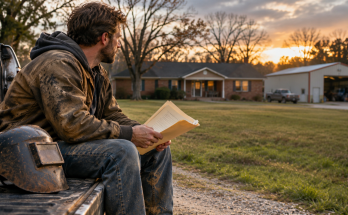
One Saturday, I drove to my parents' property.
I hadn't planned to stay long.
I wanted to see Dad and make sure he was doing all right.
The driveway looked the same.
The brick house stood behind the trees.
Nick's vehicles were parked near the workshop.
His business sign was still above the door.
I saw Dad outside.
He was carrying a small box toward the house.
I got out and walked over.
He looked at me.
For a moment, neither of us spoke.
Then he asked how work was going.
I told him it was busy.
He nodded.
I asked how he was doing.
He said he was managing.
We went inside.
Mom was in the kitchen.
She looked surprised to see me, but she smiled.
She asked whether I wanted coffee.
I said yes.
She took a mug from the cabinet.
The familiar kitchen made everything feel worse.
The refrigerator still had old family photographs.
The wooden table was still in the same place.
I remembered the Sunday dinner when I had asked for eight months to save for my own house.
I remembered Mom lowering her fork.
I remembered how quickly the conversation had become about their mortgage.
Now I knew that while I was trying to save enough to buy a modest home, my parents had been preparing documents that assigned their property to Nick.
I sat at the table.
Dad joined us.
For a few minutes, we talked about work and the weather.
Then Mom brought up the bank.
She said the January 31 deadline was getting close.
I asked whether they had spoken with the bank about other options.
She said they were considering things.
I asked whether Nick was helping.
She said he was doing what he could.
I looked toward the workshop through the kitchen window.
His business sign was visible.
I asked whether he was planning to take over the mortgage payments if he inherited the property.
Mom frowned.
She said that wasn't something we needed to discuss.
I reminded her that the trust had already answered the inheritance question.
She said the trust could be changed someday.
I asked whether they intended to change it.
She didn't answer.
Dad looked down at his coffee.
I asked him directly.
"Did you ever intend to leave me anything from that property?"
He looked uncomfortable.
He said they had made the decision they believed was best.
I asked what made it best.
He said Nick had built his business there.
I asked what I had built by paying the mortgage.
Dad didn't respond.
Mom said I shouldn't compare the two of us.
I looked at her.
She was the one who had spent years comparing our circumstances.
Nick needed help because his income was unpredictable.
I didn't need help because I had a steady job.
Nick needed a place to operate his business.
I could continue renting.
I didn't say all of that.
I was tired of explaining what was already obvious.
I finished my coffee.
Then I stood.
Dad asked whether I was leaving already.
I said I had things to do.
Mom asked me to think about the family.
I told her I had been doing that for six years.
Then I walked outside.
The workshop door was open.
Nick was working on a vehicle.
He saw me and lifted one hand.
I nodded.
I didn't go inside.
I drove back to Jonesboro.
That evening, I received a message from Mom.
She said Dad had been upset after I left.
She said I needed to understand that they were trying to protect the family home.
I read it.
Then I typed a response.
I told her I understood that they wanted to keep the property.
I also understood that they had decided Nick should receive it.
I said I wasn't going to borrow money to support that decision.
She didn't reply.
The next morning, I received another call from an unfamiliar number.
It wasn't Gerald Haskins.
I let it go to voicemail.
When I checked the message, it was a bank-related inquiry.
I didn't return the call.
I didn't want anyone treating my silence as permission to continue the application.
Later that day, I contacted Mr. Haskins.
I told him clearly that I had not agreed to be a borrower.
I asked him to make sure the file reflected that I had not authorized a credit review or signed the necessary documents.
He listened.
He said he understood.
I asked whether my name would remain on the application.
He explained that the records would reflect the information already submitted and the status of my participation.
I told him I wanted the file to show that I had declined.
He acknowledged my request.
I thanked him.
After the call, I felt calmer.
Not happy.
Just calmer.
I had finally spoken directly to the person handling the paperwork.
I didn't have to rely on Mom's explanation of what the loan meant.
I knew what the bank expected.
I knew what I had refused.
And I knew that my signature was not going to appear on that line.
That afternoon, I went to work.
I spent several hours welding.
The equipment made its familiar noise.
The work required concentration.
I found that easier than thinking about my family.
During a break, I opened my banking application.
My balance was still there.
I checked the scheduled payments.
There was no $1,850 transfer to my parents.
I didn't feel the old guilt.
I felt something closer to ownership.
It was my paycheck.
My savings.
My future.
For years, I had treated those things as secondary to keeping my parents comfortable.
Now I was beginning to understand that I had a responsibility to myself too.
When I got home, I took the yellow sticky note out of the folder.
I had photographed it already.
I looked at the empty signature line beneath it.
Then I put the note back with the application.
I didn't tear it up.
I didn't throw it away.
I wanted to remember that someone had prepared that line for me before I had agreed to anything.
The next time I was asked to sign something, I would read every page.
And I would decide for myself.
Click here to continue reading: PART 8: January Thirty-First Was Getting Closer, but I Was No Longer Willing to Rescue a Property That Had Never Been Promised to Me
For Six Years, I Thought I Was Keeping My Family Together, Until I Realized Nobody Was Saving a Place for Me
Part 7 of 20

One Comment on “PART 7 – The Yellow Sticky Note Stayed on My Kitchen Table, Reminding Me How Easily My Family Had Planned to Spend My Future”