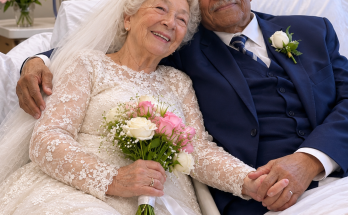
I thought planning a wedding for an eighty-nine-year-old woman would be simple.
I was wrong.
Grandma Rose had opinions about everything.
The flowers.
The dress.
The music.
The people who needed invitations.
Even the way the chairs should be arranged.
And she wasn't interested in hearing that hospice weddings usually needed to be kept small.
"I've spent enough birthdays eating cake with three people," she told me.
I was sitting beside her bed with a notebook.
"Grandma, we have to think about your energy."
"I am thinking about my energy."
She pointed at the notebook.
"Write down Lorraine."
I looked at her.
"Aunt Lorraine?"
"Do you know another Lorraine in Phoenix?"
I smiled.
"No."
"Then write her down."
Her younger sister, Lorraine, lived in Phoenix.
They had been close for most of their lives.
But distance and family disagreements had made visits less frequent.
I hadn't seen Lorraine in years.
The last time I remembered being with her was at my parents' funeral.
She had hugged Grandma for a long time.
Then she had left before dinner.
I wrote her name.
"Who else?"
"Your cousins."
I stopped writing.
"Which cousins?"
"All of them."
"Grandma, there are quite a few."
"Then your handwriting will get some exercise."
I laughed.
She didn't.
Not immediately.
Instead, she looked toward the window.
"I don't want people saying they didn't get the chance."
Something about that sentence bothered me.
I tried not to show it.
"Okay. I'll contact everyone."
"And Arthur's family."
I looked up.
"His children?"
"His children, his grandchildren, and anybody else who wants to come."
I wrote their names down as Arthur mentioned them later.
His family was surprisingly large.
He had two adult children, several grandchildren, and relatives who lived in different parts of the state.
I was beginning to understand that Grandma wasn't imagining a little ceremony.
She wanted a real wedding.
A wedding with people.
A wedding with photographs.
A wedding she could remember.
That afternoon, I started making calls.
Some relatives were surprised.
Some were emotional.
One cousin asked whether Grandma was serious.
I told her she was.
Another asked whether Arthur was someone she had known for a long time.
I explained that they had become close at the hospice.
Then came the questions I disliked most.
"Isn't she too old for that?"
"Does she really understand what she's doing?"
"Why would she want to get married now?"
I kept my answers polite.
But after the fourth conversation, I was tired of defending her happiness.
I finally told one cousin that Grandma had spent decades taking care of everybody else.
She deserved to make a decision about her own life.
There was silence on the other end.
Then my cousin said she would come.
I wrote her name down.
One by one, the invitations began taking shape.
The hardest call was to Lorraine.
I stood outside the hospice building before dialing.
She answered after several rings.
"Hello?"
"Aunt Lorraine, it's Emma."
There was a pause.
"Emma?"
"Yes."
"Oh, sweetheart. How are you?"
I swallowed.
"I'm okay. I'm calling about Grandma."
Her voice changed.
"Is something wrong?"
"No. Actually, something unexpected happened."
I explained the wedding.
At first, Lorraine didn't say anything.
Then I heard her laugh.
"Rose is getting married?"
"Yes."
"That stubborn woman."
I smiled.
"That's what I said."
"To whom?"
"Arthur. He's in room twelve."
Lorraine went quiet again.
Then she asked whether Grandma was happy.
I told her she was.
"Then I'll come," she said.
I hadn't realized how much I needed to hear that until she said it.
"Thank you."
"Don't thank me. That's my sister."
After the call, I sat in my car for several minutes.
I thought about the last time I had seen Lorraine.
I remembered her standing near the funeral home's entrance, holding Grandma's coat.
I remembered Grandma trying not to cry.
They had both lost someone that day.
And somehow, years later, they were going to meet again because Grandma wanted to get married.
It felt right.
The next few days were busy.
I spoke with the hospice staff.
They explained that Grandma's condition could change from one day to another.
There were mornings when she was alert and talkative.
There were afternoons when she needed several hours of rest.
The nurse suggested choosing a time when Grandma usually had the most energy.
We settled on Saturday.
Late morning.
The ceremony would take place in her room.
Arthur's room would be prepared nearby, and the staff would help arrange the beds so they could be together.
I asked whether that was really possible.
The nurse smiled.
"We've arranged weddings before. We'll do our best."
I thanked her.
Then I called Arthur's daughter.
She was delighted.
She said her father had been happier in the past few weeks than she had seen him in years.
"He talks about Rose constantly," she told me.
I laughed.
"Grandma talks about him too."
"Does she?"
"Mostly his crossword mistakes."
His daughter laughed.
"That sounds like Dad."
She promised to bring flowers.
I wrote that down.
Flowers.
Another thing Grandma wanted was a particular kind of dress.
She didn't want anything extravagant.
She wanted ivory.
Something comfortable.
Something with sleeves.
And buttons that wouldn't be difficult to fasten.
I spent two afternoons looking.
I visited several stores.
Some dresses were too heavy.
Some had complicated backs.
One looked beautiful on the hanger but would have been uncomfortable for someone who spent much of the day in bed.
I finally found one with soft fabric, delicate lace, and small buttons.
It wasn't a designer dress.
It didn't need to be.
When I brought it to the hospice, Grandma touched the sleeve.
"Oh."
I watched her face.
"Do you like it?"
She rubbed the lace between her fingers.
"It's lovely."
I smiled.
"Then it's yours."
She looked at me.
"You're spending too much money."
"I'm not."
"Emma."
"Grandma."
She narrowed her eyes.
I narrowed mine back.
Then she laughed.
"You're getting difficult."
"I learned from the best."
She lifted the dress slightly.
For a moment, she didn't say anything.
Then she asked me to put it away carefully.
I folded it and placed it in a garment bag.
She watched me.
"Do you remember your graduation?"
I nodded.
"Of course."
"I used those old rollers in your hair."
I smiled.
"You burned my ear with the curling iron."
"I did not."
"You absolutely did."
"You moved."
We both laughed.
She looked at the dress again.
"I want my hair done that way."
"With the rollers?"
"Yes."
"I can do that."
"Good."
There was a softness in her expression that I hadn't seen in a long time.
She looked almost shy.
It reminded me of the way she used to smile when someone gave her flowers.
I put the garment bag away.
Then she asked me something unexpected.
"Did you find the veil?"
I looked at her.
"The veil?"
"Well, I'm getting married. I need a veil."
I laughed.
"Of course."
She smiled.
"And a bouquet."
"Anything else, Your Majesty?"
"Better shoes."
I wrote that down too.
That evening, I called Lorraine again.
We discussed the travel arrangements.
She said she would arrive on Friday.
She also asked whether there was anything special she should bring.
I told her Grandma hadn't requested anything.
Then Lorraine said something that made me pause.
"Does Rose still keep all those old photographs?"
I looked toward the garment bag.
"I think so."
"She always had a photograph tucked away somewhere."
I smiled.
"That's Grandma."
Lorraine laughed quietly.
"Some things never change."
I almost asked what she meant.
But then she started discussing her flight.
So I let it go.
Looking back, I wish I had asked.
Not because I could have changed anything.
But because I would have understood sooner that this wedding meant more to Grandma than simply wearing a beautiful dress and exchanging promises.
The following day, I visited her during the afternoon.
She was resting.
The newspaper was folded on her bedside table.
Arthur's crossword was beside it.
A small vase of flowers stood near the window.
I pulled a chair close.
She opened her eyes.
"You're here."
"Of course."
"Did you call everyone?"
"Almost."
She smiled.
"Good."
I took her hand.
Her skin felt thinner than I remembered.
"Grandma?"
"Yes?"
"Are you sure you're not doing too much?"
She turned toward me.
"I've spent most of my life waiting for the right moment to do things."
She looked at the ceiling.
"Sometimes the right moment doesn't wait for you."
I didn't answer.
She squeezed my hand.
"Don't make my wedding into a sad occasion, Emma."
"I won't."
"Promise?"
"I promise."
She closed her eyes.
A few minutes later, Arthur appeared at the doorway.
He was holding two cups.
"Am I interrupting?"
Grandma opened one eye.
"Only if you've brought the wrong tea."
Arthur smiled.
He handed me one cup.
Then he placed the other on her table.
I watched him adjust the blanket around her feet.
It was a small movement.
An ordinary one.
But it told me something.
He wasn't there because he felt sorry for her.
He was there because he cared.
And Grandma knew it.
When I left that afternoon, I looked back through the doorway.
They were holding hands again.
Neither of them was speaking.
They didn't need to.
For the first time, I felt less frightened about Arthur becoming part of her life.
I was beginning to understand that loving someone didn't mean keeping every part of them for yourself.
But I still didn't understand why Grandma wanted so many people at that wedding.
Click here to continue reading: PART 3: I Used the Same Hair Rollers Grandma Had Saved Since My Graduation, While She Prepared for a Wedding Nobody Expected Her to Reach
When My Eighty-Nine-Year-Old Grandmother Announced She Was Getting Married, I Thought Grief Had Finally Taken Something From Her
Part 2 of 20