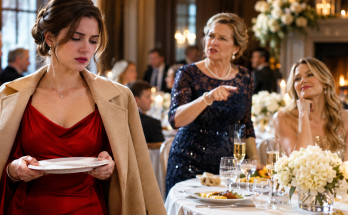
I didn't know where to go at first.
I sat behind the steering wheel with the engine running.
The snow was collecting on the windshield.
Eli was quiet beside me.
I looked at him and tried to think of somewhere he would feel safe.
Then I thought about Grandma.
She lived in Asberry, about two hours away.
She was eighty-one years old.
After Grandpa died, she had married Frank, a retired mechanic who seemed to own more cowboy boots than ordinary shoes.
He wore them all year.
Even when the weather made more sensible footwear seem appropriate.
Eli loved him.
He loved Grandma even more.
Whenever we visited them, he never seemed worried about whether he was welcome.
He could talk.
He could laugh.
He could ask questions without checking the adults' faces first.
I remembered that.
I turned toward him.
“We're going to visit Grandma.”
His expression changed slightly.
“Right now?”
“Yes.”
He didn't ask why.
I don't know whether he understood that I needed somewhere to go just as much as he did.
We started driving.
The snow made the road increasingly difficult.
I kept both hands on the steering wheel.
Every so often, I checked the mirror to make sure Eli was comfortable.
He watched the falling snow.
Neither of us talked much.
I kept thinking about the dining room.
My mother's expression.
Rachel's silence.
My father's complete lack of interest.
And Natalie's words.
I couldn't understand how someone could look at a child and say something designed to make him question his place in the world.
Especially a child who had already lost his father.
Aaron had been gone for years.
I had become a widow at thirty-one.
There had been no preparation for that kind of loss.
One day, I had a husband.
Then I didn't.
One day, Eli had a father who loved him.
Then he had to grow up remembering someone who couldn't come home.
I had tried to make his life as steady as possible.
I worked full-time.
I paid the rent.
I handled the bills.
I made sure he had what he needed.
Our apartment wasn't large.
We lived in a one-bedroom rental.
But it was our home.
I never wanted Eli to feel that we were missing something simply because our circumstances had changed.
I didn't want him to feel less important than other children.
And I certainly didn't want him to think that he had to earn his place in a family.
Yet my parents had allowed him to hear exactly that.
I gripped the steering wheel more tightly.
I was angry.
But beneath the anger was something worse.
Disappointment.
I had spent so much time trying to maintain a relationship with my parents that I had stopped asking whether that relationship was good for us.
I had convinced myself that their behavior was simply how they were.
They could be demanding.
They could be unkind.
They could make comments about my circumstances.
But they were still my parents.
That was the excuse I used.
It was also the excuse that kept costing me money.
Because the truth was that I had become responsible for expenses that weren't mine.
My parents called whenever something went wrong.
Sometimes it was a utility bill.
Sometimes their bank account was overdrawn.
Sometimes there was an emergency that needed money immediately.
I rarely asked questions.
I sent what they requested.
I told myself they needed help.
Meanwhile, I was raising my son alone and managing our own expenses.
They still had their country club membership.
They still maintained the lifestyle they wanted.
I was the one expected to make sure nothing fell behind.
And I had done it.
Again and again.
I didn't tell Eli any of that during the drive.
He was too young to carry those problems.
He had already carried enough.
The road seemed longer than usual.
Eventually, we reached Asberry.
I recognized the way to Grandma's house.
I had driven there many times.
We hadn't called ahead.
I didn't have the energy to explain anything over the phone.
I just wanted to get inside.
When we reached the house, I parked.
Frank answered the door.
He was wearing flannel pajamas.
In one hand, he had a beer.
In the other, half a gingerbread cookie.
He looked at me.
Then he looked at Eli.
Then he looked at my face again.
He didn't ask a dozen questions.
He turned toward the house and called out that we needed some attention.
Grandma appeared almost immediately.
She came hurrying across the cold tile without even putting on shoes.
Her feet were bare.
She looked at me and understood that something was wrong.
She didn't begin with questions.
She came close and held me.
That was enough to break whatever control I had been trying to maintain.
I started crying.
Not the quiet kind of crying I could hide.
I couldn't stop.
Grandma held me while Frank took Eli toward the kitchen.
He was going to make him hot chocolate.
I heard Eli asking something about the gingerbread cookie.
Frank answered him.
Their voices moved farther away.
Grandma guided me toward the living room.
She sat beside me.
Then she waited.
I couldn't explain everything immediately.
I had too many things running through my mind.
I kept thinking about how embarrassed Eli must have felt.
How he had looked at me.
How he had asked whether he had done something wrong.
Grandma didn't rush me.
Eventually, I began talking.
I told her about Christmas dinner.
I told her what Natalie had said.
I explained that the child had repeated something my mother had apparently told her.
I told her about the second comment.
The one suggesting Eli wasn't really my son.
The one connecting his existence to the attention I supposedly wanted after Aaron died.
I watched Grandma's face while I spoke.
She didn't interrupt.
She didn't defend my mother.
She didn't suggest that Natalie was too young to understand.
She simply listened.
I told her that my mother had laughed.
I told her Rachel had said nothing.
I told her my father hadn't even looked up.
I also told her we had left.
Nobody had come after us.
Nobody had called.
Nobody had asked whether Eli was all right.
I looked down at my hands.
“I don't know what I did to make them hate us so much.”
Grandma turned toward me.
She didn't answer immediately.
I was still crying.
She reached for my hand.
Then she asked me about something else.
How were we managing?
How was work?
Was the apartment still all right?
Were the bills becoming difficult?
I answered honestly.
I told her I was doing what I could.
I had a full-time job.
I was paying for everything Eli and I needed.
We weren't living comfortably, but we were managing.
Then I told her about my parents.
That was harder.
I explained that I had been helping them financially.
Not occasionally.
Regularly.
Their utility payments had become something I handled.
They had asked me to cover overdrafts.
There were always emergencies.
I didn't think of the money as something I was lending anymore.
I thought of it as something I was expected to provide.
Grandma's expression changed.
I told her they had a country club membership they continued to maintain.
I told her how often they asked me for money despite the fact that I was living in a small rented apartment and raising Eli alone.
I had never asked them to pay our rent.
I had never demanded that they support us.
But somehow, I had become the person responsible for their financial problems.
I looked at Grandma.
“I just kept thinking they were my parents.”
She listened.
Then she nodded.
There was no dramatic speech.
No attempt to make me feel foolish.
She simply sat there, holding my hand.
For the first time that day, I felt that someone was taking my pain seriously.
I glanced toward the kitchen.
Eli's voice drifted into the living room.
He sounded more comfortable.
That helped.
Grandma followed my gaze.
Then she looked back at me.
She stood up.
“I'll be right back.”
I thought she was going to get tissues.
She walked down the hallway toward her bedroom.
I remained on the sofa.
I could hear the fireplace.
I could hear Frank moving around in the kitchen.
I wiped my face and tried to calm down.
A few moments later, Grandma returned.
She wasn't carrying tissues.
She was holding a thick white envelope.
She walked directly toward the coffee table.
Then she placed it in front of me.
I looked at it.
I didn't understand.
Grandma sat down.
She pushed the envelope slightly closer.
“This belongs to you.”
I stared at her.
“What is it?”
She didn't explain.
She simply told me to open it.
Click here to continue reading: PART 3: The White Envelope on Grandma’s Coffee Table Contained Something I Had Never Imagined She Would Give Me
The Christmas Dinner Where My Son Learned What His Grandmother Really Thought About Him
Part 2 of 24