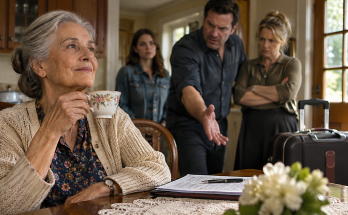
I never imagined my own son would one day pack my suitcase and decide where I would spend the rest of my life.
But that was exactly what happened.
He stood in my kitchen with his arms crossed, looking at me as if I were an inconvenience he had finally found a way to remove.
My suitcase was beside the front door.
A nursing home brochure sat on top of it.
There was a little piece of paper tucked inside the brochure with a room number written in red ink.
I looked at it for a long time.
Then I looked at Greg.
"Mom, we're not doing this forever," he said.
I was sitting at the kitchen table with my tea.
I had made it the way Walter used to like it, with just a little milk and no sugar.
Greg pushed a document toward me.
"All you have to do is sign the house over. The arrangements are already made."
I looked at the paper.
Then I looked at my son's face.
He seemed impatient.
Not nervous.
Not embarrassed.
Impatient.
As though I were making him late for something.
"What if I don't sign it?" I asked.
He sighed.
"Don't make this difficult."
I took another sip of tea.
"First, you should ask the man who owns this house."
Greg laughed.
It was a short, unpleasant laugh.
"Mom, Dad has been dead for two years."
I knew that.
I had buried my husband.
I had held his hand in the hospital.
I had watched the machines become quiet.
I knew Walter was gone.
But Greg misunderstood what I meant.
He thought I was talking about the man who had built the house.
And in one way, he was right.
Walter had built it.
But that did not mean Greg owned it.
Not anymore.
I did not explain.
I simply returned my attention to my tea.
Greg shook his head and walked out of the kitchen.
Dana, his wife, followed him.
I heard them whispering in the hallway.
Then I heard the bedroom door close.
My suitcase remained beside the entrance.
I looked at it again.
It was an old brown suitcase with a broken handle.
Walter had bought it for me before our twenty-fifth anniversary.
I had never used it much.
I certainly had never imagined my son would use it to prepare me for a nursing home.
Two years earlier, everything had been different.
Walter and I had lived in that house for nearly fifty years.
He built it in 1974.
We did not have much money then.
He worked long days, sometimes coming home with his hands covered in dust and his shirt soaked with sweat.
On weekends, he worked on the house.
I remember bringing him sandwiches while he stood on a ladder.
I remember the sound of his hammer.
I remember the smell of fresh wood.
There were days when he came inside so tired he could barely lift his arms.
But he never complained.
Whenever I asked him why he worked so hard, he always gave me the same answer.
"One day, we'll sit on that porch and know we built something that belongs to us."
And we did.
We raised our son there.
We celebrated birthdays there.
We buried our family dog beneath the old maple tree.
We watched the neighborhood change.
The little grocery store became a pharmacy.
The empty field across the street became a row of expensive houses.
And our home remained.
Walter used to say the walls remembered everything.
I believed him.
When he died, I thought the hardest part of my life had already happened.
I was wrong.
Three days after his funeral, Greg arrived with a moving truck.
I was still wearing black.
There were flowers on the dining room table.
The sympathy cards had not even been put away.
Greg came through the front door with Dana behind him.
He hugged me.
Then he looked around the living room.
"Mom, you shouldn't be here by yourself."
I remember how grateful I felt when he said that.
I had spent two nights waking up and reaching toward the empty side of the bed.
The silence was unbearable.
Having my son nearby sounded comforting.
Dana smiled and placed her handbag on the sofa.
"We'll help you get settled again," she said.
I thought she meant they would visit more often.
I did not understand what she meant.
By the following weekend, they had brought boxes.
Greg said it was temporary.
Dana said it would be easier if they moved some things into the spare room.
I agreed.
I wanted to believe I was doing the right thing.
After all, he was my son.
I had changed his diapers.
I had stayed awake when he had a fever.
I had worked extra hours so he could have school clothes that fit.
How could I refuse him a place to stay?
The first room they took was the guest bedroom.
Then they decided the master bedroom was more practical.
Greg said he needed space for his work clothes.
Dana said the bathroom downstairs was too small for both of them.
I listened.
I moved my things.
My bedroom became theirs.
My sewing room became mine.
And my bed became a folding bed.
I told myself it was temporary.
That word followed me for months.
Temporary.
A few weeks later, I noticed Dana had started rearranging the kitchen.
She moved my favorite plates into a cabinet I could barely reach.
She put her expensive coffee machine where Walter's old bread box used to sit.
I asked her if she could leave the bread box there.
She looked at me as though I had asked for something unreasonable.
"We need the counter space."
I moved it.
At Thanksgiving, Dana invited her sister and several friends.
I spent the morning preparing food.
I made Walter's favorite stuffing.
I baked two pies.
I even polished the silver serving spoons he had bought me for our thirtieth anniversary.
When everyone sat down, Dana raised her glass.
"To our new home," she said.
Everyone smiled.
I looked at her.
Our home.
Those two words stayed with me.
Nobody corrected her.
Not even Greg.
I kept serving the food.
I told myself it was only a way of speaking.
But something had changed.
After Thanksgiving, Greg began asking about my pension.
At first, it was a casual question.
"How much comes in each month, Mom?"
I told him.
He nodded.
Then he said the household expenses were getting higher.
He explained that electricity, water, groceries, and maintenance all cost money.
I agreed.
I had lived in that house long enough to understand bills.
But the following month, he asked me for three hundred dollars.
"Everybody has to contribute," he said.
I looked at him.
"Of course."
He held out his hand.
I transferred the money.
The next month, he asked again.
And the month after that.
Three hundred dollars became part of my monthly routine.
I stopped buying little things for myself.
I stopped going to the hairdresser as often.
I even began checking grocery prices more carefully.
Meanwhile, Greg bought a new truck.
It was a large, shiny vehicle that barely fit in the driveway.
Dana told me they deserved something nice after all the stress of helping me.
I did not answer.
Looking back, that sentence makes me ashamed.
Not because I believed her.
Because I was afraid to challenge her.
I was afraid of losing the only family I had left in that house.
One evening, I stood in the sewing room looking at an old photograph of Walter.
He was standing beside the house in 1974.
His shirt sleeves were rolled up.
His hands were dirty.
He was smiling.
I touched the frame.
"I wish you were here," I whispered.
The folding bed creaked beneath me.
I turned off the lamp.
For a long time, I listened to the sounds of my son and his wife moving around in the bedroom that had once belonged to us.
I thought about the house.
About the years.
About the man who had built it.
And I wondered when exactly I had become a guest in my own home.
Click here to continue reading: PART 2: The Conversation I Heard After Midnight Changed Everything, And By Sunrise I Had Made A Decision My Son Would Never Expect
My Son Thought He Had Inherited Everything, But He Had Forgotten One Important Thing About the House His Father Built
Part 1 of 20