The next few days were quiet.
I went to work.
I paid my rent.
I bought groceries and washed my clothes.
I kept the same small routine I had built over the years.
My parents didn't call.
I didn't call them.
At first, the silence made me uneasy.
I kept checking my phone.
Then I stopped.
I began to understand that silence didn't always mean something terrible was about to happen.
Sometimes it was just silence.
A week later, Mom sent me a message.
"Your father and I spoke with Steven."
I read it while sitting at my kitchen table.
She continued.
"He knows we can't keep paying for everything."
I waited for the rest.
A second message appeared.
"We're going to have to make some changes."
I stared at the screen.
I didn't know exactly what changes meant.
I didn't know whether they would sell the car, refinance it, or find another way to manage the payments.
That was their decision.
I wasn't going to make it for them.
I typed, "I hope you can work it out."
I considered adding more.
I considered asking whether Steven had agreed to help.
I considered asking whether Dad had apologized for the things he said.
But I didn't want to turn a simple message into another negotiation.
I sent those six words.
Mom replied with a heart.
I put the phone down.
It wasn't an apology.
It wasn't a new beginning.
But it was the first message in a while that didn't ask me for money.
A few days later, she called.
I answered while I was walking home.
"Hi, Mom."
"Hi, Adam."
Her voice sounded different.
Still tired.
Still careful.
But not as urgent.
"How are you?"
I stopped beside the sidewalk.
"I'm okay. How are you?"
"We're managing."
I waited.
She didn't mention the car.
She didn't mention the bills.
For a moment, neither of us knew what to say.
Then she asked, "Are you still working at the same place?"
"Yes."
"Do you like it?"
"It's all right. I'm learning a lot."
"That's good."
Another pause.
She asked about my apartment.
I told her I was still there.
She asked whether I had enough space.
I laughed softly.
"It's small, but it works."
"Do you still have that couch?"
I looked toward my living room.
The secondhand couch was still against the wall.
One cushion had started to sink.
"Yes. It's still here."
"I remember you bought it when you first moved."
I hadn't expected her to remember.
"Phil helped me move it."
"Right."
The conversation was awkward.
It didn't repair anything.
But for once, we were talking about something other than Steven's problems.
After a few minutes, Mom said, "I should have asked about your life sooner."
I stopped walking again.
The words were quiet.
I didn't know what to do with them.
"Yes," I said. "You should have."
She didn't argue.
She didn't tell me she had done her best.
She didn't say I was being unfair.
She just breathed into the phone.
"I'm sorry," she said.
I looked at the street ahead of me.
Cars passed.
Someone was locking the door of a shop.
I had imagined hearing those words for so long that I thought I would feel something dramatic when they finally came.
I didn't.
I felt sad.
And relieved.
And a little angry that it had taken so many years.
"Thank you for saying that," I told her.
"I know it doesn't fix everything."
"No, it doesn't."
"I don't know how to make it right."
I thought about the birthdays.
The Christmas presents.
The school concert.
The science fair trophy.
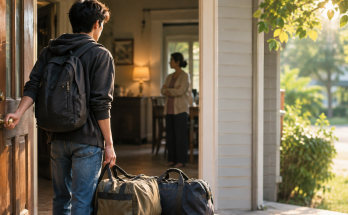
The two bags by the front door.
I thought about the restaurant where she had asked me for help.
I didn't want to pretend those things had disappeared.
"I don't know either," I said.
She started crying softly.
I let her cry.
This time, I didn't rush to make it stop.
After a while, she said, "I miss you."
"I miss having a mother I could talk to."
She was quiet.
I continued.
"I don't want every conversation to be about a problem. I don't want to be contacted only when someone needs something."
"I understand."
"I need you to ask about me because you want to know. Not because you want to ask for help afterward."
"I will try."
I knew trying wasn't the same as changing.
But I also knew I didn't have to decide the future of our relationship during one phone call.
"We can talk again," I said.
"I'd like that."
We said goodbye.
I continued walking.
When I reached my apartment, I put my keys on the table and took off my shoes.
The room was quiet.
I looked at the couch.
I remembered the first night I had slept there.
I had been eighteen.
My bags were still unpacked.
The kitchen had only a few dishes.
I had been scared.
But I had also felt something I hadn't felt at home.
I had felt that my life belonged to me.
I went to the kitchen and poured a glass of water.
Then I sat down.
I thought about Steven.
I didn't know how he was handling the car payments.
I didn't know whether he had finally understood what his parents had been doing for him.
I hoped he would learn to take care of himself.
I hoped my parents would learn to stop rescuing him from every consequence.
But I couldn't control any of that.
I could only decide what I would do.
And I had already decided.
I wasn't going to pay for the car.
I wasn't going to take over bills I hadn't created.
I wasn't going to give money just to prove I was a good son.
If my parents wanted a relationship with me, it would have to be a relationship between people who could speak honestly.
Not a permanent arrangement where I was expected to be strong enough for everyone.
A month passed.
Mom called once.
She asked about my work.
She told me Dad had been fixing something in the garage.
She mentioned that Steven was trying to manage more of his own expenses.
I listened.
I didn't ask for details.
I didn't need to supervise their choices.
The next time she called, we spoke for ten minutes.
Then fifteen.
Some conversations were awkward.
Some ended quickly.
There were still things we hadn't discussed.
Dad and I hadn't spoken again.
I didn't know whether he would ever apologize.
I stopped trying to predict it.
One evening, I found an old photograph in a drawer.
It showed me and Steven in the backyard.
I was eight.
He was seven.
We were sitting on the ground with a pile of toys between us.
I remembered showing him the hiding place behind the garage.
I remembered wanting him to feel safe.
I looked at the photograph for a while.
I didn't blame that little boy.
He had needed a family.
So had I.
I put the photograph back in the drawer.
Then I turned off the kitchen light.
The next morning, I woke up early.
I made coffee.
I packed my lunch.
I checked my rent payment and the balance in my account.
Everything was where it needed to be.
There was nothing extraordinary about the day.
And that was enough.
Five years earlier, I had walked out of my parents' house carrying two bags.
I had thought leaving would make them notice what they had been doing.
For a long time, I believed that if I stayed away long enough, they would finally understand.
But I couldn't build my life around waiting for that moment.
I had spent too many years hoping to be seen.
I didn't want to spend the rest of my life asking for permission to matter.
My parents might change.
They might not.
Steven might grow into someone who could take responsibility.
He might need more time.
Those were their lives to live.
Mine was finally mine.
And when I closed the door behind me that morning, I wasn't leaving anyone.
I was simply going to work.
PART 20 END
The End
Read more original stories on Feel Every Story.
I Thought Being the Older Brother Meant Making Room for Someone Else, Until I Realized There Was No Room Left for Me
Part 20 of 20