The telephone rang while I was preparing lunch for the daycare children.
I remember the smell of canned tomato soup.
I remember a little boy spilling milk across the table.
And I remember hearing a stranger ask whether I was Jan Gaither.
He introduced himself as a deputy sheriff from Oregon.
He asked whether I had a younger sister named Karla.
My stomach tightened.
"Yes. Is she all right?"
There was a pause.
A long one.
Then he explained that there had been a serious accident on a mountain road.
A vehicle had burned.
They had recovered a purse and identification belonging to Karla.
The deputy told me they believed she had died.
I didn't hear the rest of his explanation.
I remember holding the telephone against my ear.
I remember looking at the soup pot.
I remember thinking that Karla had promised to write again.
Then the deputy asked about arrangements.
I called Daddy immediately.
He listened without interrupting.
When I finished, he placed the telephone down.
"She made her choices."
I stared at him.
"She's our daughter."
"She left this family."
"Daddy, she's dead."
He looked toward the window.
He wouldn't travel to Oregon.
He wouldn't even discuss it.
I wanted to scream at him.
Instead, I went home and told Leland.
My husband had always been a steady man.
He worked at the farmers co-op.
He fixed things around the house without being asked.
He rarely raised his voice.
When I told him what had happened, he put down the newspaper.
I began crying before I finished the story.
"I have to go get her," I said.
Then I looked toward the living room.
Three children were sleeping in their beds.
Six more would arrive the next morning.
"I can't leave these babies, Leland. I don't know what to do."
He came over and rested his hand on my shoulder.
"Then I'll go."
I looked at him.
"That's a long drive."
"I know."
"You'll be going alone."
"I'll manage."
He didn't make a speech.
He didn't tell me everything would be fine.
He simply started preparing his old pickup.
The next morning, he left before sunrise.
I watched him disappear down the gravel road.
For nine days, I barely slept.
Every evening, I sat beside the telephone.
I kept Karla's postcards on the table.
I read them until I knew every word.
The children asked why I was sad.
I told them Aunt Karla had gone on a long trip.
I couldn't explain anything more.
On the ninth day, I heard the pickup coming up our driveway.
I ran outside.
Leland climbed out slowly.
He looked exhausted.
His clothes were dusty.
There was a small cardboard box on the passenger seat.
And beside it sat a little cedar container.
I knew immediately what it was.
I walked toward him.
He opened his arms.
I fell against his chest.
"Did you find her?"
He nodded.
"Yes, honey."
"Was she alone?"
He looked away.
"I brought her home."
I wanted details.
I wanted to know what happened.
I wanted to know whether she had been afraid.
But Leland looked so tired that I couldn't bring myself to ask everything at once.
He handed me the cedar box.
It was smaller than I expected.
I held it against my chest.
There was no way to make sense of the fact that my little sister could fit inside something I could carry with both hands.
I cried until my face hurt.
Leland stayed beside me.
A few days later, we buried the box next to Mama in Mountain Grove cemetery.
Daddy stood at the back.
He didn't cry.
He barely looked at the grave.
Leland held my hand throughout the service.
When the minister finished, my husband leaned toward me.
"She's home now, Jan."
I couldn't answer.
He squeezed my fingers.
"Let her rest."
I thought those words were kind.
I thought he had done something extraordinary for me.
And for forty-two years, I believed that was the end of Karla's story.
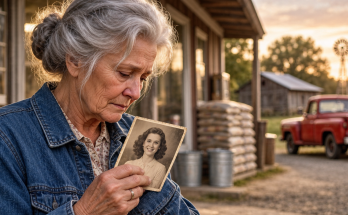
Her high school photograph went on the piano.
She was wearing a white blouse.
Her hair was pulled back.
She had that same mischievous expression I remembered from childhood.
I placed the photograph beside the telephone.
Next to it sat a little jar where I kept the money from selling eggs.
I never moved either one.
Every anniversary, Leland told me I was still the most important person in his life.
He had been a good husband.
We raised our children.
We worked hard.
We grew older together.
He spent thirty-eight years at the co-op and never missed a workday.
He wasn't a man who enjoyed gossip.
He wasn't a man who lied easily.
At least, that's what I believed.
Sometimes, when I looked at Karla's photograph, I wondered what her life might have become.
Whether she had married.
Whether she had children.
Whether she ever thought about me.
I wondered whether she had forgiven me for not going to Oregon myself.
That question hurt more than I admitted.
I had spent years explaining my absence to a girl who could no longer hear me.
One evening, I asked Leland whether he remembered the journey.
He looked up from his newspaper.
"Of course."
"Was it difficult finding the people?"
"Not especially."
"Did they tell you much?"
He folded the newspaper.
"Jan, that was a long time ago."
I nodded.
I didn't want to upset him.
I didn't know then that his answer would become important.
I didn't know that the little cedar box on my mind would soon become the reason I questioned everything about my marriage.
And I certainly didn't know that somewhere in Hartville, a woman with green eyes was about to call me by the name my sister had given me as a child.
Click here to continue reading: PART 3: Forty-Two Years After the Funeral, a Woman With Familiar Eyes Made Me Question the Story I Had Believed All My Life
The Stranger Behind the Counter Knew the One Name I Had Kept Buried in My Heart for Forty-Two Years
Part 2 of 20