The next morning, I saw Chad before he saw me.
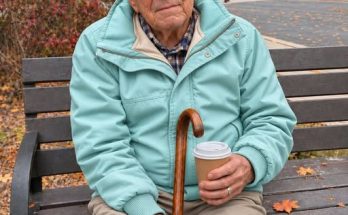
He was sitting on his usual bench.
His blue coat was buttoned all the way up, and his cane rested against his knees.
I approached slowly.
I had spent part of the previous evening thinking about how ridiculous it was that I was planning a conversation with someone who barely acknowledged my existence.
Still, I had decided to try.
"Good morning, Chad."
His head turned.
His eyebrows pulled together.
For a moment, he looked genuinely suspicious.
"Where did you get that name?"
I almost smiled.
It was the longest sentence he had spoken to me.
"I heard one of the nurses say it yesterday."
He continued looking at me.
I could tell he was deciding whether he believed me.
Then he made a face.
"You pay attention to too many things."
I laughed quietly.
"I suppose I do."
He looked back toward the entrance.
That seemed to be the end of the conversation.
But I didn't mind.
At least now I knew his name.
Chad.
It suited him somehow.
A little sharp.
A little stubborn.
Not especially welcoming.
I continued toward the entrance, thinking about his reaction.
I hadn't expected him to be friendly.
But I also hadn't expected him to question me as though I had been investigating him.
Looking back, I think he was used to people noticing him without actually caring about him.
Perhaps he had learned to be suspicious of attention.
Perhaps he simply didn't like strangers.
I couldn't know.
And I didn't want to make assumptions.
The following morning, I passed him again.
He was looking down at his hands.
I greeted him.
He didn't answer.
I didn't stop.
That became our arrangement for a little while.
I said hello.
He acknowledged me when he felt like it.
Some days he gave me a grunt.
Other days, nothing.
I began to recognize little details about him.
His cane had a worn handle.
His coat had a small crease near the left pocket.
He usually sat with his feet planted firmly on the ground.
And he never seemed to take his eyes off the entrance for very long.
There were plenty of people around us.
Nurses walking in and out.
Visitors carrying bags.
Patients being helped toward waiting cars.
Some people sat on nearby benches while checking their phones.
But nobody seemed to sit with Chad.
Nobody stopped to ask how his morning was going.
Nobody appeared to know him well enough to make him smile.
I noticed that.
Perhaps because I had started to feel uncomfortable about how easy it was to walk past him.
I didn't think I was doing anything extraordinary.
I wasn't.
A greeting cost almost nothing.
But I began to understand that even something small could become important when it was the only thing someone received regularly.
One morning, I arrived carrying my usual coffee.
The smell followed me as I walked toward the entrance.
Chad looked at the cup.
Only briefly.
But I noticed.
I continued walking.
The next day, he was there again.
His expression hadn't changed.
Neither had mine.
"Morning, Chad."
He gave a short grunt.
I was getting used to it.
Then the weather changed.
The mornings became colder, and the wind outside the hospital made standing still uncomfortable.
I noticed Chad rubbing his hands together.
His fingers were red.
He kept them close to his body, occasionally moving one hand over the other.
I looked at him for a moment.
Then I looked at my coffee.
It was warm.
He had nothing in his hands except that old cane.
I continued toward the entrance, but the image stayed with me.
That afternoon, I remembered his hands.
I remembered the way he sat without moving.
And I remembered that blue coat.
The next morning, I looked at the bench before anything else.
Chad was there.
His shoulders were hunched.
His hands were resting over the cane.
I slowed down.
For a few seconds, I considered asking whether he was cold.
But I already knew the answer.
And I suspected he would tell me to mind my own business.
I almost laughed at that thought.
He had become predictable in the strangest way.
I didn't know what had happened in his life.
I didn't know why he spent so much time outside that hospital.
But I knew one thing.
I didn't want him sitting there feeling as though the entire world had forgotten he existed.
That morning, I made a decision.
I was going to do something about those cold hands.
Not because I expected a thank-you.
Not because I wanted him to become my friend.
I simply thought someone should.
And the next morning, I would have a reason to stop beside him again.
Click here to continue reading: PART 3: I Bought Two Cups Instead of One, Never Expecting That the Man Who Refused My Kindness Would Eventually Look For It
The Old Man Who Sat Outside the Hospital Every Morning Had a Way of Making Everyone Feel They Were Interrupting Something
Part 2 of 20