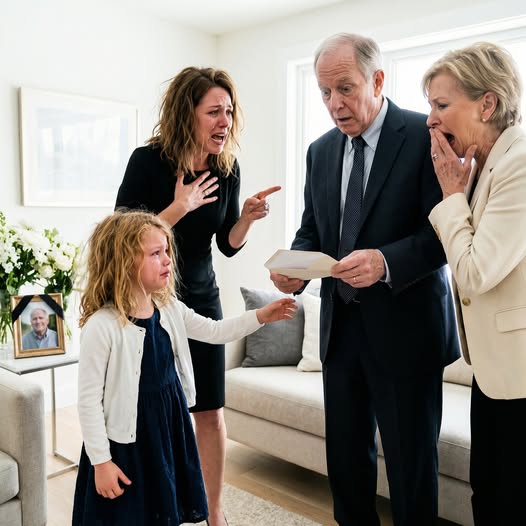
I called my parents to say my husband had died, but they were too busy celebrating my sister’s birthday. Days later, they showed up demanding half his inheritance—until my 8-year-old daughter handed them an envelope that made their hands shake.
When my husband, Ethan Cole, collapsed in our kitchen on a rainy Thursday night, I thought he had fainted from exhaustion. He had been working fourteen-hour days for months, trying to keep his small construction supply company afloat while still making it home in time to help our eight-year-old daughter, Lily, with math homework. But when I knelt beside him and saw the unnatural stillness in his face, the way his hand slipped from mine without resistance, I knew something was terribly wrong.
The paramedics tried everything. At St. Mary’s in Portland, Oregon, a doctor with tired eyes and a careful voice told me Ethan had suffered a massive aortic rupture. It was sudden. Catastrophic. There had been almost no chance.
I remember calling my parents from a plastic chair outside the ICU, my jeans damp from kneeling on the kitchen floor, my hands still smelling like Ethan’s cologne and hospital sanitizer. My mother answered on the third ring, already sounding irritated.
“Oh, Savannah, we’re at your sister Heather’s birthday dinner,” she said. “Can this wait until tomorrow?”
I thought maybe she hadn’t heard me.
“No,” I said. “He’s gone.”
In the background, I heard laughter. Glasses clinking. My father’s voice asking who was on the phone.
Then my mother said the words I would never forget.
“We’re busy tonight. Heather only turns thirty-five once.”
And she hung up.
I sat there in that hallway and stared at the dark screen until Lily crawled into my lap and asked if Grandma and Grandpa were coming. I lied and said they were on their way. I lied because she had already lost her father. I couldn’t make her lose everyone else in the same hour.
They never came. Not to the hospital. Not to Ethan’s visitation. Not to the funeral. Heather posted smiling photos from her birthday weekend in Napa while I stood beside a walnut casket explaining to my daughter why her father wouldn’t wake up.
Four days after the burial, my parents finally arrived at my house dressed in expensive beige coats, carrying the same solemn expressions people put on when they want to look grieving without actually feeling grief.
My mother didn’t hug me. My father didn’t ask about Lily.
Instead, he cleared his throat and said, “We heard Ethan had a life insurance policy and substantial business assets. Since family should share burdens and blessings, we expect half.”
I was too stunned to answer.
Before I could speak, Lily stepped out from the hallway in her navy cardigan, holding a sealed manila envelope in both hands. She looked straight at them and said, in a voice far too calm for an eight-year-old, “This is what you came for.”
My mother opened it.
The color drained from both their faces.
Their hands began to shake.
My mother gripped the papers so tightly I thought they might tear. My father leaned over her shoulder, his face losing color line by line. For the first time since they stepped into my living room, they stopped performing. The smug certainty was gone. They looked exactly like what they were: two people who had walked into the wrong house expecting easy money and found a trap waiting for them.
Inside the envelope were three things.
The first was a copy of a notarized promissory note for $187,400, signed by both of them eighteen months earlier. Ethan had loaned them the money when Heather’s boutique bakery was collapsing under unpaid rent, payroll tax penalties, and a disastrous expansion into a second location. My parents had come to us crying, saying Heather would lose everything if they didn’t move fast. Ethan, against my better judgment, had agreed to help because he said family should never drown while you stand on the dock and watch. He had insisted on paperwork, though. “Not because I don’t trust them,” he told me then. “Because money makes people forget what they promised.”
The second item was a letter from Ethan’s estate attorney, Margaret Kline. It stated clearly that the debt had been assigned back to Ethan’s estate and was now due in full within thirty days. No extensions. No informal arrangements. No family exceptions. If unpaid, the estate would proceed with a civil claim, including interest, attorney’s fees, and a petition to place a lien on my parents’ lake cabin in Bend.
The third item was what made my mother’s hands tremble the most: a transcript and audio certification from the hospital call I had made the night Ethan died. St. Mary’s automatically recorded inbound and outbound calls on patient-family coordination lines once connected through their bereavement desk. Margaret had obtained the record because Ethan, during an earlier business dispute, had taught me something important: if the truth matters, document it before someone rewrites it.
There it was in black and white.
My voice, breaking: “Mom, Ethan died.”
My mother’s reply: “We’re at your sister Heather’s birthday dinner. Can this wait until tomorrow?”
Then: “We’re busy tonight. Heather only turns thirty-five once.”
At the bottom of the page was a short note from Margaret: In light of the family’s documented indifference and their immediate financial demand following the decedent’s funeral, any future attempts to contest the estate or seek funds outside the will shall be treated as bad-faith harassment.
My father was the first to speak.
“This is insane,” he snapped. “That loan was for Heather. Ethan knew we were acting on her behalf.”
“Yes,” I said. “That’s why both of you signed personally.”
My mother finally looked up. “You would sue your own parents?”
I almost laughed at the wording. As if I had done something cruel. As if they had shown up with casseroles and comfort instead of calculators in their eyes.
“You didn’t come here as my parents,” I said. “You came here as debtors.”
Lily moved closer to me and slipped her hand into mine. I could feel how cold her fingers were. She had been quiet since Ethan died, but not absent. Children hear more than adults think. She had heard their voices at the door. She had heard my father say “fifty percent” before I even let them sit down.
My mother’s gaze shifted to Lily and softened, though not from guilt. From strategy. “Sweetheart,” she said gently, kneeling a little, “grown-ups are just having a misunderstanding.”
Lily looked at her without blinking. “You didn’t come when my dad died.”
The room went still.
My father muttered, “That’s not fair.”
“No,” Lily said, her little chin lifting, “it wasn’t.”
For a second, Ethan was everywhere. In her spine. In her voice. In that quiet refusal to pretend.
My mother stood up slowly. “Your sister had an event people had flown in for,” she said to me, the excuse sounding thinner now that it was out in the open. “We couldn’t just leave.”
“You could,” I said. “You chose not to.”
My father threw the envelope onto the coffee table. “Heather can’t pay this.”
“That’s not my problem,” I said.
“It will ruin her.”
I looked at him and felt something inside me settle with icy clarity. “Ethan is dead,” I said. “Lily lost her father. I buried my husband. You missed the funeral and came for money. So let me be very clear: I am done arranging my life around Heather’s emergencies.”
The truth was, this wasn’t new. Heather had always been the center of gravity in my parents’ world. When she totaled her third car at twenty-two, my dad called it bad luck. When I got a scholarship, my mother said not to mention it too much because it made Heather feel insecure. When Ethan and I bought our first house, my parents borrowed money for Heather’s “temporary setback” and forgot to pay us back for eleven months. Ethan had noticed the pattern long before I admitted it. He never attacked my family directly, but once, while balancing our checkbook at the kitchen counter, he said quietly, “Savannah, one day they’re going to mistake your love for permission.”
He had been right.
My mother tried one last angle. “You know Ethan wouldn’t have wanted hostility.”
I stared at her. “Ethan also wouldn’t have wanted Lily’s college fund drained to rescue people who skipped his funeral.”
That landed.
Because yes, the inheritance existed. Ethan had carried a two-million-dollar life insurance policy and owned his company outright. But that money was no jackpot. It was a structure for survival. Mortgage. Taxes. Payroll settlements. College. Grief counseling. The future Ethan would no longer be here to build with his own hands.
My father’s jaw tightened. “So that’s it? You’re turning your back on us?”
I shook my head. “No. I’m finally facing you.”
They left without another word. My mother forgot her sunglasses on the entryway table, and for one wild second I considered running after her with them out of pure habit. Then I stopped myself.
That evening, I called Margaret. She said she had expected them to react badly and had already filed notice preserving the estate’s claim. She also told me something Ethan had arranged six months earlier, after my parents asked him for another loan and he refused: he had amended his will.
Not only had he excluded my parents from any discretionary family assistance he sometimes set aside in side letters, he had written a personal statement to be opened if anyone from my side of the family attempted to pressure me financially after his death.
Margaret asked if I wanted to hear it.
I said yes.
By the time she finished reading, I was crying too hard to answer.
And I knew the worst part for my parents was still coming.
Two mornings later, I met Margaret Kline at her office downtown while Lily was at school. Margaret was one of those women who never wasted motion. Silver bob, dark suits, precise diction, no patience for emotional theater. Ethan trusted her because she respected facts more than personalities, and in that moment, facts felt like the only solid surface left in my life.
She slid a document across the conference table and folded her hands.
“This is Ethan’s statement,” she said. “It isn’t legally necessary for distributing assets, but he wanted it preserved with his estate planning file in case anyone challenged your judgment or tried to pressure you after his death.”
I took a breath and began to read.
Savannah, if you are reading this, it means I am not there to make sure people behave the way they should. So I’m going to say plainly what I’ve said to you gently for years: you do not owe loyalty to people who treat you like a backup daughter and then show up as primary creditors.
My vision blurred.
The statement went on to explain why he had structured the estate the way he did. The insurance proceeds and business assets were to flow into a revocable trust for me and Lily. The trust included living support, Lily’s education, and a provision that no loans, gifts, or “family rescues” could be made from principal to any member of my side of the family without written approval from both me and the trustee. Margaret had full authority to refuse requests she deemed manipulative, coercive, or harmful to Lily’s long-term security.
Then came the line that made me put the paper down and cover my mouth.
For the avoidance of doubt: the outstanding loan to Daniel and Monica Bennett is to be collected in full. If they ask Savannah for grace they did not extend to her in grief, the answer is no.
I sat there shaking.
Not because Ethan had been harsh. Because he had seen it all so clearly. Even while loving me, even while trying to stay respectful, he had understood the exact shape of the danger I kept minimizing. He had built guardrails for me after he was gone.
Margaret pushed a tissue box toward me and waited.
When I could finally speak, I asked, “Did he really think they’d do this?”
Margaret’s expression softened just a little. “He hoped they wouldn’t,” she said. “But he planned as though they might.”
That afternoon, my parents made their next move.
Heather posted a long message on Facebook about how “some people weaponize money in times of loss” and how “family should not be punished for being imperfect during emotionally complicated events.” She didn’t use my name, but everyone knew. There was a photo from Ethan’s funeral pulled from a relative’s page, cropped to make it look like my parents had attended. My mother commented with a broken-heart emoji. My father privately messaged two of my cousins saying I had become unstable and vindictive after Ethan’s death.
For an hour, I stared at the screen, rage moving through me so fast it made my hands numb. Then I remembered something Ethan used to say whenever a subcontractor tried to bully him into a rushed decision: “Urgency is often just somebody else’s strategy.”
So I didn’t respond online.
I sent everything to Margaret.
By six that evening, cease-and-desist letters had gone out to Heather, my parents, and the cousin who had threatened to “help them expose” me if I didn’t settle privately. Margaret also filed notice with the probate court documenting attempted coercion tied to the estate. If my parents kept pushing, they were going to leave a paper trail behind them so ugly even Heather’s favorite filter couldn’t soften it.
Then came the real shock.
Three days later, Margaret called to say a forensic review of Ethan’s business records had turned up something connected to the original loan. When Ethan transferred the $187,400, the money hadn’t all gone to Heather’s bakery as promised. Nearly sixty thousand dollars had been rerouted to pay off my parents’ personal credit cards and overdue property taxes on the lake cabin. Ethan had apparently discovered that months ago and requested backup documentation, which they never provided. He had kept the file open in case he needed to pursue fraud.
“Can they be charged?” I asked.
“Possibly, if intent can be proven,” Margaret said. “At minimum, it strengthens the civil case significantly.”
That evening, my parents came back.
Click Here to continues Read Full Ending Story👉PART2: I called my parents to say my husband had died, but they were too busy celebrating my sister’s birthday. Days later, they showed up demanding half his inheritance—until my 8-year-old daughter handed them an envelope that made their hands shake.
I called my parents to say my husband had died, but they were too busy celebrating my sister’s birthday. Days later, they showed up demanding half his inheritance—until my 8-year-old daughter handed them an envelope that made their hands shake
Part 1 of 2