The morning after the gathering, I called my attorney.
I had slept badly.
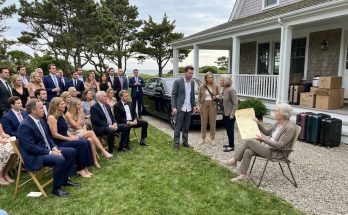
Every time I closed my eyes, I saw Cullen standing beside the suitcases, insisting that the beach house was already his.
Then I saw the cream-colored envelope.
The tape across the flap bothered me more than I wanted to admit.
I had spent years keeping important documents in their proper places.
I wasn't careless with papers that concerned my home.
When my attorney answered, I told him what had happened on September 26.
I explained that Cullen had claimed to have seen a completed deed.
I told him Miles had believed the paperwork was signed in June.
I also described the invitation Laurelai had sent to thirty-four people.
He listened without interrupting.
When I finished, he asked me to bring the envelope and all the papers connected to the property.
I agreed.
Before ending the call, he asked one question.
"Are you certain you know who opened that envelope?"
"No."
"Then we need to keep that distinction clear."
I wrote the sentence down.
I was beginning to understand how easily a suspicion could become an accusation when a family was already angry.
I wanted answers.
But I didn't want to make the situation worse by pretending I had evidence I didn't possess.
I placed the envelope inside a folder and drove to his office.
He examined the papers carefully.
He checked the document he had prepared and asked me about the conversations we had held months earlier.
I explained that I had wanted to consider a future arrangement for Cullen.
I had not wanted to transfer ownership without understanding the consequences.
That was why I had sought legal advice in the first place.
My attorney reviewed the document again.
He explained that preparation alone did not establish that I had completed a transfer.
He also made it clear that we needed to examine the actual paperwork before drawing conclusions about what Cullen had seen.
I asked whether the papers could have been mistaken for a deed.
He said he couldn't determine what Cullen had looked at without seeing the specific document he claimed to have seen.
That answer frustrated me.
I wanted something definite.
I wanted him to tell me exactly how this misunderstanding had started.
Instead, he reminded me that we had to work with what we knew.
I appreciated his honesty, even though I wanted more.
He asked whether I had signed any document transferring the house to Cullen.
I told him I had not knowingly signed such a document.
He made a note.
Then he examined the envelope.
The strip of tape was visible across the flap.
He asked whether I had kept it sealed after receiving the paperwork.
I explained that I had stored it with my other important papers and later discovered the tape.
He didn't claim that the tape proved who had opened it.
He simply noted its condition.
That mattered to me.
I had been tempted to point toward Cullen because he had the most obvious reason to want the documents.
But wanting something and taking something were different things.
I needed to remember that.
Before I left, my attorney gave me a copy of the papers for my records.
He advised me to keep the originals secure and to avoid signing anything until I understood exactly what was being proposed.
I thanked him.
On the drive home, I thought about the wedding.
I had wanted to give Cullen something meaningful on that day.
Instead, I had been excluded from it.
I wondered whether the document had become part of his expectations before I had ever spoken to him about it.
Perhaps he had heard something from someone.
Perhaps he had misunderstood a conversation.
Perhaps he had simply assumed that my plans for the future meant the house was already his.
I couldn't settle on an explanation.
When I reached home, I put the documents away.
Then I took out the invitation.
The names of Laurelai and Miles were printed at the top.
I placed it beside my attorney's notes.
It seemed strange that a formal invitation could cause so much trouble.
The paper itself was harmless.
The problem was what it represented.
People had been invited to watch an event that depended on my agreement.
No one had asked for that agreement.
That afternoon, I received a message from Blythe.
She said she wanted to talk.
I read it several times before answering.
I had no desire to fight with her.
But I wasn't ready to pretend that nothing had happened.
I told her I was willing to speak when we could have a calm conversation about the house and the decisions that had been made without me.
She replied that she hoped we could work things out.
I put the phone down.
For the first time in several days, I felt a small amount of hope.
Not because the problem was solved.
Because I had finally stopped trying to solve it by myself.
Click here to continue reading: PART 14: Blythe Wanted to Talk About Her Future, but I Needed Her to Understand That My Home Was Not Already Part of It
The Sunday Morning Call That Made Me Question Everything I Thought I Knew About My Only Son
Part 13 of 24