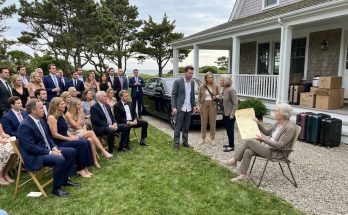
The following week, I hired someone to look at the porch railing.
I had postponed the repair because other worries kept taking up my attention.
Now I wanted to deal with the things I could see and measure.
The contractor examined the boards, checked the fastenings, and pointed out where the weather had done the most damage.
He also looked at a section of the gray roof shingles.
“Nothing here needs to be decided in a hurry,” he told me. “But it would be wise to take care of the railing before it gets worse.”
I appreciated the plainness of that advice.
I asked him to prepare an estimate.
Then I walked around the outside of the house.
The wraparound porch had been one of Nile's favorite features.
He used to sit near the blue door in the early evening and watch the light change over the water.
After the hurricane, we had spent six summers rebuilding what had been damaged.
There had been days when the work seemed endless.
We had argued about paint, lumber, and money.
We had also laughed more than I remembered laughing anywhere else.
The house was not simply an asset worth $1.94 million.
It was the record of a life we had built together.
I went inside and opened the notebook where I had written my three sentences.
Then I added another.
I could love Cullen without giving him ownership of my decisions.
I stared at that line for a while.
It sounded simple on paper.
Living by it would take more effort.
Later that afternoon, Miles called.
He asked whether I had time to talk.
I told him I did.
He said he had been thinking about the gathering and his part in it.
“I should have spoken to you directly before inviting people to your property,” he said.
“Yes, you should have.”
“I trusted what Cullen told us.”
“I understand that. But you treated his statement as though it came from me.”
He accepted that.
He did not blame Laurelai or suggest that I had misunderstood the invitation.
That made the apology easier to hear.
“I thought I was helping them begin their marriage,” he said.
“I know you may have thought that.”
“I didn't intend to disrespect you.”
“I believe you. But good intentions don't give you permission to make decisions about my house.”
He was quiet.
Then he said he understood.
I asked whether he remembered seeing the completed legal paperwork Cullen had described in June.
He said he could not remember seeing a final document himself.
He had trusted Cullen's confidence.
That was all he could tell me.
I thanked him for being honest.
We ended the call without solving the mystery of the envelope.
I did not call Laurelai.
I had nothing useful to add to the arguments we had already had.
A few days later, Blythe sent me a message asking whether we could speak.
I agreed to a phone call.
She sounded calmer than she had during our first conversation.
She told me that she and Cullen were still working out their living arrangements.
I listened without offering to change mine.
“I know the gathering went badly,” she said.
“It went badly because people were invited to watch something I had never agreed to do.”
“I understand that.”
“Do you understand why I was hurt by the wedding, too?”
She took a moment to answer.
“I know you felt excluded.”
“I wasn't only excluded. People were given a reason that made it sound as if my health kept me away.”
She said Cullen had handled the questions about my absence.
I reminded her that she had also been part of the wedding.
She did not argue.
“I should have asked you directly about the house,” she said. “I believed Cullen had already spoken to you.”
“And did you ever hear me say the house was yours?”
“No.”
I appreciated the honesty.
I told her I was not asking her to agree with every feeling I had.
I was asking her to recognize that the house was not available simply because the two of them had made plans.
She said they would not try to move in.
I told her that was the first clear statement about the house I had heard from her.
We ended the call politely.
It did not make us close.
It did make the next conversation possible.
That evening, I opened the drawer where I kept the papers Nile had left me.
I did not remove the envelope.
I had already let my attorney examine the document, and I had no reason to keep handling it.
Instead, I took out the small notebook where I had written down memories of rebuilding the house.
There were notes about the first summer, when we replaced damaged boards and worked until our hands ached.
There was a reminder about the blue paint Nile had chosen for the front door.
There was a little list of things we had promised ourselves we would do when the house was finished.
Some had been done.
Others had been forgotten.
I ran my finger over the page.
I had once imagined giving Cullen the house as a way of continuing something that mattered to his father.
I had pictured him caring for it, repairing it, and understanding what it had cost us to make it a home.
I had never imagined that he would treat the future gift as a present possession.
That difference mattered.
The next morning, I called my attorney and asked what options I could consider without committing myself.
He explained that I could keep the house, make a future arrangement if I chose, or revisit my plans later.
Any decision would need proper legal advice and clear documentation.
He reminded me not to use the house as a reward for an apology or a punishment for a mistake.
I told him I had no intention of doing either.
I wanted a decision I could live with when the anger faded.
That afternoon, Cullen called to ask about the contractor.
I told him the railing needed work.
“Would you like me to help?” he asked.
I considered it.
“Not this time. I have someone coming to do it.”
“Okay.”
He did not sound pleased, but he accepted my answer.
We spoke about ordinary things for a few minutes.
He asked whether the weather had been rough along the coast.
I told him the wind had been strong and that the porch needed more attention than I had expected.
Before hanging up, he said he hoped we could keep talking.
I told him I hoped so, too.
Then I returned to the kitchen and put the notebook away.
The house still needed repairs.
My son still needed to learn that asking was different from assuming.
And I needed to remember that a decision made freely was worth more than one made to quiet a room full of people.
Click here to continue reading: PART 24: I Kept the Keys, Protected the Home Nile and I Rebuilt, and Finally Understood What My Son Had to Learn Before Any Future Could Be Promised
The Sunday Morning Call That Made Me Question Everything I Thought I Knew About My Only Son
Part 23 of 24