
By the time the weather began to turn, the porch railing had been repaired.
The contractor had replaced the weakest boards and secured the loose section near the steps.
I stood outside while he packed his tools.
The blue door was behind me.
The gray roof stretched above the house, and the water moved steadily beyond the yard.
Nothing about the property looked different enough for a stranger to notice.
But I felt better knowing I had begun taking care of it again.
I paid the contractor and kept the receipt with the other house records.
Then I went inside and checked the locks.
They worked smoothly.
I tested the front door once, then placed my keys on the kitchen table.
I had changed those locks because Cullen and Blythe had planned to enter my home as though permission had already been granted.
I had not changed them because I wanted to erase my son from my life.
That distinction had become important to me.
I could leave a door open to a conversation without leaving my home open to an arrangement I had never approved.
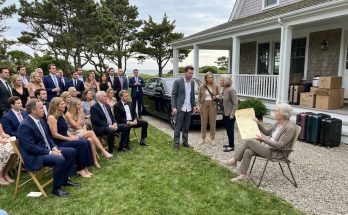
I still thought about the day the guests arrived.
I remembered Laurelai arranging the chairs.
I remembered the black car entering the driveway.
I remembered Cullen's anger when he saw his suitcases on the porch.
Most of all, I remembered his claim that the house had already been settled.
He had been so certain.
But certainty was not consent.
A prepared document was not automatically a completed transfer.
A family expectation was not an agreement.
And a gathering planned by other people could not turn their wishes into my decision.
I had needed my attorney to explain the legal distinctions carefully.
I had needed Cullen to admit that he had not asked me.
I had needed time to accept that I might never learn who opened the envelope or moved Nile's photograph.
Those questions still mattered.
They simply no longer controlled every hour of my day.
One Sunday, Cullen came by again.
He called first and asked whether I would be home.
I told him I would.
When he arrived, he brought a small paper bag from a bakery in town.
He set it on the counter.
“I didn't know what you wanted,” he said, “so I brought a few things.”
I thanked him.
We made coffee and sat together at the kitchen table.
He asked how the porch repair had gone.
I told him the work was finished and showed him the receipt.
He studied it briefly.
“Dad would have fixed that himself,” he said.
“He would have tried.”
We both smiled a little.
For a few minutes, we talked about Nile.
Cullen remembered helping him carry boards along the porch.
He remembered the blue paint on his father's hands.
I remembered how Nile had laughed when Cullen accidentally stepped into a bucket of water while trying to help.
The memories did not erase what had happened.
They reminded us that our relationship contained more than one painful season.
After a while, Cullen became quiet.
“Mom, I know you haven't decided what will happen with the house.”
“That's right.”
“I won't ask you for an answer today.”
I looked at him carefully.
“Thank you.”
He told me he had been thinking about the difference between what he expected and what I had actually promised.
He said he had repeated his expectation to so many people that he had stopped questioning it.
He had believed his own version of events.
I told him that was why the situation had become so painful.
He had made decisions based on a conversation we had never had.
Then he had invited other people to witness the result.
“I was wrong,” he said.
I did not rush to tell him everything was forgiven.
Instead, I said, “You can be wrong and still choose to do better next time.”
He nodded.
We talked about the wedding again.
He admitted that he should have told me about it before the ceremony.
He also admitted that saying I could not attend had allowed him to avoid explaining that I had not been invited.
I told him I could not change the wedding or the photographs.
I could not make the guests forget what they had been told.
But I could decide whether we spoke honestly from then on.
He said he wanted that.
I told him that wanting it was a start.
We finished our coffee.
Before he left, he stood near the mantel and looked at Nile's photograph.
“I'm glad you put it back,” he said.
“It belongs there.”
He touched the edge of the frame, then drew his hand away.
“I should have treated it with more care.”
“Yes,” I said.
He apologized again.
This time, I accepted the apology without pretending it fixed everything.
At the door, he asked whether he could visit another Sunday.
I told him to call first.
He agreed.
After he left, I washed the cups and put the bakery bag in the kitchen cupboard.
I did not take the envelope out again.
My attorney had explained what I needed to know about the document, and I had kept the original safe.
If I made a future decision about the house, I would do it carefully, with proper advice and without an audience waiting for a handover.
I would not promise the property because someone expected it.
I would not withhold it just to make someone suffer.
I would decide based on what I wanted, what made sense, and what I could stand behind when nobody else was in the room.
That decision was not ready yet.
I was allowed to let it wait.
In the weeks that followed, Cullen called occasionally.
Sometimes we talked about the house.
More often, we talked about ordinary things.
He did not ask for the keys again.
Blythe and I remained polite when we spoke, though we were not suddenly close.
Laurelai did not arrange another gathering at my property.
Miles and I exchanged a few messages, and he continued to acknowledge that he should have checked with me before accepting Cullen's claim.
No one discovered a clear answer about who had opened the envelope.
I could not honestly accuse a particular person.
I could only keep the papers secure and refuse to let uncertainty become another excuse for someone else to decide my future.
One evening, I stood in the front hall and looked toward the kitchen.
The house had survived a hurricane.
Nile and I had spent six summers rebuilding it, one damaged board and one repaired wall at a time.
It had held our arguments, our work, our laughter, and the quiet years after he was gone.
I had once thought that giving it to Cullen might be the simplest way to honor his father's memory.
Now I understood that a gift meant nothing if it was taken for granted before it was given.
The future remained open.
Cullen might grow into someone who could care for the house without treating it as something owed to him.
Or I might decide to keep it for the rest of my life.
I did not need to settle that question to know what was true today.
The keys were mine.
The home was mine.
The decision was mine.
I went to the mantel and straightened Nile's photograph one last time.
Then I turned off the kitchen light and locked the front door.
I had not lost my only son.
But I had learned that keeping a relationship did not require handing over everything I had built.
For now, I would keep the house, keep the keys, and let trust be rebuilt through actions rather than promises.
That was enough for one evening.
The End
Read more original stories on Feel Every Story.
The Sunday Morning Call That Made Me Question Everything I Thought I Knew About My Only Son
Part 24 of 24


One Comment on “PART 24 – I Kept the Keys, Protected the Home Nile and I Rebuilt, and Finally Understood What My Son Had to Learn Before Any Future Could Be Promised”