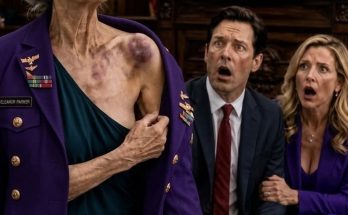
The judge had not entered yet when Curtis Hale stood beside Daniel's table.
He was a neatly dressed man with a practiced courtroom voice.
I had seen his name on the petition.
He represented my son.
Curtis glanced at me, then returned his attention to the papers in front of him.
He did not introduce himself.
I suppose he did not think there was any need.
To him, I was an older woman without a lawyer, sitting alone with a cane.
Daniel had already supplied the explanation for everything he expected the court to see.
According to his petition, I had been falling at home.
I had bruises on my arms.
I had injured my wrist.
There was a cut above my eyebrow.
The petition suggested that I sometimes became confused and could not explain how these injuries happened.
Daniel claimed he feared I would hurt myself more seriously if the court did not intervene.
He made it sound like a son asking for help.
He did not mention that I had refused to surrender control of my savings.
He did not mention the argument in the hallway.
He did not mention the documents on my husband's desk.
He certainly did not mention his hands.
I remembered every injury.
The wrist came first.
The mark near my shoulder came later, after Daniel shoved me against the hallway wall because I would not agree to let him handle my finances.
I had not expected him to touch me.
For a few seconds afterward, I could only stare at him.
He looked angry.
Then he looked frightened by what he had done.
I thought that meant he was sorry.
He told me I had made him lose his temper.
I believed him for longer than I care to admit.
The cut above my eyebrow happened when I tried to stop Daniel and Vanessa from removing papers from my husband's desk.
Those papers mattered to me.
My husband had kept important documents in a particular drawer for years.
He liked things in order.
Even after he died, I could still picture him standing at that desk, tapping the edges of a stack of papers against the wood until every page lined up.
When I saw Daniel opening the drawer, I asked what he was looking for.
He said he was organizing things.
I told him I could do that myself.
He became impatient.
Vanessa moved toward the papers while I stepped between them and the desk.
The next moments passed too quickly for me to describe them perfectly.
I remember stumbling.
I remember the sharp pain above my eye.
I remember touching my forehead and seeing blood on my fingers.
Daniel told me to sit down.
Vanessa fetched a cloth.
For a moment, I thought they were finally worried about me.
Then she began asking whether I remembered how I had fallen.
I had not said I fell.
I had not even been given time to explain what happened.
She asked the question again.
Daniel stood behind her.
I saw them exchange a look.
That was when I understood that the injury itself was not the only problem.
They had already decided what it meant.
Afterward, they told other people I had been unsteady.
They said I sometimes became upset over ordinary matters.
Daniel repeated that I needed help.
At first, I corrected him.
I explained that I had not fallen.
I told him exactly what had happened.
He listened with a patient expression that made me sound unreasonable even when I was telling the truth.
Eventually, I stopped arguing with him in front of other people.
I thought silence might keep the peace.
Instead, silence gave his story room to grow.
Vanessa began taking photographs.
She would notice a mark on my arm and ask whether I remembered getting it.
If I said yes, she asked me to explain.
If I said no, she looked concerned.
Either answer seemed to please her.
She wrote things down.
Dates.
Little descriptions.
Observations about my behavior.
I saw her holding a notebook once when she thought I was asleep in the living room.
When I asked what she was writing, she said she was keeping track of my health.
I wanted to believe her.
I also wanted her to stop looking at me as if I were a problem that needed to be solved.
The photographs eventually appeared in the court papers.
There I was, my own body presented as evidence that I could not be trusted.
A bruise became a fall.
An injury became confusion.
An argument became proof that I was unstable.
Curtis Hale intended to use those photographs to support the petition for emergency guardianship.
He would ask the judge to give someone else authority over my money and my property.
Daniel wanted that authority.
I knew because he had asked for it before the petition was filed.
He had told me it would make everything simpler.
I had refused.
After that, his concern became harder to distinguish from anger.
I sat quietly while Curtis organized the documents.
Daniel leaned toward Vanessa.
She whispered something back.
Neither of them looked frightened.
They believed the photographs told their story clearly enough.
I wondered whether they had considered what would happen if somebody asked where the injuries had really come from.
Perhaps they believed nobody would ask.
Perhaps they believed that even if someone did, I would be too embarrassed to answer.
That was the part they had never understood about me.
I was embarrassed.
I was ashamed that my son had hurt me.
I was ashamed that I had spent so long defending him.
But shame was not the same as forgetfulness.
I remembered the hallway wall.
I remembered Vanessa's fingers closing around my wrist.
I remembered the papers scattered across the desk.
I remembered Daniel standing over me and telling me I needed help.
Those memories had not become less clear with time.
They had become more painful.
Curtis finally sat down.
The clerk called for everyone to rise.
I placed my hand on the bench and pushed myself to my feet.
My cane slipped slightly against the floor.
Daniel glanced at me.
For a second, his expression softened into something almost like pity.
Then I saw the satisfaction underneath it.
He thought the cane proved his case.
He did not know what I had spent my life learning to recognize.
A document could be accurate and still tell a lie.
A photograph could show a real injury and conceal the person responsible.
And a person could look fragile without having surrendered the ability to think.
The judge entered.
Everyone stood.
Click here to continue reading: PART 3: Three Weeks Before the Hearing, My Son Changed the Locks on the House Where His Father and I Had Spent Forty Years
My Son Thought the Court Would See a Helpless Old Woman, but He Had Never Asked What I Remembered
Part 2 of 24