Daniel took a breath before answering.
He said he wanted to make sure my finances were handled properly.
He said he was worried about the house.
He said he believed he was acting in my best interests.
The words were familiar.
I had heard them at my kitchen table.
I had heard them during arguments about my savings.
I had heard them when Daniel insisted that selling the house would make things easier for everyone.
But the judge was asking about authority, not intentions.
“Mrs. Vance has stated that she can manage her own affairs,” Judge Mercer said. “What specific evidence contradicts that statement?”
Daniel looked toward Curtis again.
Curtis rose.
He said the petition described repeated injuries and concerns about my judgment.
The judge asked him to identify the evidence concerning my ability to manage my accounts.
Curtis referred to the family's observations.
The judge asked whether those observations included any specific instance in which I had been unable to understand my finances.
Curtis paused.
I watched him turn another page.
There was no satisfaction in seeing him struggle.
I had not come to court because I wanted to embarrass a lawyer.
I had come because my son was trying to take control of my life.
That was enough.
The judge asked Vanessa to explain her role in documenting my injuries.
She sat straighter.
“I was worried about Eleanor,” she said. “I wanted to keep track of what was happening.”
She used my first name instead of calling me her mother-in-law.
It sounded strangely formal.
The judge asked what she had recorded.
She described the photographs and the dates.
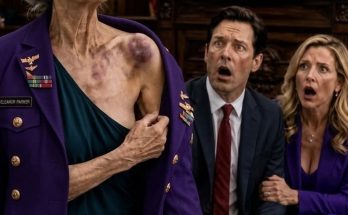
She said she had noticed bruises and other marks.
“Did you personally witness Mrs. Vance falling on the occasions documented in those photographs?”
Vanessa hesitated.
“Not all of them.”
“Which ones did you witness?”
She answered carefully.
Her account was not the same as the certainty conveyed by the petition.
I could see her trying to choose words that would not make her earlier statements sound stronger than what she had personally observed.
The judge asked whether I had offered explanations for any of the injuries.
Vanessa looked at me.
For a moment, I thought she might tell the truth.
She said I had sometimes become upset when they tried to help.
I waited.
That was not an answer to the question.
Judge Mercer repeated it.
“Did Mrs. Vance offer an explanation for the injuries?”
Vanessa's hands moved together in her lap.
“She said we had hurt her.”
The room became very quiet.
I looked directly at her.
She had heard me.
She had heard me when I said she had grabbed my wrist.
She had heard me when I told Daniel what happened in the hallway.
She had heard me explain the injury above my eyebrow.
Those conversations had not been secrets.
I had spoken to the people responsible.
They had simply chosen a different account to tell everyone else.
Judge Mercer asked whether Vanessa had included those explanations in her notes.
She said she had recorded her concerns.
The judge asked whether the notes distinguished between injuries she had personally witnessed and injuries she had photographed afterward.
Vanessa did not answer immediately.
Curtis rose, but the judge asked him to wait.
I looked at the woman sitting beside my son.
I remembered when she first came into our family.
I had wanted her to feel welcome.
I had made room for her at our table.
When she and Daniel visited, I asked about her work and her family.
I had bought small gifts for her birthdays.
I had tried not to interfere in their marriage.
I had told myself that a good mother-in-law did not need to be loved, only respectful.
I had never imagined that one day she would sit in court and help portray me as a woman who could not be trusted with her own life.
I felt grief.
Not just anger.
Grief for the family I thought we were.
Vanessa finally said that her notes reflected what she believed was happening.
Judge Mercer looked at her.
“Belief and direct observation are not necessarily the same thing, Mrs. Vance.”
She lowered her eyes.
Daniel leaned toward Curtis and whispered something.
The judge noticed the movement and asked them to allow the questioning to continue.
I took a slow breath.
The cane beside my chair had a small worn patch near its handle.
My husband had helped me choose it.
He had held several canes in the store and told me to pick the one that felt right in my hand.
I remembered laughing at him because he had treated the purchase like an important financial decision.
He said important things deserved careful attention.
I wished he had been sitting beside me.
He would have hated seeing our son and daughter-in-law turn my injuries into a reason to take my property.
But I could not make the judge understand what my husband would have felt.
I could only answer the questions in front of me.
Judge Mercer asked me whether I had ever told Vanessa that I was confused about how the injuries occurred.
“No, Your Honor.”
“Did you tell her that you had fallen?”
“No.”
“Did you tell her that she had hurt you?”
“Yes.”
He nodded and made a note.
Curtis requested permission to ask me some questions.
The judge allowed it.
Curtis asked whether I had ever needed assistance after an injury.
I said I had accepted help when I needed it.
He asked whether I had ever been upset with Daniel or Vanessa.
I told him I had been upset with them on several occasions.
He asked whether family arguments could become emotional.
“Yes,” I said. “They can.”
He seemed to expect me to deny that.
I would not.
I had been emotional.
I had cried in the motel room.
I had been frightened when I could not open my own front door.
I had been angry when Daniel treated my refusal as proof that I could not make decisions.
None of those feelings meant I had forgotten what happened.
Curtis asked whether I could guarantee that I would never fall again.
“No,” I said. “I cannot guarantee that.”
He paused.
“But I can tell you that the injuries described in this petition were not all caused by falls.”
Judge Mercer watched me closely.
I did not add anything.
The truth was enough.
When Curtis finished, the judge returned to Vanessa's notes.
The photographs remained part of the record.
But the questions had exposed something those photographs could not show.
Vanessa had documented the marks.
She had not established the explanation she wanted the court to accept.
And now the judge knew that I had disputed that explanation from the beginning.
Click here to continue reading: PART 11: I Had Once Built a Career Finding What People Hid in Paperwork, and Now I Needed the Court to Look Beyond a Photograph
My Son Thought the Court Would See a Helpless Old Woman, but He Had Never Asked What I Remembered
Part 10 of 24