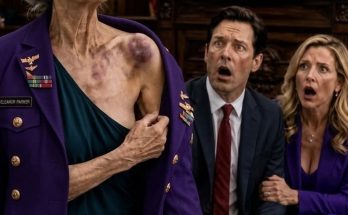
I did not begin with the worst injury.
I began with the wrist.
It was easier to describe because I could still remember the exact pressure of Vanessa's fingers.
I had refused to give her access to my savings.
She said she was trying to make things easier.
I told her I could manage my own money.
She reached for my arm.
When I pulled away, she grabbed me harder.
The bruise appeared later.
Vanessa photographed it.
Then she told people I had fallen.
I explained this to the judge without raising my voice.
He asked whether anyone had witnessed the incident.
“No,” I said.
I did not pretend otherwise.
I could have made the story sound stronger by claiming someone had seen it.
I had spent too many years working with evidence to do that.
“I understand the court must distinguish between what I remember and what can be independently established,” I said.
Judge Mercer looked at me for a moment.
“That's correct.”
Curtis stood.
“Mrs. Vance, isn't it possible that you misremembered the circumstances?”
“It is possible for any person to misremember something.”
“Even you?”
“Even me.”
He appeared pleased with that answer.
Then I continued.
“That is why I keep records, and why I do not ask the court to accept my word without examining the rest of the evidence.”
His expression changed.
I placed my written notes beside the photographs.
They were not a secret diary.
They were simple records of dates, conversations, and events I had wanted to remember accurately.
I had written down what happened after the argument about my savings.
I had written down when Vanessa photographed the bruise.
I had written down the words she used when she told me what she planned to say about it.
The notes did not prove every detail by themselves.
I knew that.
But they showed that I had recorded the events before the court hearing became the center of my life.
Judge Mercer examined the pages.
Curtis asked to review them.
The judge allowed it.
Curtis took his time.
Daniel watched him.
Vanessa sat very still.
When Curtis returned the papers, he did not immediately speak.
Judge Mercer turned to the next photograph.
“This is the mark near your shoulder?”
“Yes, Your Honor.”
“Tell me how you received it.”
I described the hallway.
Daniel and I had argued.
He wanted me to stop interfering with what he called family business.
I told him that my husband's documents were mine to protect.
He shoved me against the wall.
It happened quickly.
I remembered the shock more clearly than the pain.
I remembered reaching for the edge of a small table to steady myself.
I remembered Daniel stepping away.
Later, the mark near my shoulder became another example of my supposed instability.
Curtis asked whether I had fallen.
“No.”
“Did you seek medical attention?”
“Not at the time.”
“Why not?”
I took a moment before answering.
“Because he was my son.”
The words came out quietly.
I heard a chair creak behind me.
I did not turn around.
“I thought the argument would pass,” I continued. “I thought he would regret it. I thought keeping the matter private might allow us to repair our relationship.”
Curtis asked whether I had reported the incident to the police.
“No.”
“Then you have no official report proving that your son pushed you.”
“I have not claimed that I filed a report.”
He looked toward the judge.
I could see what he wanted to do.
He wanted the absence of an official report to become proof that the incident had never happened.
But those were not the same thing.
Judge Mercer seemed to understand the distinction.
“Mr. Hale, the fact that an incident was not reported does not, by itself, establish that it did not occur.”
Curtis sat down.
I moved to the third injury.
The cut above my eyebrow had happened when I tried to stop Daniel and Vanessa from taking documents from my husband's desk.
I had gone into the room because I heard a drawer being opened.
Some of those papers related to the house.
Others were old financial records my husband had kept.
I told them I wanted to know what they were taking.
The argument grew louder.
I was struck above the eyebrow during the struggle.
I remembered the sharp pain and the warmth running down my face.
I remembered Vanessa stepping back.
I remembered Daniel telling me to sit down.
Later, the cut appeared in another photograph.
The explanation attached to it was that I had fallen.
Judge Mercer studied the image.
“Mrs. Vance, are you saying your daughter-in-law took these photographs after each incident?”
“Yes.”
“And then described the injuries as accidental?”
“Yes.”
“Did you object to those descriptions?”
“I did.”
“What happened?”
“They told me I was confused.”
Vanessa lifted her head.
“That isn't how it happened.”
The judge turned toward her.
“Mrs. Vance, you will have an opportunity to respond. Please wait until I ask you.”
Vanessa pressed her lips together.
For a moment, I saw the woman who had smiled when I walked into the courtroom.
She had expected my cane to tell the story for her.
She had expected my silver hair to make every answer sound uncertain.
She had expected the photographs to speak without anyone asking who had taken them or what had happened first.
I could not blame her for knowing how a photograph might look.
I could blame her for treating the image as a substitute for the truth.
Judge Mercer asked Curtis whether his clients had any evidence that the injuries were caused by falls.
Curtis referred to their written statements.
The judge asked whether there were independent witnesses.
Curtis said there were none identified in the materials before the court.
He referred again to the photographs.
The judge looked at the pictures, then at the written notes, then at me.
“Photographs establish that injuries were present,” he said. “They do not automatically establish how those injuries occurred.”
Nobody spoke.
I had waited for someone to say that for months.
Hearing it did not undo what had happened.
It did not return the night I spent in the motel.
It did not erase the moment I stood outside my own house, turning a key that no longer worked.
But it meant the court was finally looking at the difference between an injury and the explanation someone had attached to it.
Judge Mercer asked Vanessa to respond.
She stood and adjusted the sleeve of her jacket.
“We were worried about her,” she said. “We thought she was getting worse.”
“What made you believe she could not manage her own affairs?” the judge asked.
“She was angry all the time.”
“Anger is not the same as incapacity.”
“She wouldn't let us help.”
“What help did you offer?”
Vanessa hesitated.
“We offered to manage things.”
“Which things?”
“Her accounts. The house. Her paperwork.”
“Did she agree?”
“No.”
“Then why did you believe her refusal meant she could not make decisions?”
Vanessa glanced at Daniel.
He did not look back at her.
“I thought she wasn't thinking clearly,” she said.
“On what specific basis?”
She had no immediate answer.
I watched her fingers twist the edge of her sleeve.
For months, she had written down my supposed confusion.
Now the judge was asking her to explain it.
The difference was simple.
A note could repeat an opinion.
A court required a reason.
Judge Mercer gave Vanessa time to answer.
She eventually mentioned arguments, disagreements, and the fact that I had become more private after my husband's death.
I did not deny any of those things.
I had become more private.
I had also become more careful about who I allowed near my finances.
Grief had changed my days.
It had not erased my judgment.
When Vanessa finished, the judge asked whether she had ever obtained a professional evaluation showing that I lacked the capacity to manage my affairs.
Curtis answered that they had not submitted such an evaluation.
Judge Mercer wrote another note.
I sat quietly.
I did not need to win an argument with Vanessa.
I needed the court to understand that her opinion about me was not the same as a finding about me.
When the judge turned back to the file, I placed my notes in order.
For the first time, I felt that the photographs were no longer the only things being examined.
Click here to continue reading: PART 23: My Son Had Asked the Court to Take Away My Independence, and Now He Had to Answer for What He Had Done With It
My Son Thought the Court Would See a Helpless Old Woman, but He Had Never Asked What I Remembered
Part 22 of 24