The clerk brought the papers back to the judge.
I remained seated, waiting for the next question.
My back hurt, and the cane had left a red mark across my palm.
I loosened my grip.
Daniel was speaking quietly to Curtis Hale.
Vanessa sat beside them, looking toward the bench.
Nobody was laughing now.
I remembered the way they had behaved when I first entered the courtroom.
Daniel had leaned toward his wife and whispered something that made her cover her mouth.
He had believed the outcome was settled before the judge even arrived.
Now he watched every page the judge turned.
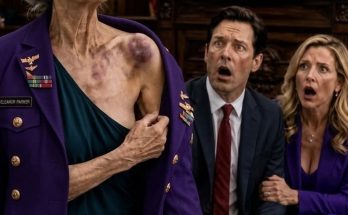
Judge Mercer returned to the photographs attached to the petition.
He looked at the picture of my wrist.
Then he studied the image showing the cut above my eyebrow.
I knew what those pictures showed.
I also knew what they did not show.
They did not show Vanessa reaching for my wrist when I refused to give her access to my savings.
They did not show Daniel pushing me against the hallway wall.
They did not show the argument beside my husband's desk.
They showed the injuries afterward.
That was all.
“Mr. Hale,” the judge said, “I want to return to the documentation submitted with this petition.”
Curtis stood.
“Yes, Your Honor.”
“Who took these photographs?”
Curtis referred to Vanessa's notes.
He explained that she had documented the injuries because she was concerned about me.
The judge asked whether the photographs had been taken immediately after each incident.
Curtis checked the papers.
He answered as best he could from the information provided.
The judge asked whether the circumstances surrounding each injury had been recorded.
Curtis said the notes described the family's concerns and my behavior.
“That is not quite what I asked,” Judge Mercer said.
Curtis stopped.
The judge looked down at the documents again.
“Do the records establish that Mrs. Vance fell on each occasion?”
Curtis admitted that the photographs did not establish that fact by themselves.
I watched Daniel's face.
He looked at Vanessa.
She did not turn toward him.
The photographs had been their strongest evidence.
They had arranged them carefully.
They had dates and descriptions.
They had been presented as a pattern that supposedly proved I could no longer look after myself.
But the judge was examining the difference between documenting an injury and establishing its cause.
That difference was the reason I had spent years working with financial records.
Evidence could be real and still be used to support a conclusion it did not prove.
A bank statement could be genuine.
A number could be correct.
The story attached to those facts could still be wrong.
Judge Mercer asked Daniel whether he had personally seen me fall during the incidents described in the petition.
Daniel repeated that he had not witnessed every incident.
The judge asked him how he had concluded that the injuries resulted from falls.
Daniel said he had relied on the circumstances and what he believed was happening to me.
I felt my shoulders tighten.
He had not asked me what happened and accepted my answer.
He had decided what happened.
Then he had presented that conclusion as a reason to take control of my life.
The judge asked whether I had ever told Daniel that he had caused an injury.
“Yes, Your Honor,” I answered when invited to speak.
“Did you tell him that before the petition was filed?”
“Yes.”
Daniel shifted in his chair.
I kept my eyes on the judge.
“I told him what happened. I told Vanessa, too.”
The judge asked whether I had ever claimed that I could remember nothing about those incidents.
“No, Your Honor.”
I paused.
“I remember them clearly.”
The words were simple.
They were also the words I had wanted to say for months.
I remember.
I remember.
I remember.
The judge looked back at Daniel.
“Mr. Vance, do you dispute that your mother gave you those explanations?”
Daniel said that he remembered the conversations differently.
Curtis rose, but the judge continued asking Daniel questions.
“Did you include her explanations in the information submitted to support your petition?”
Daniel did not answer immediately.
He said the petition was intended to describe the family's concerns.
The judge asked again whether my explanations had been included.
Daniel acknowledged that the petition focused on the injuries and his concerns about my condition.
I sat quietly.
Nobody had to accuse him of lying for the omission to matter.
The judge could see that the petition contained photographs of real injuries but did not establish the explanation Daniel had offered for them.
He could also see that I had disputed that explanation.
I could not tell what conclusion he would draw.
I did not try to read his expression.
I had learned that hope could become another trap if I treated every small sign as a promise.
Judge Mercer set the photographs aside.
He asked Curtis to address the evidence concerning my ability to manage my own affairs.
Curtis returned to the general concerns already discussed.
The judge asked for specific examples.
Curtis reviewed the file.
Daniel looked down.
Vanessa's hands were clasped so tightly that her knuckles had turned pale.
I remembered her notebook.
I remembered the careful dates.
I remembered how she had watched me after each injury, waiting for me to say something she could interpret as confusion.
I had spent months feeling that I was being observed inside my own home.
Now the court was observing the people who had done the observing.
The difference mattered.
Judge Mercer asked for a moment to review the documents.
I sat back and let out a breath I had not realized I was holding.
I had not won anything yet.
But the photographs no longer stood alone.
My account was there beside them.
And Daniel could not make me forget what had happened simply by insisting that I had.
Click here to continue reading: PART 18: The Question About My Savings Changed the Room, Because My Son Finally Had to Explain Why He Wanted Control
My Son Thought the Court Would See a Helpless Old Woman, but He Had Never Asked What I Remembered
Part 17 of 24