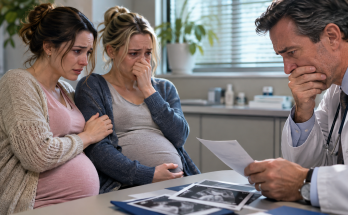
The clinic contacted us three days later.
The additional laboratory comparison had been completed.
Dr. Harrison wanted us to meet with a genetic specialist.
He also asked whether Margaret and Helen could attend.
I immediately understood that the meeting would be important.
Emily arrived at my apartment that morning.
She had brought Rebecca's letters.
I had brought the old photographs.
We placed everything in a folder.
Then we drove to the clinic.
Margaret and Helen were already waiting.
Neither looked particularly well.
Helen had barely slept.
Margaret kept rubbing her hands together.
We entered the consultation room together.
Dr. Harrison introduced us to Dr. Patel, a specialist in medical genetics.
She greeted everyone calmly.
Then she explained that she had reviewed the available laboratory information and the family records we had provided.
She wanted to distinguish three separate questions.
First, whether Emily and I were biological sisters.
Second, whether the donor identity matched the records.
And third, what the findings meant for the pregnancies.
I appreciated the way she explained it.
There were too many emotions involved already.
We needed the facts separated from our fears.
Dr. Patel began with the first result.
"Our testing confirms that Sarah and Emily are full biological sisters."
I looked at Emily.
She nodded.
We already knew this.
But hearing it again in a medical setting still felt strange.
Then Dr. Patel moved to the second question.
She explained that the comparison involving the archived sample showed a very close genetic match to the biological family information we had provided.
However, the available documentation was not sufficient to establish the identity of the donor conclusively.
I leaned forward.
"Does that mean Daniel could be the donor?"
She looked at me.
"It means the possibility needs to be investigated further. We cannot responsibly make that identification without a complete and verified comparison."
Emily looked frustrated.
"But we've already given you his name."
"I understand. The problem is that a name on a document does not prove who provided the biological material."
Our attorney nodded.
He explained that the clinic had requested additional historical records.
They were also examining how the donor profile had been created and whether any information had been altered.
I looked at Dr. Patel.
"What about the babies?"
She opened a separate file.
She explained that if the donor were unrelated to Emily and me, the expected genetic relationship between our children would be half-siblings.
But if the donor were our biological father, the children would have a much closer genetic relationship to us than we had originally believed.
That could increase the likelihood of inherited recessive conditions.
It did not mean the children were automatically affected.
It meant the medical team needed to identify any relevant risks and determine whether additional prenatal testing was appropriate.
I looked down.
The word recessive seemed to remain in my head.
Emily asked what that meant in simple language.
Dr. Patel explained that some inherited conditions occur when a child receives certain genetic changes from both biological parents.
When the parents are closely related, they are more likely to carry the same inherited changes.
That was why the identity question mattered.
I felt my eyes fill with tears.
"Can you tell whether our babies are healthy?"
She answered gently.
"Some conditions can be investigated during pregnancy. Others cannot be ruled out completely. We need to review the specific findings before giving you an individual assessment."
I nodded.
It wasn't the answer I wanted.
But it was honest.
Then Dr. Patel asked about our family history.
She wanted to know whether either side of the family had documented inherited disorders.
Margaret and Helen looked at each other.
Helen said she remembered Rebecca mentioning a medical condition in Daniel's family.
But she couldn't remember its exact name.
Margaret brought out the documents.
Dr. Patel examined them.
One page contained an old note about a relative who had experienced a serious inherited illness.
The information was incomplete.
Still, it gave the specialist another reason to recommend further investigation.
I watched her make notes.
I thought about the months we had spent discussing baby names.
We had been so careful about choosing a donor.
We had believed we were protecting our future children by completing medical screening.
Now we were learning how much could remain unknown.
After reviewing the records, Dr. Patel recommended that both pregnancies continue under specialist supervision.
She also discussed the available prenatal diagnostic options.
She explained the benefits, limitations, and possible risks of each.
Emily asked whether we should undergo additional testing immediately.
Dr. Patel said the decision would depend on the specific findings and our individual medical circumstances.
She encouraged us to take time to understand the information.
Nobody pressured us.
That mattered.
At the end of the appointment, Dr. Harrison gave us copies of the reports.
He also confirmed that the clinic was continuing its internal investigation.
Our attorney asked for a written explanation of the donor identification discrepancy.
The clinic agreed.
Outside the office, Helen began crying.
She looked at Emily.
"I am sorry."
Emily didn't answer immediately.
Then she hugged her mother.
I watched them.
I knew forgiveness would take time.
But I also knew that the women standing in front of us had carried this history for years.
They had made decisions that hurt us.
They had also raised us with love.
Both things could be true.
On the drive home, Emily was quiet.
Finally, she spoke.
"I keep thinking about the children."
"So do I."
"What if they have to deal with everything we have dealt with?"
I looked at the road.
"Then we'll make sure they don't have to face it alone."
She nodded.
That evening, I placed the medical reports beside Rebecca's letter.
The two documents seemed to belong to different worlds.
One described the past.
The other described a future we were still trying to understand.
And somewhere between them was the truth about Daniel.
Click here to continue reading: PART 12: A Stranger Contacted Our Attorney With Information About Daniel, and His Message Changed the Direction of the Investigation
The Promise Two Little Girls Made Twenty-Five Years Ago Was About to Change Both Their Lives Forever
Part 11 of 20