I couldn't stop thinking about Rebecca's note.
We had now found two separate warnings.
One told us not to believe everything Daniel said.
The other told our mothers to verify his identity if he ever returned.
Those were not ordinary words.
They sounded like someone trying to protect her children from something she couldn't explain.
The following morning, Emily came to my apartment.
She had brought the envelope Helen had given her.
We placed it beside the other documents.
I noticed that the handwriting was slightly different from the letter we had found in the wooden box.
Rebecca must have written it at another time.
Emily carefully unfolded the paper.
There was a date at the top.
It was several months before her death.
The letter was addressed to Helen.
Rebecca wrote that she had been trying to find someone who could explain Daniel's old medical records.
She mentioned that his personal information had changed at least once.
She also wrote that she had found a document containing a different identification number.
I read the lines twice.
Then Emily pointed to something near the bottom.
There was a name.
Not Daniel Whitmore.
A different name entirely.
We looked at each other.
"Do you recognize it?" Emily asked.
I shook my head.
We photographed the letter and sent a copy to our attorney.
He replied that we should not make assumptions.
He wanted the clinic to verify the information.
That afternoon, he arranged a meeting with Dr. Harrison.
The clinic had received a response from its previous records provider.
Some of the original donor documents were still available.
They had not yet been fully reviewed.
Our attorney explained that the records might help establish whether the donor profile we selected had been created using accurate information.
I asked whether the clinic could identify the biological father of our babies through testing.
He said that was precisely what the medical team was trying to establish.
But the identity of a person could not be determined simply because a name appeared on a form.
There had to be reliable evidence.
I agreed.
We had learned that lesson the hard way.
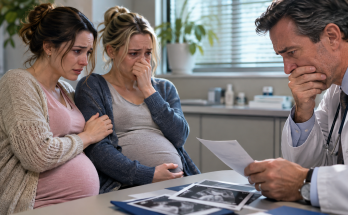
Two days later, Emily and I returned to the clinic.
Dr. Harrison was waiting with a new folder.
He told us that the archived records provider had located an original donor registration document.
It included a photograph, a date of birth, and a medical history questionnaire.
I felt my heart beating faster.
"Is it Daniel?"
Dr. Harrison placed the photograph on the desk.
I looked at it.
The man was not the same person as the man in Rebecca's photograph.
Emily leaned closer.
She studied his face.
Then she shook her head.
"That's not our father."
I looked at the document again.
The name printed beneath the photograph was Daniel Whitmore.
But the face was different.
The donor profile we had selected had included a different photograph from the one in the archived registration.
I felt confused.
"How can the same name belong to two different men?"
Dr. Harrison explained that this was the exact issue the clinic was investigating.
The original registration appeared to have been associated with a different person.
Some later records had been linked to it.
The clinic was trying to establish when and how that happened.
Our attorney asked whether the original donor had been genetically compared with our family samples.
Dr. Harrison said the comparison had not yet been completed.
He wanted to make sure the records were properly authenticated first.
Emily looked at the photograph again.
"So the man we selected might not be Daniel Whitmore at all?"
"That is possible."
I felt a strange mixture of relief and fear.
If the donor was a different man, perhaps the most frightening possibility was wrong.
But we still needed proof.
Dr. Patel joined us.
She explained that the next step was to compare the available biological samples with the relevant family reference samples, subject to consent and laboratory validation.
She also wanted to review the specific genetic findings from our pregnancies.
She was careful not to promise that one test could answer every question.
We agreed to continue.
When we left the office, Emily stopped near the elevator.
"Sarah, what if our whole family story has been mixed up with somebody else's records?"
I thought about the old photograph.
The man standing beside Rebecca.
The donor profile.
The different names.
"I think that's what we're trying to find out."
She looked down.
Then she laughed quietly.
It wasn't a happy laugh.
"Imagine choosing a donor because we wanted our children to share the same father, and then discovering we don't even know who the donor is."
I didn't laugh.
Because she was right.
We had made one of the biggest decisions of our lives based on information we believed was accurate.
Now we were questioning the foundation of that decision.
That evening, Margaret visited.
I showed her the photograph from the archived donor registration.
She studied it carefully.
Then she shook her head.
"I've never seen this man."
I showed her Daniel's photograph.
She immediately recognized him.
"That's him."
I asked whether Rebecca had ever mentioned another man with the same name.
Margaret thought for a moment.
Then she remembered something.
Rebecca had once told her that Daniel had a cousin who looked remarkably like him.
They had even joked that people sometimes confused them.
Margaret couldn't remember the cousin's name.
But she remembered that he had worked in medicine.
I felt a chill.
Emily looked at her.
"Did Rebecca ever tell you whether he was involved with the donor clinic?"
Margaret shook her head.
"No. I only remember the resemblance."
We gave that information to our attorney.
He added it to the investigation file.
For the first time, the possibility of mistaken identity seemed more than a theory.
But there was still no proof.
Before Margaret left, she held my hand.
"Your mother wanted you to have a peaceful life."
I looked at her.
"I know."
"She didn't want this."
I thought about the two little girls in the photograph.
Then I looked at Rebecca's letters.
"Maybe she wanted us to know the truth more than she wanted us to stay comfortable."
Margaret didn't answer.
She simply hugged me.
And for the first time, I allowed myself to cry in her arms.
Click here to continue reading: PART 15: The Genetic Comparison Finally Identified the Man Behind the Donor Profile, but His Connection to Our Family Was Not What We Expected
The Promise Two Little Girls Made Twenty-Five Years Ago Was About to Change Both Their Lives Forever
Part 14 of 20