The next morning, I woke up before Nate.
I lay there listening to the farmhouse.
The pipes knocked.
A floorboard creaked downstairs.
Somewhere outside, a tractor started.
Everything sounded normal.
That was the strange part.
Our lives had been turned upside down, but the house continued as if nothing had happened.
I got dressed and went into the kitchen.
The white cabinets looked exactly as they had the day we finished installing them.
The butcher block countertop had a few small marks from years of cooking.
Near the sink was a faint brown stain from a coffee spill I had never managed to remove completely.
I touched it with my finger.
Thirty-eight thousand dollars.
That number kept coming back to me.
It wasn't just money.
It was weekends we had sacrificed.
It was holidays spent painting instead of visiting friends.
It was the extra work Nate had taken because we wanted better cabinets.
It was every time I told myself not to buy something because we were saving for the house.
And now Tanner was supposed to walk into that room and use everything we had paid for.
I couldn't stop thinking about it.
Nate came into the kitchen.
He had already put on his work boots.
"Did you sleep?"
"A little."
He poured coffee into his travel mug.
Then he looked at the cabinets.
"I've been thinking."
I knew what he meant.
"We need to talk to someone."
He nodded.
An attorney.
Neither of us wanted to involve lawyers in a family matter.
But we also couldn't afford to make another expensive mistake.
We arranged an appointment.
Before going, Nate collected the receipts and bank statements we still had.
I found photographs from the renovation.
There were pictures of the old kitchen before we started.
Pictures of Nate installing the cabinets.
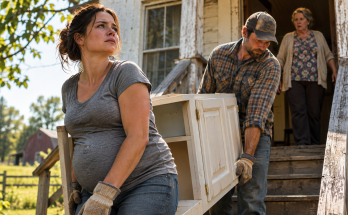
Pictures of the countertop being carried through the upstairs doorway.
I even found a photograph of Ada sitting on the unfinished floor, wearing a little pink dress and holding a paintbrush.
She had been too young to remember most of the work.
But those pictures showed how much of ourselves we had put into the place.
The attorney listened carefully.
He asked about the original agreement.
We explained that Darlene and Myron had told us the upstairs would eventually belong to us.
He asked whether anything had been signed.
We shook our heads.
"Nothing?"
"No lease. No deed. Nothing formal."
He asked how long we had lived there.
"Six years."
"And you haven't paid rent?"
"No."
He looked through our renovation records.
Then he leaned back.
I could tell he was choosing his words carefully.
He explained that promises about future ownership were difficult to enforce without written documentation.
He also explained that living there without paying rent for six years would be considered when assessing the money we had spent.
In other words, we shouldn't expect to recover the full thirty-eight thousand dollars simply because we had receipts.
I felt sick.
Nate looked down at the papers.
"So we lose everything?"
"Not necessarily."
The attorney separated the renovation expenses into different categories.
Some improvements were permanently attached to the building.
Others were removable items.
He explained that the legal treatment could depend on ownership, installation, and the circumstances.
Then he pointed to the kitchen cabinets.
He asked who had purchased them.
"We did," Nate answered.
The countertops?
Us.
The sink?
Us.
The stove?
Us.
The attorney explained that these items could be treated differently from improvements that had become part of the structure.
He advised us to document what belonged to us and remove only what we had a legal right to take.
He was very clear about one thing.
We should not damage the property.
We should not remove anything belonging to Darlene or Myron.
And we should not make assumptions about plumbing, wiring, or structural work.
I appreciated that.
I didn't want to leave the farmhouse in pieces.
I just wanted to leave with what we had purchased.
When we walked outside, Nate stood beside the car for a long time.
The wind was cold.
He held the attorney's business card between two fingers.
"Six years," he said.
I didn't answer.
He looked toward the road.
"We trusted them."
That was the part I couldn't explain away.
We hadn't just spent money.
We had trusted people who were supposed to protect us.
On the drive home, we barely spoke.
I watched the fields pass.
Then I remembered something.
"What about the kitchen?"
Nate glanced at me.
"What about it?"
"The cabinets. The counters. The sink. The stove."
He nodded.
"We can take those."
I looked at him.
"All of them?"
"Everything the attorney confirmed was ours."
For the first time in days, I felt something other than fear.
Not happiness.
Not relief.
Something closer to control.
We couldn't take back the six years.
We couldn't force Darlene to honor a promise she had never written down.
But we didn't have to leave behind everything we had bought.
That evening, Nate brought a small notebook into the bedroom.
He wrote down the items we could remove.
White cabinets.
Butcher block countertops.
Farmhouse sink.
Stove.
He also wrote down what we needed to leave untouched.
Walls.
Wiring.
Plumbing connections that weren't ours to remove.
He drew little boxes beside each item.
I watched him work.
"Are you really going to take the kitchen apart?"
He looked at me.
"Yes."
I swallowed.
"What will your mother say?"
He put down the pencil.
"She already said what she wanted."
I had never heard him speak that way about Darlene.
He wasn't angry in the way people become angry when they want to fight.
He sounded tired.
Very tired.
The next morning, we started looking for somewhere to live.
We didn't tell Darlene.
We didn't want another argument before we had a place secured.
We needed somewhere close enough to Nate's job.
Somewhere the children could sleep comfortably.
Somewhere with three bedrooms if possible.
And somewhere we could afford.
The listings weren't encouraging.
Some places were too expensive.
Others needed repairs.
One house had a beautiful yard but a kitchen that looked older than the farmhouse.
Another had only two bedrooms.
I began wondering whether we had waited too long to make a plan of our own.
Then we found a rental in Mifflintown.
It wasn't fancy.
The outside needed fresh paint.
The driveway was narrow.
The kitchen was smaller than the one we had built upstairs.
But there were three bedrooms.
The children would have room.
And nobody else had the right to decide who lived there.
We arranged to see it.
The landlord showed us around.
I remember Ada running into the smallest bedroom and asking whether she could put her stuffed animals on the windowsill.
Nate stood in the kitchen looking at the cupboards.
They weren't beautiful.
They weren't new.
But he smiled.
"Good enough."
I looked at him.
"More than good enough."
The rent was eleven hundred dollars a month.
It was more than we wanted to spend.
But we could manage it if we adjusted a few things.
We sat at the small dining table and discussed the numbers.
Nate calculated his weekly income.
I calculated groceries, utilities, and the children's expenses.
It would be tight.
But it was possible.
We signed the lease on Tuesday during Holy Week.
I held the pen for a moment before writing my name.
It felt strange.
For six years, I had believed our next chapter was already decided.
Now we were signing papers for a completely different beginning.
When we got back to the farmhouse, Darlene was in the downstairs kitchen.
She asked where we had been.
"Running errands," Nate answered.
She nodded.
Then she mentioned Tanner again.
"He'll probably bring his things over the weekend before Easter."
Nate didn't respond.
I looked at the refrigerator.
There was a little drawing Ada had made.
It showed five people standing beneath a yellow sun.
She had written our family name above them.
I took it down carefully and put it inside a drawer.
I didn't want Darlene to see me doing it.
That night, I lay awake thinking about the new rental.
Eleven hundred dollars every month.
A new address.
A different kitchen.
And a family that would finally have a place nobody could take away from us without our agreement.
I was still frightened.
But I was beginning to understand something.
Leaving didn't mean we had failed.
Staying might have meant accepting that our sacrifices could be dismissed whenever someone else wanted something.
And I wasn't prepared to teach my children that.
Click here to continue reading: PART 3: My Five-Year-Old Asked Whether We Were Taking the Kitchen Too, and Her Father’s Answer Made Me Realize What Home Meant
I Thought We Were Building a Future in That Farmhouse Until One Sunday Dinner Changed Everything We Had Planned
Part 2 of 20