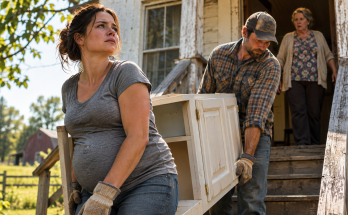
The following morning, Nate received a message from his father.
It was short.
Your mother wants to know when you're coming back for anything else.
Nate read it twice.
Then he put the phone on the table.
"We got everything."
I looked at him.
"Tell him that."
He typed a reply.
Everything we owned has been removed. We left the upstairs clean and undamaged.
He sent it.
A few minutes later, another message arrived.
Myron had written that Tanner was coming over that afternoon.
Nate didn't respond.
We had nothing more to arrange with Tanner.
The kitchen belonged to us.
The lease belonged to us.
The rest was Darlene's responsibility.
Still, I couldn't stop thinking about the first day we moved upstairs.
I remembered how excited we had been.
I remembered Darlene standing in the doorway, telling us the space would become a proper home.
I remembered believing her.
I wondered whether she remembered those conversations.
Or whether she had convinced herself that they had never happened.
That afternoon, I was putting clothes away when my phone rang.
It was a number I recognized.
Darlene.
I almost let it go to voicemail.
Then I answered.
"Hello?"
Her voice was sharp.
"Your kitchen is gone."
I looked at the bedroom door.
"Yes."
"Tanner came over."
I didn't respond.
"He was expecting the cabinets."
I closed my eyes.
"Why would he expect our cabinets?"
There was a pause.
Then she said, "Because I told him the upstairs was ready."
I sat on the edge of the bed.
"Did you tell him we owned the kitchen?"
Another pause.
"I thought you would leave everything."
I felt something cold settle in my chest.
There it was.
She had expected us to leave everything.
Not because we had agreed.
Not because it belonged to her.
Because she thought we would.
I kept my voice steady.
"We paid for those things, Darlene."
"You didn't have to take the sink."
"We bought it."
"And the countertops?"
"Yes."
She sighed.
"Now the room looks terrible."
I looked toward the hallway.
Our children were playing in the living room.
The new house was still messy.
Boxes were everywhere.
But it felt peaceful.
I answered quietly.
"It looked like that before we moved in too."
She didn't say anything.
I continued.
"We improved it because we believed it would be our home."
Darlene's voice became louder.
"Your father and I let you live there for six years."
"I know."
"You didn't pay rent."
"I know."
"Then why are you acting like we stole something from you?"
I didn't answer immediately.
Because I didn't want to say something I would regret.
Finally, I said, "Because you promised us something and then changed the decision without talking to us."
She went quiet.
Then she said Tanner was disappointed.
I almost laughed.
I was disappointed too.
Nate was disappointed.
Our children had lost the place they knew.
But somehow, Darlene seemed to believe Tanner's disappointment mattered more.
I told her we had nothing else to discuss.
Then I ended the call.
Nate came into the bedroom.
He had heard enough.
"What did she want?"
"She says Tanner expected the kitchen."
Nate shook his head.
"That's not our problem."
He sat beside me.
I leaned against his shoulder.
We stayed that way for a while.
Later that evening, Myron called.
Nate answered.
His father sounded uncomfortable.
He said the upstairs was empty.
He said Tanner had asked why the cabinets were missing.
He said Darlene was upset.
Nate listened.
Then he asked one question.
"Dad, did you know we were promised that upstairs?"
Myron didn't answer immediately.
Then he said yes.
Nate looked down.
I watched his face.
He had been hoping for something different.
Maybe an explanation.
Maybe an admission that his parents had made a mistake.
Myron continued.
He said he remembered the conversations.
He remembered the renovations.
He remembered the money we had spent.
But he also said Darlene believed the farm was hers to manage.
Nate asked whether that meant she could make promises and ignore them.
Myron had no answer.
Eventually, he said he wished things had happened differently.
Nate thanked him for calling.
Then he hung up.
I looked at my husband.
"Are you okay?"
He nodded.
But his eyes were wet.
I reached for his hand.
He squeezed mine.
The next day, Ada asked whether we could visit Grandma and Grandpa.
I wasn't ready.
Nate wasn't either.
We told her we would see them another time.
She accepted it.
Then she asked whether Tanner was living in our old room.
Nate looked at me.
I didn't know what to say.
He crouched in front of her.
"Grandma and Grandpa are figuring things out."
Ada nodded.
Then she asked whether our new house would always be ours.
Nate looked at her for a moment.
He didn't promise something he couldn't control.
He simply said we would take care of this home together.
I watched her return to her toys.
That evening, I sat in the new kitchen.
The plain cupboards were still unfamiliar.
The countertop was not butcher block.
The sink was smaller.
But I had made dinner there.
The children had eaten.
Nate had washed the dishes.
Nobody had walked in and told us that another person needed the room.
And that was enough for one day.
I knew the situation with Darlene wasn't finished.
There would be family gatherings.
There would be conversations.
There would probably be people who heard only her version.
But we had stopped trying to convince everyone.
We had a new address.
We had our children.
We had the things we had paid for.
And we had learned something that thirty-eight thousand dollars had not taught us.
A promise can sound permanent when it is spoken around a family table.
But if someone refuses to honor it, the people who trusted that promise are the ones who have to live with the consequences.
Click here to continue reading: PART 9: I Thought Moving Away Would End the Argument, but Darlene Was Still Telling Everyone We Had Taken Advantage of Her
I Thought We Were Building a Future in That Farmhouse Until One Sunday Dinner Changed Everything We Had Planned
Part 8 of 20