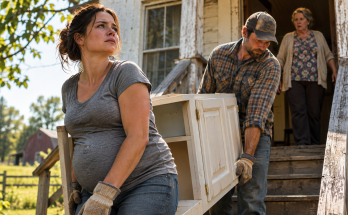
I used to believe that if you worked hard enough to make a place your home, eventually the people around you would recognize it as yours.
I was wrong.
And I learned that lesson at a Sunday dinner table, with a plate of roast chicken in front of me and my husband's mother sitting across from us.
My name is not important here.
What matters is that I was twenty weeks pregnant with our third child, married to a man named Nate, and living in the upstairs of his parents' farmhouse.
We had been there for six years.
Six years of waking up beneath the same slanted ceiling.
Six years of carrying laundry down the narrow staircase.
Six years of hearing the old farmhouse pipes knock whenever someone turned on the water downstairs.
We had two children.
Our daughter, Ada, was five.
Our son was three.
And another baby was on the way.
I thought we were finally becoming the family we had always wanted.
Nate worked as a driver for the local feed mill.
He left early most mornings, usually before the coffee finished brewing.
His hands were rough from work, and there was almost always a little dirt beneath his fingernails.
He wasn't a man who talked about his feelings.
If something broke, he fixed it.
If a door squeaked, he oiled the hinge.
If the roof leaked, he climbed up and patched it.
That was how he showed love.
And I had always believed his parents understood that about him.
His mother was Darlene.
She was a woman who liked things done her way.
She kept the farmhouse organized, knew everyone's business, and had a habit of making decisions before asking whether anyone else agreed.
His father, Myron, was different.
He was quiet.
Sometimes too quiet.
He spent most of his days between the barn, the equipment shed, and the fields.
He rarely involved himself in family disagreements.
For years, I thought that meant he trusted us to work things out.
Looking back, I wonder whether he simply hated confrontation as much as Nate did.
When Nate and I first moved upstairs, the arrangement sounded temporary.
His parents owned the farmhouse.
The upstairs needed work.
Darlene told us we could make it comfortable and eventually have a place of our own there.
She said it more than once.
We believed her.
There was no written agreement.
No deed.
No official paperwork promising us ownership.
Just conversations around the kitchen table and assurances that we were investing in our future.
We were young enough to believe that a family's word was enough.
The upstairs was not much to look at when we arrived.
The kitchen had old cabinets with peeling edges.
The bathroom was cramped.
The flooring was worn, and the walls needed attention.
But Nate saw possibilities.
He walked through the rooms with a measuring tape and a little notebook.
He pointed out where the refrigerator should go.
He showed me where he wanted the sink.
He even talked about adding better lighting over the counter.
I remember smiling at him.
"We could make this really nice."
He nodded.
"We'll do it right."
And we did.
We spent approximately thirty-eight thousand dollars improving the upstairs.
Some of that money came from savings.
Some came from extra shifts Nate picked up.
Some came from money we had planned to use for other things.
We bought new kitchen cabinets.
White ones.
I remember choosing them because they made the small room feel brighter.
We installed butcher block countertops.
A farmhouse sink.
A new stove.
We replaced much of the bathroom and worked on making the space comfortable for our growing family.
Every purchase felt like another step toward something permanent.
The first night we cooked in the finished kitchen, I made spaghetti.
Nothing special.
But Ada sat at the little table and announced that it was the prettiest kitchen in the world.
Nate laughed.
I remember looking at him and thinking we had finally made it.
We had a home.
Not a perfect one.
But ours.
Or so I thought.
Over the next six years, we never paid monthly rent to his parents.
That was part of the original arrangement.
We handled our own expenses and invested our money into the upstairs.
We also helped around the property when needed.
Nate repaired things.
I helped with cleaning and occasional household tasks.
We never considered ourselves guests.
We were family.
That distinction mattered to me.
Maybe it mattered too much.
Because I began making plans around a future that had never been put on paper.
I imagined the children growing up there.
I imagined the upstairs becoming their familiar place.
I imagined having grandchildren visit someday.
I even pictured the white cabinets staying in that kitchen long after we were old.
Then I got pregnant again.
It was a surprise, but a happy one.
Nate smiled when I showed him the test.
He put his hand on my stomach even though there was nothing to feel yet.
"Another little one," he whispered.
I laughed.
"We're going to need more space."
He kissed my forehead.
"We'll figure it out."
I believed him.
I believed we were going to figure it out together.
I didn't know that someone else had already made a decision about where our family would live.
The Sunday dinner was supposed to be ordinary.
Darlene had prepared roast chicken, potatoes, and green beans.
Myron sat at the end of the table.
Nate was beside me.
Ada was talking about something she had done at preschool.
Our son was trying to reach the bread basket.
I waited until everyone had started eating.
Then I smiled and shared our news.
"We're having another baby."
For a moment, nobody said anything.
Myron looked up.
Nate smiled.
Ada immediately started asking whether the baby would be a boy or a girl.
Then Darlene put down her fork.
Not slowly.
Not accidentally.
She placed it beside her plate and looked directly at me.
"Well, that makes things difficult."
I thought she was talking about the extra space we might need.
Then she continued.
"Five people cannot keep living upstairs."
My smile disappeared.
Nate looked at her.
"What?"
Darlene wiped her mouth with her napkin.
"Tanner needs somewhere to stay. He'll be moving into the upstairs by Easter."
I stared at her.
Tanner was her sister's son.
He was twenty-four years old.
He wasn't a stranger.
We had seen him at family gatherings, birthdays, and holidays.
But I had never heard anything about him moving into our home.
"Moving in where?" I asked.
Darlene looked almost surprised that I needed clarification.
"Upstairs."
The room became very quiet.
Ada stopped talking.
Nate put down his fork.
"Mom, what are you saying?"
"I'm saying Tanner needs a chance to get started. He can't keep living the way he is."
Nate stared at her.
"And what about us?"
Darlene shrugged.
"You have children. You'll find somewhere suitable."
I felt my stomach tighten.
I looked at Nate, waiting for him to say something.
He didn't raise his voice.
He didn't slam his hand against the table.
He simply looked at his mother.
"Mom, we put thirty-eight thousand dollars into that upstairs."
She picked up her glass.
"And you've lived here without paying rent for six years."
That answer hurt more than I expected.
Not because it was completely untrue.
We hadn't paid rent.
But that had never been presented as a gift that could be taken back whenever she wanted.
It was part of the arrangement.
It was why we had agreed to invest our savings into the property.
I tried to explain.
"We were told this would eventually be our home."
Darlene looked at me.
"Plans change."
Just three words.
Six years reduced to three words.
Then she explained why Tanner deserved the opportunity.
Her sister had helped her and Myron with the down payment on the farm forty years earlier.
Darlene believed she owed that family a favor.
She wanted to give Tanner somewhere to live while he got his life together.
I understood helping relatives.
I understood wanting to repay kindness.
But I couldn't understand why the price of that favor had to be paid by my children.
And why had nobody spoken to us before deciding?
Nate pushed his chair back.
He didn't leave the table.
He just sat there with both hands resting beside his plate.
"Did you talk to Dad about this?"
Darlene glanced toward Myron.
"He knows."
That was when I noticed Myron wasn't looking at anyone.
He had finished eating.
His hands were folded near his plate.
He stood up without saying anything and walked toward the back door.
A moment later, we heard it close.
He went to the barn.
Again.
That was what he did whenever something uncomfortable happened.
He disappeared into work.
I wanted to cry.
But I didn't want to do it in front of Darlene.
So I helped Ada with her food and pretended the conversation hadn't changed everything.
That night, after the children were asleep, Nate sat on the edge of our bed.
He was holding a pencil.
There was a small piece of paper beside him.
I watched him draw a line through something he had written.
Then he looked at me.
"She's serious."
I nodded.
"She wants us gone by Easter."
He stared at the pencil.
For a while, neither of us spoke.
Then he said something I hadn't expected.
"We need to find somewhere else."
I looked at him.
"Where?"
"Somewhere we can actually call home."
And for the first time in six years, I realized that we might have to start over.
Click here to continue reading: PART 2: The Lawyer Explained What We Could Lose, but One Small Detail Changed the Way Nate Looked at Our Kitchen
I Thought We Were Building a Future in That Farmhouse Until One Sunday Dinner Changed Everything We Had Planned
Part 1 of 20