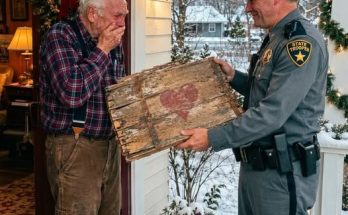
The following Christmas, Ora brought the board outside again.
She had kept it in a safe place during the year.
It wasn't fancy.
The wood had its imperfections, and the paint wasn't perfectly even.
But the message was clear.
We attached it to our fence.
I remember stepping back to look at it.
Ora stood beside me.
"Think anyone will come?"
"I don't know."
She smiled.
"Well, at least they'll know they're welcome."
That was enough for her.
We didn't advertise anything.
We didn't make a list of people who might need dinner.
We simply put the sign where passing drivers and pedestrians could see it.
Then we went inside and prepared our Christmas meal.
That first year after L.J., nobody came.
We still ate together.
Ora didn't seem disappointed.
She said the sign could stay up whether anyone used it or not.
I agreed.
The next year, we did it again.
And the year after that.
Some Christmas Eves passed quietly.
The sign stood outside, the snow came down, and nobody knocked.
Other years were different.
A truck driver stopped once.
He had been traveling and needed a proper meal.
Ora invited him into the kitchen.
He sat at our table and ate.
I remember him thanking her several times.
She kept telling him there was no need.
Another year, a widow who lived farther down our road came by.
She had spent Christmas without her husband and didn't want to sit alone that evening.
She didn't have to explain much.
Ora understood.
We made room for her.
Sometimes the visitors came in pairs.
There was a young couple whose vehicle had broken down.
They had been trying to deal with the trouble and were left without a warm place to spend the evening.
We invited them in.
They sat together, and Ora served them dinner.
I watched her moving between the kitchen and the table.
She never treated anyone as though they were a burden.
That was one of the things I loved about her.
She didn't make people feel that they had to prove they deserved a meal.
There was another visitor I remembered especially.
He had recently been released from prison.
He had nowhere to stay that night.
He came to our house because he had seen the sign.
I remember the way he stood at the entrance.
He looked uncertain.
He didn't seem sure whether we would change our minds after learning about his past.
Ora didn't.
She made him a plate.
He sat down.
And for that evening, he was simply another person eating at our table.
I sometimes wondered what happened to those people afterward.
I wondered whether the truck driver made it safely to his destination.
Whether the young couple got their vehicle working.
Whether the widow found other people to spend time with.
Whether the man who had left prison managed to build a better life.
We didn't know.
We weren't keeping track of their futures.
We were only offering them a place to eat.
That was the agreement, even though we'd never needed to say it aloud.
Ora cooked.
I handled the extra chairs.
And the old wooden sign stayed on the fence.
Years passed.
The board became familiar to us.
Every December, I would take it out and check that it was still in good enough condition to hang.
Sometimes the paint needed touching up.
Sometimes the wood needed a little cleaning.
Ora always wanted the words to remain easy to read.
She would stand back and inspect my work.
"That letter needs more paint."
"Which one?"
She would point.
I'd fix it.
Then she would nod.
It became one of our Christmas preparations.
Other couples had their traditions.
Some decorated trees.
Some traveled to visit family.
Some prepared the same special meal every year.
We had our sign.
And we had the people who occasionally came through our door.
I never thought of them as strangers for very long.
Once they sat down, once they accepted a plate, they became guests.
There was something comforting about that.
Our house wasn't large, but it had enough room.
A table.
A few chairs.
A kitchen where the food stayed warm.
That was all we needed.
I also learned how to recognize the sound of someone approaching the front door.
There was a particular hesitation before a knock.
People who came because they were hungry or lonely often stood outside for a moment.
They looked at the house.
They looked at the sign.
Then they gathered enough courage to knock.
Ora always answered.
She never made them wait.
I used to watch her open the door and step back.
She would ask them to come in.
Sometimes they smiled.
Sometimes they looked close to tears.
Sometimes they barely spoke.
She knew not to demand anything from them.
That was her gift.
I had other gifts, I suppose.
I could drive people where they needed to go.
I could carry groceries.
I could fix a loose chair.
But Ora knew how to make someone feel that they belonged somewhere.
And that was harder.
Over the years, our son Norris heard about the tradition many times.
He lived in Billings.
He was fifty-two years old now, and he had his own ideas about how people should live.
He had never been comfortable with our Christmas arrangement.
Even when Ora was alive, he questioned it.
He would ask who these visitors were.
He wanted to know whether we knew anything about their backgrounds.
He worried about what might happen if we invited the wrong person inside.
I understood that he was concerned.
He was our son.
He didn't want anything bad to happen to us.
But I didn't agree with his way of looking at things.
One time, he brought it up again.
"Dad, you can't just let anybody walk into your house."
I told him that we weren't forcing anyone to come.
The people who stopped were there because they needed something.
He shook his head.
"You don't know what they're capable of."
I didn't have a perfect answer.
I only knew what I had seen.
For all those years, nobody had harmed us.
People had come.
People had eaten.
People had left.
Some were grateful.
Some were quiet.
Some barely said anything at all.
But they had all been treated with dignity.
I told Norris that his mother knew how to judge people.
He didn't seem convinced.
Looking back, I probably should have listened more carefully to his concerns.
But I also think he never understood what the tradition meant to us.
It wasn't about being careless.
It wasn't about proving that we were better people than anyone else.
It was something that had begun with a cold teenager who had been walking through the snow.
And it had continued because we couldn't forget him.
Every Christmas Eve, I remembered that first night.
The thin hoodie.
The trembling hands.
The three plates of food.
The old flannel shirt.
I remembered L.J. standing beside the bus.
I remembered his words.
Nobody had ever done something like that for him before.
I couldn't make those words disappear.
They stayed with me.
Ora kept another thing that became important to our tradition.
A guest book.
It wasn't a fancy book.
It was simply somewhere to write down the names of the people who had joined us.
She began keeping it after the first Christmas.
Whenever someone came for dinner, she would write their name.
If they wanted to add something, she let them.
Some wrote a few words.
Others simply signed their names.
She kept the book in the house.
I didn't always read it.
But she did.
Sometimes I would find her looking through the pages.
She would stop at a particular entry and smile.
I asked her what she was thinking.
She would tell me she remembered that person.
She remembered the night they came.
She remembered what they had eaten or how cold they had been.
The book held more than names.
It held little pieces of our life together.
The first entry was especially important to her.
L.J.
His handwriting was uneven.
He had written it when he was sixteen.
Underneath his name, there was a message.
I had read that message many times.
I never became tired of it.
There were years when Ora and I had no visitors at all.
We still put up the sign.
There were other years when the house was full enough that I had to find extra places for people to sit.
Ora managed every meal.
She never complained about the work.
If anything, she seemed happiest when she had more plates to prepare.
I used to tell her that she was making too much food.
She would look at me as if I had missed something obvious.
"Someone might come."
That was her answer.
And she was usually right to prepare for them.
Then, six years before the Christmas I am telling you about, Ora died.
There are things about losing someone that are difficult to explain.
The house doesn't suddenly become different.
The same furniture remains.
The same kitchen stays where it always was.
The same windows look out toward the road.
But the person who made those things feel like home is no longer there.
I missed her everywhere.
I missed the sound of her moving around the kitchen.
I missed the way she checked the food.
I missed the little corrections she made whenever I thought I had done something properly.
And I missed the sign.
For a while, I couldn't bring myself to put it outside.
I would look at the board and remember her hands painting those words.
I remembered the first Christmas Eve.
I remembered every year after it.
Then I realized something.
The sign hadn't belonged only to Ora.
It belonged to the promise we had made together.
So I continued.
The first year without her, I carried the board outside myself.
It felt heavier than I remembered.
I attached it to the fence.
Then I stood there looking at it.
I didn't say anything.
I just went back inside.
I also had to learn how to prepare her ham.
That wasn't easy.
Ora had never needed to think about every little step.
She simply knew what to do.
I had to teach myself.
I made mistakes.
I adjusted things.
I kept trying until I could prepare a meal that reminded me of hers.
It wasn't exactly the same.
Nothing was.
But I did my best.
Every Christmas Eve, I continued setting the table.
I continued watching the road.
And every year, I thought about the woman who had started it all.
The sign remained.
So did the guest book.
And so did the promise.
Click here to continue reading: PART 3: My Son Came Home Before Christmas, Saw the Sign Waiting on My Porch, and Made Me Choose Between His Approval and My Promise
The Winter Night I Opened My Door to a Boy Who Had Nowhere Else to Go
Part 2 of 20