I used to believe that a person could always find a little kindness if they knew where to look.
I believed that for most of my life.
Then I got older, lost my wife, and watched my own son tell me that kindness could get me into trouble.
I'm eighty-one years old.
And the first time I understood what a simple invitation could mean to somebody, it was Christmas Eve in 2001.
My name is Sherman.
I live in a small yellow house outside Missoula, Montana.
It isn't a special house.
The paint has needed attention for years, the porch steps creak, and the windows let in a little cold whenever the winter wind blows hard enough.
But it was home.
It was where my wife, Ora, and I raised our family and spent most of our married life.
By 2001, we'd already shared many Christmases.
We had our routines.
Ora handled most of the cooking, and I took care of the things around the house.
She was better at knowing what people needed.
I was better at pretending I didn't need help.
That was how we worked.
Neither of us expected that one snowy evening would give us a tradition that lasted twenty-five years.
It started with a boy walking past our property.
I remember the snow first.
It had been falling for hours.
Not the pretty little flakes people like to photograph, but the kind that covered the road and made everything outside look difficult.
The trees were heavy with it.
The driveway had almost disappeared beneath a white layer.
I was inside with Ora when she stopped what she was doing.
She had been near the kitchen window.
I noticed her looking outside, but she didn't say anything immediately.
Then she turned toward me.
"Sherman, come here a minute."
I walked over.
She pointed toward the road.
There was a boy out there.
A teenager.
He was moving slowly along the edge of the road, with his shoulders pulled forward and his head lowered against the weather.
I couldn't believe what he was wearing.
A thin hoodie.
Sneakers.
Nothing that looked remotely suitable for a Montana winter.
I looked toward the road again.
"Where's his coat?"
Ora didn't answer.
She was already watching him carefully.
He kept walking.
One step.
Then another.
His hands were close to his body, and even from inside the house, I could see that something wasn't right.
Ora looked at me.
"Go see if he'll come inside."
I remember hesitating.
Not because I didn't want to help.
I simply wondered what had happened to bring a boy outside in that weather.
He was alone.
He was young.
And he looked like he had been walking for quite some time.
I put on my coat and went outside.
The cold hit my face immediately.
I walked toward him, calling out before I got too close.
"Son, are you all right?"
He stopped.
He looked at me.
"I'm fine."
That was his answer.
He said it quickly, almost as if he wanted me to leave him alone.
But he wasn't fine.
His body was shaking.
His teeth were making a little clicking sound, and his hands looked painfully cold.
I stood there for a moment.
"You can't be out here dressed like that."
"I'm okay, sir."
I knew that answer.
I'd heard it from people who didn't want anyone to know they needed something.
I had probably said it myself more times than I could count.
I looked back toward the house.
"Come inside and warm up. My wife has food ready."
He didn't move.
I wasn't sure whether he was suspicious of me or simply embarrassed.
Maybe both.
I didn't ask him to explain anything.
I just told him the house was warm and that he could sit down for a while.
After a few more seconds, he followed me.
Ora had been watching from the window.
By the time we reached the porch, she had already started preparing a place for him.
She opened the door and stepped aside.
"Come in, sweetheart. You're freezing."
The boy looked down at his shoes.
He seemed uncomfortable bringing snow into the house.
I told him not to worry about the floor.
Ora took one look at him and went to find something warmer.
She returned with one of my old flannel shirts.
It was a little large for him, but it was clean and warm.
"Put this on."
He accepted it quietly.
I noticed that his fingers were still trembling when he took the shirt.
He changed into it, and Ora directed him toward the kitchen.
The smell of dinner was already filling the room.
Ham.
Potatoes.
A warm kitchen.
A table that had been set for two people.
Ora brought another plate.
She didn't ask him how hungry he was.
She simply put food in front of him.
The boy stared at the plate.
Then he started eating.
I had never seen anyone eat quite like that.
He finished what Ora had served him.
Then he looked down at the plate.
She offered him more.
He accepted.
He finished that too.
By the time he had eaten his third helping, I was beginning to understand just how long he might have gone without a proper meal.
Ora didn't comment.
She just kept making sure he had enough.
I sat across from him.
For a while, nobody said much.
The boy seemed more comfortable looking at his food than looking at us.
I didn't want to make him feel as though he owed us an explanation.
After a while, Ora asked him his name.
"L.J."
He spoke quietly.
I waited a moment.
"How old are you, L.J.?"
"Sixteen."
Sixteen.
I looked at him again.
He was still a child, no matter how grown he might have wanted to appear.
I asked whether someone was expecting him.
He explained that he'd had an argument with his stepfather.
He had left home.
He was trying to get to his aunt's house in Idaho.
I asked whether he understood how far away that was.
He nodded.
He had apparently decided to walk the entire distance.
I didn't know what to say.
Sixteen years old.
Snow falling.
No proper coat.
Trying to reach another state on foot.
There were things I wanted to ask, but I could see that he wasn't ready to talk about them.
So I didn't push.
Ora looked at me.
We didn't need a long conversation.
We both knew we weren't sending him back outside that night.
"You can stay here until morning," I told him.
He looked up.
"Really?"
"Yes. We've got a couch."
He didn't argue.
Ora brought out bedding, and we made the living room comfortable for him.
I remember seeing him sit on the couch with that oversized flannel shirt hanging from his shoulders.
He looked smaller than he had outside.
Tired, too.
I wished I could have known what had happened before he reached our road.
But I also understood that sometimes the most useful thing you could give someone was a few hours without questions.
That night, L.J. slept in our living room.
Ora and I went to bed knowing he was warm.
It was enough.
The next morning, the snow had settled over everything.
I made arrangements to get him to the bus station.
I drove him there and paid for his ticket so he could continue toward his aunt's home.
It wasn't a complicated thing.
A ticket.
A ride.
A little money.
I had spent more than that on things I couldn't even remember buying.
When we arrived, L.J. gathered his things.
He stood beside the bus and looked at me.
For the first time, he seemed to know exactly what he wanted to say.
"Thank you, sir."
I nodded.
He paused.
Then he said something I carried with me for years.
"Nobody has ever treated me like that before."
I didn't know how to answer.
I told him to take care of himself.
He climbed aboard.
I waited until the bus pulled away.
Then I drove home.
I didn't know whether I'd ever see him again.
I didn't know whether he would remember our little yellow house.
I didn't even know whether the flannel shirt had fit him properly.
But that evening, Ora did something I hadn't expected.
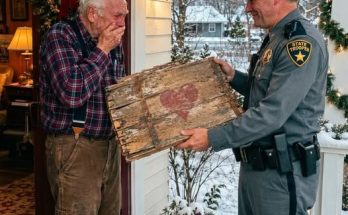
She found an old wooden board.
It had been sitting around the house, and she decided it could be used for something.
She brought out paint and began working on it.
I watched her from the kitchen.
"What are you making?"
She kept painting.
Then she turned the board around.
There were words across it.
Words that were simple enough for anyone passing our property to understand.
Nobody should have to spend Christmas hungry or alone.
And if they needed a place to sit, they could come to us.
I looked at the board.
Then I looked at Ora.
She smiled.
I understood what she wanted.
We would put it outside next Christmas.
Neither of us knew how many people would ever stop.
But that wasn't really the point.
For the first time, I began to understand that a house could be more than a place where two people lived.
It could also be a place where someone else found a little warmth.
And that was how it started.
Click here to continue reading: PART 2: The Old Wooden Board Became Part of Our Christmas, Even After the Woman Who Painted It Was Gone
The Winter Night I Opened My Door to a Boy Who Had Nowhere Else to Go
Part 1 of 20