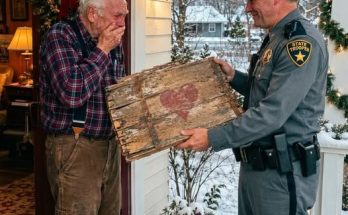
Norris had never liked our tradition.
I knew that long before he came to visit that December.
He had brought it up many times.
Sometimes he spoke calmly.
Other times, he sounded irritated.
But the message was always the same.
He thought I was making a mistake.
He lived in Billings, and he had his own life there.
He was fifty-two years old.
I was eighty-one.
And as far as he was concerned, those two facts explained everything.
He believed I was too old to keep inviting people into my house.
I understood the concern.
I really did.
I was no longer a young man.
My wife had been gone for six years.
I lived alone.
There were practical things I had to consider.
But I didn't believe that meant I had to stop caring about other people.
The tradition was one of the few things that still connected me to Ora in a way I could touch.
The board.
The guest book.
The Christmas meal.
They were ordinary things.
But they mattered.
I didn't want to give them up.
Norris had visited during the week before Christmas.
I remember the day because I had been preparing the house.
The old wooden sign was leaning near the porch.
I had taken it out, as I usually did, and was waiting for the right time to attach it to the fence.
I hadn't hung it yet.
The board was resting against the porch.
Norris noticed it as soon as he arrived.
He looked at it.
Then he looked at me.
"You're planning to put that thing outside again?"
I knew what was coming.
"It's Christmas."
He didn't smile.
"That isn't what I asked."
I told him I was planning to continue the tradition.
He looked toward the sign again.
I could see the frustration on his face.
"Dad, we've talked about this."
I told him I remembered.
He said I was living alone and had no way of knowing who might show up.
I answered that we'd been doing this for years.
He shook his head.
"That doesn't make it safe."
I didn't want to argue.
We had been through the same conversation too many times.
I told him I was careful.
He told me I wasn't careful enough.
Then he walked toward the board.
At first, I thought he was going to move it.
Maybe he wanted to put it somewhere else.
Maybe he was going to bring it inside.
I didn't expect what happened next.
He picked it up.
Then he bent it across his knee.
The sound was sharp.
A crack.
I stared at him.
For a moment, I couldn't understand what I had just seen.
"Norris!"
The board had broken.
The sign that Ora had painted.
The sign we had carried outside every Christmas Eve.
The sign that had stood through years of snow and wind.
He had broken it as if it were an unwanted piece of lumber.
I looked at the two sections in his hands.
I couldn't speak immediately.
He seemed determined to make sure I understood that he wasn't changing his mind.
"I've had enough of this, Dad."
I looked at him.
He was angry.
Not worried in the quiet way a son might be worried about his father.
He was angry.
He told me I was eighty-one and had no business opening my home to people I didn't know.
He said one of them could steal from me.
He said someone could hurt me.
He mentioned people with drug problems.
He made it sound as though every person who might knock on my door was a danger waiting to happen.
I listened.
I didn't interrupt.
I had spent years trying to explain why the tradition mattered.
But standing there, looking at the broken board, I realized he wasn't interested in hearing it again.
I told him that nobody had ever hurt me.
That was the truth.
Twenty-five Christmas Eves.
Different people.
Different circumstances.
And not once had anyone harmed me.
He looked at me.
"That doesn't mean it won't happen."
I didn't have an answer that could satisfy him.
There was always the possibility that something bad might happen.
There was always the possibility that a stranger might not be who they appeared to be.
I understood that.
But there was also the possibility that somebody was cold.
Somebody was hungry.
Somebody had nowhere to go.
I had seen that possibility become real more than once.
Norris didn't seem to think about those people.
He only thought about the danger.
Then he said something that hurt more than the rest.
"Your mother isn't here anymore to watch over you."
I looked away.
He was right about one thing.
Ora wasn't there.
She wasn't standing in the kitchen.
She wasn't checking the food.
She wasn't reminding me to make enough for anyone who might arrive.
She wasn't there to tell Norris that the sign was staying.
I missed her.
That was the part I couldn't explain to him.
I wasn't continuing the tradition because I had forgotten my age.
I wasn't doing it because I didn't understand the risks.
I was doing it because I remembered her.
And I remembered the boy.
But Norris continued.
He said that if I put another sign outside, or allowed another stranger into the house, he would contact the police.
He would tell them I was no longer safe living alone.
I stared at him.
I had never expected my son to use the police as a threat against me.
He said it plainly.
No hesitation.
No uncertainty.
I tried to speak.
Nothing useful came out.
He gathered the broken pieces of the board.
Then he carried them toward the end of the driveway.
There was a trash can there.
He opened it and threw both pieces inside.
I watched him.
I remember the sound of the wood landing.
Then he closed the lid.
He returned to his vehicle.
I stood on the porch.
He didn't come back to discuss anything.
He didn't ask whether I was upset.
He didn't ask what the board meant to me.
He got into his car and drove away.
I watched until the vehicle disappeared.
Then I looked at the empty place where the sign had been leaning.
There was something embarrassing about how helpless I felt.
I was eighty-one years old.
I had lived long enough to bury my wife.
I had raised a son.
I had worked, paid bills, maintained a home, and made decisions for myself.
Yet there I stood, looking at a broken wooden board in a trash can.
And I didn't know what to do.
I went inside.
The house was quiet.
I looked toward the kitchen.
I thought about Ora.
I could almost imagine her asking what had happened.
I knew exactly what she would have said.
She would have wanted the sign put back together.
She would have told me not to let an argument take away something good.
But she wasn't there.
I couldn't ask her.
I sat down.
For a long time, I did nothing.
Then I said something out loud.
"All right."
I wasn't agreeing that Norris was right.
I wasn't suddenly convinced that the tradition had been foolish.
I was tired.
And I didn't want another argument.
I decided I wouldn't hang the sign.
Not that year.
I could have found another piece of wood.
I could have written the same words again.
I knew that.
But I couldn't bring myself to do it.
The original board had been made by Ora.
A replacement would have been only a replacement.
I didn't want one.
I wanted the old one.
I wanted the board she had painted.
I wanted the words in her handwriting.
I wanted the thing we had kept for twenty-five Christmas Eves.
And now it was gone.
I didn't go to the trash can to retrieve it.
I didn't call Norris.
I didn't tell him what he had taken from me.
I just left things as they were.
The days passed.
Christmas came closer.
I continued doing the ordinary things around the house.
I prepared meals.
I kept the rooms warm.
I looked outside when I heard a vehicle approaching.
But there was no sign on the fence.
For the first time in twenty-five years, the road had no invitation waiting beside it.
I thought about the people who might pass.
I wondered whether anyone would notice.
I wondered whether somebody who had needed us in another year might come looking.
I didn't know.
And I couldn't make myself put up another board.
There was one thing Norris hadn't considered.
He knew about the sign.
He knew about the visitors.
He knew about the meals.
But he didn't know how much Ora had kept.
The guest book was still in the house.
She had written down the names of every person who had come to our table.
I knew where it was.
I had looked through it many times since she died.
I remembered the first page.
L.J.
The name was written in a teenager's uneven handwriting.
And underneath it was a message that had stayed with me for twenty-five years.
I had never thrown that book away.
I couldn't.
It was one of the few things that held all those Christmas Eves together.
Norris had broken a board.
But he hadn't erased the people who had come through our door.
He hadn't erased the names.
And he hadn't erased what the first boy had written.
Click here to continue reading: PART 4: I Left the Fence Empty for the First Time in Twenty-Five Years, but I Still Prepared a Christmas Dinner for Two
The Winter Night I Opened My Door to a Boy Who Had Nowhere Else to Go
Part 3 of 20