
By the time the weather grew colder, I had stopped thinking of the little house as temporary.
At first, I'd treated every box I unpacked as though I might need to move it again.
I had left some things in their cartons.
I hadn't bothered to arrange the kitchen cupboards properly.
I kept telling myself I would settle in once I knew everything was going to work out.
But nothing in life ever worked out all at once.
The house had become home while I was busy waiting for certainty.
One morning, I decided to finish unpacking.
I took the remaining boxes from the corner of the bedroom and opened them on the floor.
There were old photographs, a few books, some kitchen things, and papers I had carried from the farmhouse.
I found a small stack of letters Dale had written to me before we were married.
I sat down to read them.
His handwriting was uneven.
He had never been a man who used many words when speaking, but he wrote more when he had time to think.
One letter mentioned how he hoped we'd have a place of our own someday.
At the time, we'd been living in a rented room.
We had almost nothing.
I smiled at the memory.
We had talked about a little house with a kitchen where I could cook and a door we could close at night.
We had eventually built a life that felt like that, even when the house belonged to someone else.
I folded the letter carefully and placed it back in its envelope.
Then I put it in the wooden box with the others.
I wasn't trying to pretend my life with Dale had been perfect.
We'd argued.
We'd worried about money.
We'd had months when every unexpected bill felt like a personal insult.
But we had made decisions together.
We had learned how to disagree without making the other person feel like a burden.
That was what I wanted to remember.
After I finished unpacking, I arranged the kitchen shelves.
I put the cups where I could reach them.
I set the plates in a cupboard near the sink.
I moved the saucepan to a lower shelf because bending down to reach it had become uncomfortable.
Then I wiped the counter.
The work made me feel settled.
I was no longer waiting for someone else to tell me whether I belonged.
I belonged because I lived there.
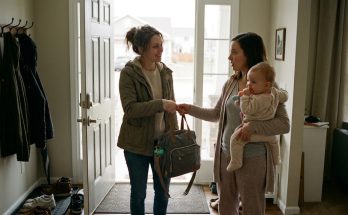
That afternoon, Michelle stopped by with the children.
She had called first.
I was home, so I told her to come over.
Sadie ran inside carrying a drawing.
She wanted to show me a picture of our family.
There were several figures lined up across the page.
Michelle stood beside Todd.
The children were drawn in bright colors.
I was standing near a small white house.
Above me, Sadie had drawn a yellow sun.
I looked at it carefully.
"That's a lovely picture."
She pointed to the house.
"That's yours, Grandma."
"I can tell."
"And this is Mommy's house."
She pointed to another building on the opposite side of the page.
The houses were separate.
The people were connected by a long, crooked line.
"What does this line mean?" I asked.
Sadie shrugged.
"It means we can go visit."
I looked at Michelle.
She had heard.
For a moment, neither of us spoke.
Then Michelle smiled.
"That makes sense."
I put the drawing on the table beside the others.
Sadie wanted to sit on the porch swing.
I went outside with her.
The weather was cool, so I brought a blanket.
She tucked her feet beneath it and leaned against me.
We watched the grain trucks.
She asked why the drivers had to wait.
I told her the same thing I'd told her before.
Everybody had to take a turn.
She nodded as though she had learned something important.
Then she asked whether I was happy in my house.
I looked at the white siding.
I looked at the one step leading to the front door.
I thought about the keys in the bowl beside the sink.
"Yes, sweetheart. I am."
She smiled.
"Good."
Children sometimes make complicated things simple.
That evening, after Michelle and the children left, I put the blanket away.
I checked the windows and locked the doors.
Then I stood at the kitchen sink.
The two keys lay in the bowl.
I picked them up and turned them over in my hand.
One opened the front door.
The other opened the back.
They weren't expensive keys.
They weren't a gift from a wealthy person or a reward for doing something extraordinary.
They were ordinary pieces of metal.
But they represented a decision I'd made when I was frightened and running out of time.
I could have accepted the basement because I was afraid of being alone.
I could have paid the eight hundred dollars and tried to convince myself that the arrangement was fair.
I could have watched the children four days a week and told myself that my own plans no longer mattered.
Perhaps I would have managed.
People manage difficult things every day.
That doesn't mean they should have to accept every difficult thing offered to them.
I had chosen another way.
I had found a small house for five hundred and fifty dollars a month, with electricity separate.
I had chosen a place that allowed me to live within my means.
I had also chosen to keep talking to my daughter.
Those decisions had not made me less of a mother.
They had given me a better chance of remaining one without resentment.
I put the keys back in the bowl.
Then I turned off the kitchen light.
The house was quiet.
I could hear a distant truck near the elevator, but the sound soon faded.
I went to bed thinking about the life I had left behind and the one I was building now.
I missed Dale.
I missed the farmhouse.
I missed the children when they weren't here.
None of that meant I had made the wrong decision.
Love could remain even when people lived in different houses.
Family could survive a disagreement.
And saying no to an arrangement did not have to mean saying no to the people who offered it.
I was sixty-seven years old.
I had spent enough years believing that keeping everyone happy was the same thing as keeping everyone close.
Now I knew better.
I could love Michelle without moving into her basement.
I could help Todd and the children without giving away every day of my week.
I could be a grandmother without becoming an unpaid promise.
And I could be alone in my little house without being abandoned.
The next morning, I would make coffee.
I would open the curtains.
I would decide what to do with my day.
Those were ordinary freedoms.
They were mine.
Click here to continue reading: PART 17: The First Cold Morning in My Little House Brought Back the Basement Offer, but This Time I Knew What My Answer Meant
The Number My Son-in-Law Circled Twice and the Question I Was Too Afraid to Answer at My Daughter’s Table
Part 16 of 20

One Comment on “PART 16 – The Two Keys Beside My Sink Reminded Me That I Could Love My Family Deeply Without Handing Them Every Decision About My Life”