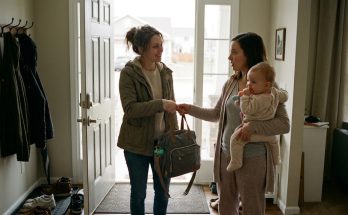
Michelle brought the children over on Saturday.
I had made a simple lunch.
There was soup on the stove, bread on the counter, and a plate of sliced apples ready for the children.
I wasn't trying to make a special occasion out of the visit.
I just wanted everyone to feel welcome.
Sadie came through the door first.
She ran toward the kitchen and stopped beside the table.
"Grandma, is this where we eat?"
"It is."
She climbed into a chair.
Her brother followed, carrying a toy he wanted to show me.
Michelle came in behind them.
She looked around the kitchen and smiled.
"It smells good in here."
"That's the soup."
She put a bag on the counter and began helping me set out the bowls.
There was no need to discuss who had brought what.
We were preparing lunch together.
That was all.
Todd arrived a little later.
He greeted me and asked whether the cupboard hinge was still holding.
I opened the cupboard to show him.
It worked perfectly.
He smiled.
"Good."
Then he sat down with the others.
We ate together.
The children talked over one another.
Sadie told a story about something that had happened at home.
Her brother interrupted to show Todd his toy.
Michelle asked me whether I'd found a better way to keep the kitchen warm.
Todd mentioned that the weather was expected to remain cold.
The conversation moved naturally.
Nobody was keeping score.
After lunch, Michelle helped me clear the table.
Todd took the children outside to look at the porch swing.
Sadie wanted to know whether it moved faster if she pushed with her feet.
I heard Todd telling her to be careful.
Their voices drifted through the open doorway.
Michelle stood beside the sink.
"Mom, can I tell you something?"
I turned toward her.
"Of course."
She dried her hands.
"I've been thinking about that Saturday when we offered you the basement."
I set a plate in the cupboard.
"So have I."
"I wish we'd asked what you needed instead of deciding what we could offer."
I looked at her.
She was speaking quietly, but she wasn't avoiding my eyes.
"I think we wanted to make the situation easy for ourselves," she continued. "You needed somewhere to live, and we needed help with the children and the bills. We put those things together and thought we'd found an answer."
I nodded.
"That's what it felt like."
She took a breath.
"I didn't understand that you might hear it as a price for being part of the family."
I leaned against the counter.
"I didn't want to feel that way."
"I know."
She looked toward the window.
"I was hurt when you chose the other house. I thought you'd rather be alone than live with us."
I waited.
"But I think I was also embarrassed. I'd offered you something I thought was generous, and you didn't want it."
That was an honest thing to admit.
I hadn't considered how much pride might have been involved.
"I wasn't trying to embarrass you," I said.
"I know that now."
She gave a small, sad smile.
"I wish I'd known it then."
"So do I."
We stood quietly for a moment.
Then she reached for my hand.
"I don't want us to go back to being afraid to talk to each other."
"Neither do I."
She squeezed my fingers.
"I want you to know you have a place in our family whether you live in our house or not."
I felt my eyes sting.
"That's all I ever wanted, honey."
She leaned forward and hugged me.
I held her close.
I didn't tell her that everything was forgiven and forgotten.
It wasn't.
I didn't need to.
The important thing was that we were talking honestly now.
We could acknowledge the hurt without making it the only thing that defined us.
When she stepped back, she wiped her eyes.
"I love you, Mom."
"I love you, too."
Outside, Sadie called for us to come see something.
We went to the porch.
She had placed two small stones on the swing.
One was white.
The other was gray.
"These are for your house," she announced.
I looked at them.
"What do they do?"
She shrugged.
"They're just pretty."
I laughed.
"Then I'll keep them."
I carried the stones inside and placed them on the windowsill.
They were ordinary little stones.
But they belonged to a visit that had gone well.
I liked having things in the house that reminded me of the people I loved.
I also liked knowing that I didn't have to live under the same roof to keep those memories close.
Before leaving, Todd came to speak with me.
He stood near the front door, looking a little uncomfortable.
"Judy, I hope you know I'm grateful you gave us another chance."
I studied him.
"I didn't want to lose my family over a bad decision."
He nodded.
"I understand."
"And I don't want you to think the lesson is that you can never talk to me about money."
He looked surprised.
I continued.
"We can discuss expenses. We can talk about what help is needed. We can make plans together. I just need to be part of those decisions when they affect my life."
Todd nodded slowly.
"That's fair."
He paused.
"I should have asked you first."
"Yes, you should have."
He smiled a little, accepting the answer.
"I won't forget that."
I hoped he wouldn't.
When they left, I stood on the porch and watched their car disappear down the road.
Sadie waved from the back seat.
I waved until I couldn't see her anymore.
Then I went inside.
The house was quiet again, but it didn't feel empty in the same way it had during those ten days when Michelle wasn't speaking to me.
I put the remaining dishes away.
I wiped the kitchen table.
I moved the little stones into a safer place on the windowsill.
Then I sat down beside Dale's photograph.
I thought about the life we'd shared.
We had never owned much.
We had lived carefully.
We had worked hard.
We had raised a daughter and watched her build a family of her own.
After Dale died, I had been afraid that losing him would mean losing the rest of the life I understood.
Then the farmhouse had to be returned.
The basement offer had arrived at the same time I was frightened and uncertain.
For a moment, I thought accepting it might be the only way to keep my daughter close.
I was wrong.
The little house had given me something I hadn't known how badly I needed.
Not luxury.
Not security from every possible worry.
A place where I could make my own decisions.
I could pay my rent.
I could decide when to visit Michelle.
I could watch my grandchildren because I wanted to spend time with them, not because four days of my week had been included in an arrangement.
I could say yes.
I could say no.
And I could still be their mother and grandmother.
That was the part I wanted other people to understand.
Sometimes older people accept arrangements that make them unhappy because they are afraid that refusing will leave them alone.
Sometimes families offer help without realizing that the conditions attached to it can make the person receiving it feel smaller.
Neither side has to be cruel for hurt to happen.
But love requires more than good intentions.
It requires listening.
It requires asking.
It requires leaving room for another person to remain themselves.
I had learned that at sixty-seven, sitting at a kitchen table with a piece of paper in front of me.
The eight-hundred-dollar figure had seemed so definite.
It had two dark circles around it, as though the decision had already been made.
But it hadn't been made.
Not until I made my own choice.
I chose the little house.
I chose the rent I could manage.
I chose to keep the keys.
And I chose to keep talking to my daughter, even when the silence hurt.
Those choices did not give me a perfect life.
They gave me a life I could recognize as my own.
That evening, I sat on the porch swing.
The grain trucks moved toward the elevator, one after another.
The air was cold.
I wrapped my sweater around myself and watched the last light fade from the road.
Then I went inside.
I locked the front door.
I placed my keys in the bowl beside the sink.
One opened the front door.
The other opened the back.
I looked at them for a moment before turning off the kitchen light.
They were ordinary keys.
But they reminded me that I had found a place where I could live without asking permission to be myself.
I had my own little house.
I had my family.
I had memories of Dale that would always belong to me.
And I had learned that I didn't have to trade one for another.
I was sixty-seven years old.
I had spent enough years trying to prove that I was useful.
From then on, I wanted to spend my time being present.
A mother.
A grandmother.
A woman with a small house behind the grain elevator and two keys beside her sink.
That was enough.
The End
Read more original stories on Feel Every Story.
The Number My Son-in-Law Circled Twice and the Question I Was Too Afraid to Answer at My Daughter’s Table
Part 20 of 20