I don't remember how long I stood in the kitchen holding Brady's note.
It might have been a minute.
It might have been longer.
I remember the groceries at my feet and the bananas on the island.
I remember thinking that I'd brought home everything needed for a holiday dinner except the one thing that mattered.
A family that cared.
I wanted to cry.
I wanted to call Brady and make him explain himself.
I wanted to hear him say there was a mistake.
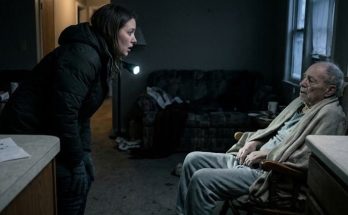
But Victor was still in the living room.
He needed me more than I needed an explanation.
So I put the note down.
I went back to him.
“Victor, I'm going to help you.”
He looked at me, but his expression was distant.
I couldn't tell how much he understood.
I knew enough about emergencies to understand that I couldn't treat this like an ordinary afternoon of caring for a sick relative.
He was elderly.
He had stage-four cancer.
He'd been exposed to dangerous cold, and he appeared severely neglected.
I needed professional medical help.
I also needed to make him more comfortable while I arranged it.
I turned the heating system back on.
The room didn't warm immediately.
I could hear the system starting, but the floor remained cold, and Victor continued to shiver.
I found clean clothes and fresh blankets.
Then I helped him as carefully as I could.
His soaked sweatpants had to be changed.
The mess beneath his chair had to be cleaned.
I didn't want him to feel ashamed, so I kept my voice calm and my movements practical.
I'd learned that approach while caring for wounded soldiers at a forward operating base.
People could endure terrible pain and still feel humiliated when they needed help with ordinary things.
They deserved to keep their dignity.
Victor had spent his life being the man other people depended on.
Now he needed someone to depend on.
I wasn't going to make him feel worse for that.
“Take your time,” I told him.
He nodded faintly.
I cleaned him and helped him into fresh clothes.
Then I replaced the thin blanket with something warmer.
It wasn't enough to fix what had happened, but it was a start.
I looked for water.
I found what I needed and brought it within his reach.
I also prepared some canned soup and warmed it.
The smell of the food seemed almost out of place in that cold room.
I'd imagined roasting a turkey that afternoon.
Instead, I was helping a terminally ill man eat a little soup because he'd been left without proper care.
I sat beside him and offered him small amounts at a time.
He struggled.
I waited between spoonfuls.
I didn't hurry him.
Every movement seemed to cost him something.
Watching him like that made me angry in a way I couldn't easily describe.
It wasn't just anger at Brady.
It wasn't just anger at Elaine.
It was the knowledge that someone had looked at Victor's needs and decided they could wait until Monday.
They had treated his suffering as an inconvenience.
And they'd expected me to arrive and take over without asking a single question.
I kept thinking about the note.
Since you're coming home, you can look after Victor.
That was the message behind it.
They hadn't asked me to help.
They had made the decision for me.
They had left their responsibility in my hands and gone to enjoy themselves.
I looked at Victor.
He was exhausted.
I needed to make sure he received appropriate medical attention and that his pain was managed safely.
I began checking the things they'd left within reach.
That was when I found his prescribed morphine.
The bottle was labeled morphine sulfate.
I picked it up carefully.
Something about the liquid didn't look right to me.
It seemed unusually thin.
I couldn't identify its contents just by looking at it.
I wasn't going to pretend otherwise.
But I had enough medical experience to know that medication meant for a vulnerable patient shouldn't be given when there was a reason to question what was inside.
I set the bottle aside.
I looked at the label again.
Then I looked at Victor.
“Have you been taking this?”
He moved his head slightly.
“Elaine gives me that,” he said.
His voice was weak, and I had to lean closer to hear him.
“Elaine gives it to you?”
He nodded.
I waited a moment before asking the next question.
“Does she pick up your prescriptions?”
“She gets them every week.”
I looked down at the bottle.
The possibility that had entered my mind was ugly.
I didn't want to accuse anyone without evidence.
I didn't know what was in the bottle.
I didn't know whether Victor had received the correct medication.
I certainly couldn't prove that Elaine had taken anything for herself or sold anything to someone else.
But I knew there was a question that needed an answer.
And it wasn't a question I could safely ignore.
I thought about Elaine's recent purchases.
I remembered the designer handbag she'd bought.
I remembered how determined she'd been to book a balcony cabin for the cruise.
Those details had seemed like ordinary examples of her spending before.
Now I couldn't look at them the same way.
I wondered whether the money had come from somewhere it shouldn't have.
I wondered whether Victor had been getting everything he needed.
I wondered how many times he'd sat in that chair waiting for someone who never came.
The questions kept coming.
None of them was proof.
I reminded myself of that.
Anger could make a person careless.
I couldn't afford to be careless with Victor's life.
I arranged for him to receive urgent medical care and proper pain relief rather than risk giving him medication I couldn't verify.
I kept the suspicious bottle.
I intended to have its contents professionally examined.
There would be no guessing.
No accusations based on appearance.
No confrontation that could destroy evidence before anyone had a chance to examine it.
I wanted answers.
Real ones.
I also wanted Victor to understand that he wasn't responsible for what had happened to him.
He hadn't caused this by being sick.
He hadn't caused it by needing help.
And he hadn't done anything wrong by trusting the people who were supposed to care for him.
I pulled my chair closer.
He was looking at the floor.
“Victor, can I ask you something?”
He turned toward me.
I held his hand.
“Have you been getting all your medicine?”
His eyes changed.
Not much.
Just enough for me to notice.
He looked tired, but there was something else beneath the exhaustion.
Something that made me stop asking questions for a moment.
I waited.
He swallowed.
Then he spoke.
“She needs money.”
I leaned closer.
“Who does?”
“Elaine.”
He paused to catch his breath.
“For the trip,” he said. “And those handbags.”
I felt his fingers tighten around mine.
It was the first time he'd said anything that suggested he understood what was happening around him.
He knew about the spending.
He knew about the vacation.
And he had been suffering while it continued.
I wanted to ask him everything at once.
I wanted to know what Elaine had done, what Brady knew, and how long Victor had been living like this.
But he was weak, and I wasn't going to turn his chair into an interrogation room.
I squeezed his hand gently.
“You don't have to deal with them right now,” I told him.
He looked at me.
“I'm here.”
For a while, neither of us spoke.
The heating system continued running.
The blanket rested around his shoulders.
And Brady's note remained on the kitchen island, waiting for the people who had written it to come home.
Click here to continue reading: PART 3: Victor Had Barely Enough Strength to Speak, Yet His Next Words Made Me Question Everything I Thought I Knew About Him
I Thought I Was Coming Home for Thanksgiving, Until the Cold Inside That House Told Me Something Was Terribly Wrong
Part 2 of 20