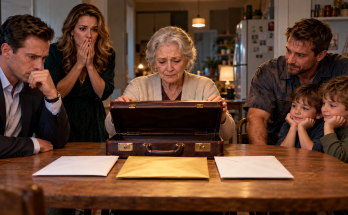
The lawyer adjusted his glasses.
“There’s one final section,” he repeated, “concerning the residence at 1847 Willow Creek Drive.”
Brianna’s smile disappeared.
I stared at the polished conference table.
That address had been my home for six years.
It was where my son had made coffee every morning before work. Where he’d insisted on planting roses beneath the kitchen window because his father had once grown them for me. Where he’d brought me after my husband died and said, “Mom, you shouldn’t have to be alone.”
And it was the house I’d been forced to leave before the flowers from Nathan’s funeral had even begun to wilt.
The attorney, Mr. Harrison, turned another page.
“Before proceeding, I need to clarify something about the property’s ownership.”
Brianna leaned forward.
“What do you mean?”
He looked at her.
“The residence is not part of Nathan’s probate estate.”
Silence.
Brianna blinked.
“Excuse me?”
Mr. Harrison folded his hands.
“The house was transferred into a separate trust three years ago.”
I lifted my head.
“A trust?”
He nodded.
“Yes, Mrs. Whitmore.”
My name was Eleanor Whitmore.
And until that moment, I had believed my son had left me nothing but memories.
Mr. Harrison continued.
“The trust identifies you as its primary lifetime beneficiary.”
Brianna stared at him.
“What?”
He looked down at the document.
“Under the terms of the trust, Mrs. Whitmore has the right to occupy the residence for the remainder of her life, subject to the provisions outlined here.”
My breath caught.
Brianna shook her head.
“No. That’s impossible.”
Mr. Harrison’s expression remained calm.
“The trust was properly executed, and the property records reflect its ownership.”
She looked at me.
Then back at him.
“But I’m his wife.”
“Yes,” he replied. “And Nathan made substantial provisions for you in his will.”
Brianna’s voice rose.
“Then the house should be mine!”
Mr. Harrison paused.
“Your husband made a different arrangement concerning the house.”
He slid a certified document across the table.
And there, beneath several paragraphs of legal language, was my son’s signature.
Nathan Daniel Whitmore.
The handwriting I knew better than my own.
My hands began trembling.
Brianna’s face turned pale.
Then Mr. Harrison said something that made the entire room feel as though it had stopped moving.
“There’s also a letter Nathan instructed me to give his mother if she was ever asked to leave.”
I couldn’t breathe.
Because my son had known.
Somehow, before he died, he’d known.
My name is Eleanor Whitmore.
I’m sixty-eight years old, a widow, a mother, and, until recently, a woman who believed she understood what it meant to lose everything.
My husband, Daniel, died seven years ago after thirty-nine years of marriage.
He was a quiet man who repaired appliances for a living, kept a vegetable garden behind our little house, and believed there was no problem that couldn’t be made slightly better with a cup of tea and a patient conversation.
When he died, the silence in our home became unbearable.
Every room seemed to be waiting for him.
His slippers remained beside the bed.
His work jacket hung behind the kitchen door.
And every morning, for nearly six months, I made two cups of coffee before remembering there was no one to drink the second.
Nathan was our only child.
He was thirty-eight when his father died.
He worked in commercial construction management and had inherited Daniel’s steady temperament.
He didn’t speak unnecessarily.
But when he made a promise, he kept it.
One Sunday afternoon, he came to visit me.
I was sitting at the kitchen table sorting through old photographs.
He looked around the house.
Then sat beside me.
“Mom, I want to talk about something.”
I smiled faintly.
“That sounds serious.”
He reached for my hand.
“I want you to come live with us.”
I shook my head immediately.
“Nathan, you and Brianna need your privacy.”
“We have plenty of room.”
“I don’t want to become a burden.”
He looked almost offended.
“Mom, you raised me.”
“That doesn’t mean you owe me a bedroom.”
He smiled.
“No. But it means I want you in my life.”
I looked down.
He continued.
“Dad wouldn’t want you sitting here alone.”
My eyes filled.
Nathan squeezed my hand.
“And neither do I.”
Three months later, I moved into the house on Willow Creek Drive.
I thought it would be the beginning of a peaceful new chapter.
For a while, it was.
The house was beautiful.
Two stories.
Cream-colored siding.
A wide front porch.
Four bedrooms.
A large kitchen overlooking a fenced backyard.
Nathan had purchased it shortly before marrying Brianna.
He loved the neighborhood.
The quiet streets.
The old maple trees.
The little walking path that wound behind the houses.
He converted the downstairs guest room into a comfortable space for me.
A reading chair beside the window.
A small television.
Bookshelves.
A quilt I’d made when he was a teenager.
He even placed a framed photograph of Daniel on the dresser.
The first evening I slept there, Nathan knocked on my door.
“Everything okay, Mom?”
I smiled.
“It’s lovely.”
He leaned against the doorway.
“Good.”
Then he grinned.
“And if you hear noises upstairs, that’s just Brianna watching crime documentaries at midnight.”
I laughed.
He laughed too.
I remember that moment so clearly now.
The ordinary happiness of it.
The feeling that life, after so much grief, might still have room for kindness.
Brianna was polite at first.
She was thirty-two when I moved in.
Beautiful.
Ambitious.
Always carefully dressed.
She worked in luxury real estate marketing and seemed to measure success through appearances.
Designer furniture.
Expensive vacations.
Immaculate countertops.
Perfect photographs.
She wasn’t openly cruel in the beginning.
Her displeasure arrived in small ways.
A sigh when I left my knitting on the sofa.
A comment about my cooking.
A suggestion that I should eat dinner earlier because she and Nathan needed time alone.
I tried to be considerate.
I cleaned up after myself.
Bought groceries.
Helped with laundry.
Cooked meals.
And stayed in my room whenever they entertained guests.
But the rules kept changing.
One afternoon, I was arranging flowers in the kitchen when Brianna walked in.
She looked at the vase.
“Eleanor, those don’t match the room.”
I blinked.
“They’re from the garden.”
“I know, but the colors clash.”
I looked at the yellow roses.
Nathan had planted them for me.
“I can move them.”
She sighed.
“Please.”
I carried the vase back to my room.
That evening, Nathan noticed.
“Mom, where are the roses?”
I hesitated.
“In my room.”
“Why?”
I smiled.
“I thought they’d look nice there.”
He studied me.
Then looked toward Brianna.
I saw something change in his expression.
But he didn’t press the issue.
Not then.
Over the next few years, Brianna became more comfortable showing her irritation.
She began referring to my bedroom as “the guest room.”
Then “the spare room.”
Eventually, when friends visited, she called it “the room we’re planning to renovate.”
I learned about that plan during a dinner party.
One of Brianna’s friends asked whether she and Nathan wanted children.
Brianna laughed.
“Eventually. But first we need to reclaim some space.”
Her eyes moved toward me.
“We’ve had a long-term guest.”
The women around the table chuckled.
I smiled politely.
Nathan didn’t.
He set down his fork.
“Mom isn’t a guest.”
Brianna’s smile tightened.
“I didn’t mean anything by it.”
Nathan looked at her.
“Then don’t say it.”
The table went quiet.
I stared at my plate.
Later that night, Brianna blamed me for embarrassing her.
“You always make Nathan feel guilty,” she said.
I stood beside the kitchen sink.
“I didn’t say anything.”
“Exactly. You sit there looking wounded, and he rushes to defend you.”
I swallowed.
“Brianna, I don’t want to cause trouble.”
She crossed her arms.
“Then maybe you should think about getting your own place.”
I nodded.
“I’ll speak with Nathan.”
Her expression changed.
“No. Don’t involve him.”
I looked at her.
“Why?”
She hesitated.
“Because he’ll make it into a bigger issue.”
I said nothing.
But that was the first time I understood that Brianna’s kindness depended on Nathan not knowing how she treated me when he wasn’t around.
Nathan’s health began declining the following year.
At first, it was exhaustion.
Then headaches.
Then episodes of dizziness.
He blamed long hours at work.
Stress.
Poor sleep.
Eventually, after several medical appointments and tests, the doctors discovered a serious neurological illness.
Our world changed.
There were hospital visits.
Treatment plans.
Medication schedules.
Days when Nathan seemed almost like himself.
And days when getting out of bed required more energy than he had.
I stayed beside him whenever he wanted me there.
Brianna did too, at first.
She organized appointments.
Managed phone calls.
Handled insurance paperwork.
But as the months passed, the strain began showing.
She became impatient.
Angry.
Sometimes she snapped at Nathan.
Sometimes at me.
I tried not to judge her too harshly.
Illness can bring out fear in people.
And fear doesn’t always look gentle.
But I also knew that being frightened didn’t make cruelty harmless.
One evening, Nathan asked me to sit with him.
He was resting in the downstairs bedroom because climbing stairs had become difficult.
The room was quiet.
Rain tapped against the window.
He looked tired.
“Mom?”
“Yes, sweetheart?”
“Are you happy here?”
I hesitated.
“Of course.”
He studied my face.
“Really?”
I looked down.
“Nathan, you have enough to worry about.”
He reached for my hand.
“That’s not what I asked.”
I swallowed.
“I love being near you.”
He smiled sadly.
“But?”
I stared at the quilt across his legs.
“Brianna wants more space.”
His expression hardened.
“Did she tell you that?”
I nodded.
“Sometimes.”
He closed his eyes.
For a long moment, he said nothing.
Then he whispered, “I thought so.”
I looked at him.
“Nathan, please don’t argue with her.”
He shook his head.
“Mom, you shouldn’t have to spend your life trying not to upset someone.”
My eyes filled.
He squeezed my hand.
“I’ll take care of it.”
I tried to smile.
“You need to take care of yourself.”
He looked at me.
“I can do both.”
I didn’t know what he meant.
I assumed he would speak to Brianna.
Perhaps ask her to be more patient.
Perhaps suggest we find a better arrangement.
I never imagined he had already been making legal preparations.
Nathan had always been careful with money.
He’d inherited that from Daniel.
He maintained savings.
Invested steadily.
Kept records.
And consulted professionals before making major financial decisions.
What I didn’t know was that three years earlier, after noticing how Brianna treated me, he had begun reviewing his estate plan.
He’d met with Mr. Harrison.
Discussed the house.
Considered his responsibilities to his wife.
And created a trust intended to protect my ability to remain in the home if he died before me.
He hadn’t told me.
Later, I learned why.
He knew I would have protested.
I would have told him not to worry.
Not to complicate his marriage.
Not to spend money on lawyers.
And he knew I might have insisted on moving out simply to keep the peace.
So he quietly made arrangements.
Then returned home.
And continued being my son.
The final months were difficult.
Nathan grew weaker.
Some days he could barely speak.
Other days, he wanted to talk for hours.
We discussed his childhood.
His father.
The camping trips we’d taken.
The time he broke the kitchen window playing baseball.
The terrible haircut I’d given him when he was seven.
He laughed whenever I mentioned that haircut.
“Mom, you made me look like a mushroom.”
I laughed through tears.
“You moved your head.”
“I was seven!”
We laughed until he became tired.
Then I held his hand.
And we sat quietly together.
One afternoon, he looked at me.
“Mom?”
“Yes?”
“Promise me something.”
I swallowed.
“Anything.”
“Don’t let anyone make you feel like you don’t belong.”
My throat tightened.
“Nathan—”
“Promise.”
I nodded.
“I promise.”
He smiled.
“Good.”
I didn’t know those would become some of the last words he ever said to me.
Nathan died on a Sunday morning.
He was forty-four.
I was sitting beside his bed.
Brianna stood near the window.
The nurse had just stepped into the hallway.
Nathan’s breathing slowed.
I held his hand.
And then he was gone.
There are moments when the world changes so completely that the mind refuses to understand what has happened.
I remember looking at his face.
Waiting for him to breathe again.
Waiting for his eyes to open.
Waiting for someone to tell me there had been a mistake.
But there was no mistake.
My son was gone.
And with him went the last living person who remembered every version of me.
The young mother.
The exhausted wife.
The woman who burned pancakes on Sunday mornings.
The woman who cried when he left for college.
The woman who had spent her entire adult life loving him.
I kissed his forehead.
Then whispered, “I love you, sweetheart.”
And for the first time in forty-four years, he couldn’t answer.
The funeral took place five days later.
The church was full.
Coworkers.
Neighbors.
Friends.
Relatives.
People who had known Nathan at different stages of his life.
They spoke about his kindness.
His reliability.
His quiet humor.
His habit of helping people without expecting recognition.
I listened.
I cried.
And I tried to memorize every story.
Because each one gave me another small piece of my son.
After the burial, everyone returned to the house.
There were casseroles.
Coffee.
Paper plates.
Soft conversations.
And the strange, unbearable normality of people discussing traffic while my son’s photograph stood beside a vase of white lilies.
I was standing near the kitchen when Brianna approached.
She wore a black dress and pearl earrings.
Her makeup was flawless.
“Eleanor.”
I turned.
“Yes?”
She looked directly at me.
“Tomorrow you need to get out.”
I stared at her.
“What?”
“This house isn’t your place anymore.”
My breath caught.
“Brianna, Nathan was buried two hours ago.”
She folded her arms.
“I know.”
I looked toward the living room.
Several relatives were nearby.
One of them stopped talking.
I lowered my voice.
“Can we discuss this later?”
She shook her head.
“No. I’ve waited long enough.”
I felt my knees weaken.
“Where am I supposed to go?”
She shrugged.
“You’ll figure something out.”
I stared at her.
She continued.
“Nathan left everything to me.”
I swallowed.
“I understand.”
Her expression softened slightly, but only because she believed she’d won.
“Then please don’t make this difficult.”
I looked toward my son’s photograph.
And I made a decision.
I would not turn his funeral into a public argument.
I nodded.
“All right.”
Then I went upstairs.
And packed.
I spent the first night at a roadside motel.
The mattress was too soft.
The air conditioner rattled.
The curtains didn’t close completely.
I sat on the edge of the bed holding Nathan’s old sweater.
It was navy blue.
He’d bought it for me years earlier because he said I always complained about being cold.
I pressed it against my face.
And cried until my chest hurt.
Not because I’d lost a house.
Because I’d lost my son.
And the place where I had cared for him during his final months had been taken from me before I could even begin to grieve.
Two days later, Brianna sent a text.
Will reading Thursday. 10 a.m. Harrison & Cole.
No greeting.
No question about where I was staying.
Just instructions.
I almost didn’t go.
I assumed there was nothing for me.
Nathan had been married.
He had built a life with Brianna.
I didn’t expect an inheritance.
But I wanted to hear his final wishes.
So I went.
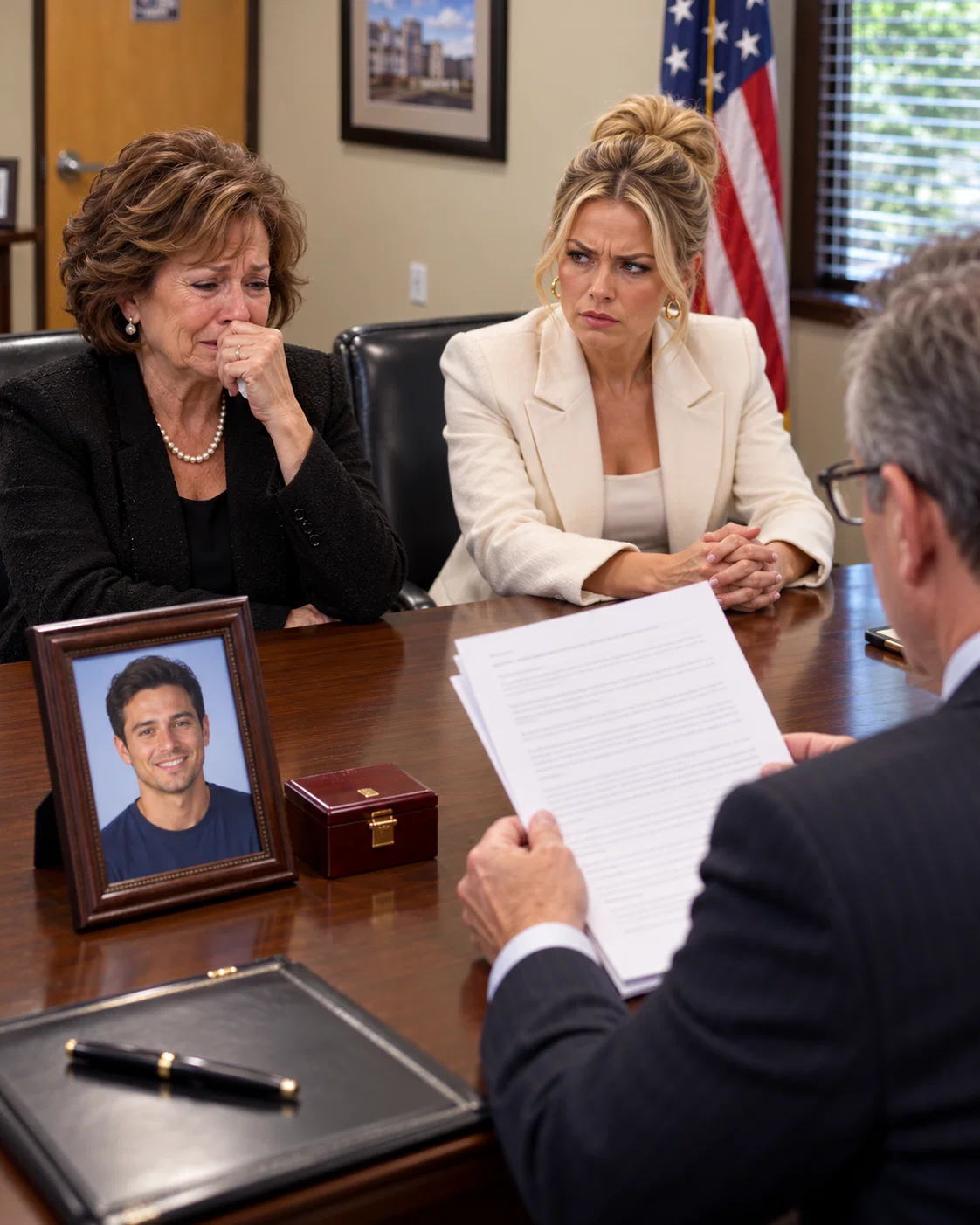
Mr. Harrison’s office occupied the sixth floor of a downtown building.
The conference room had large windows overlooking the city.
Brianna sat across from me.
She wore a cream blazer and expensive earrings.
Beside her sat her older brother, Lucas.
He barely acknowledged me.
Mr. Harrison began reviewing Nathan’s will.
There were bank accounts.
Investments.
Personal belongings.
Insurance proceeds payable to named beneficiaries.
And several provisions benefiting Brianna.
I listened quietly.
Each time Mr. Harrison said “to my wife,” Brianna’s smile grew.
Then she leaned toward me.
“Hope you get used to having nowhere to go,” she whispered.
I stared at her.
She continued.
“Because I made sure you get nothing.”
I looked down at my hands.
They were trembling.
I folded them together.
Then Mr. Harrison turned a page.
“There is one final section.”
Brianna leaned back.
And everything changed.
“The residence at 1847 Willow Creek Drive,” he began, “is held in the Nathan D. Whitmore Residence Trust.”
Brianna frowned.
“What trust?”
Mr. Harrison looked at her.
“The trust your husband established three years ago.”
She stared.
“He never told me about that.”
Mr. Harrison remained calm.
“I can explain the documents and the provisions relevant to each of you.”
He turned toward me.
“Mrs. Whitmore, your son named you as the primary lifetime beneficiary of the residence.”
I blinked.
“I don’t understand.”
He spoke gently.
“Subject to the trust’s terms, you have the right to live in the house for the rest of your life.”
My mouth went dry.
Brianna sat forward.
“No.”
Mr. Harrison continued.
“The trust also provides for certain maintenance expenses through designated assets.”
Brianna shook her head.
“This is ridiculous.”
He looked at her.
“Nathan made substantial provisions for you separately.”
She pointed toward me.
“But she doesn’t own the house!”
Mr. Harrison nodded.
“Correct. The trust owns the property.”
Brianna stared.
“And the trust gives Mrs. Whitmore a protected right of occupancy.”
Silence.
I could hear the air conditioner humming.
Brianna’s brother looked at her.
Then at the documents.
She turned pale.
“What happens when she dies?”
Mr. Harrison reviewed the relevant section.
“The remaining property interest is to be distributed according to the trust’s remainder provisions.”
He explained that Nathan had directed the eventual sale of the house, with the net proceeds going to a charitable foundation supporting families facing serious illness.
I stared at him.
Brianna’s mouth fell open.
“So I don’t get the house?”
Mr. Harrison answered carefully.
“Not under the current trust documents.”
For several seconds, nobody moved.
Then Brianna whispered, “He couldn’t have done that.”
Mr. Harrison looked at her.
“He did.”
I barely heard the rest.
My mind kept returning to Nathan.
The evening he asked whether I was happy.
The way he squeezed my hand.
The promise he’d made.
I’ll take care of it.
He had.
Even while fighting for his own life, he had thought about mine.
Mr. Harrison reached for a sealed envelope.
“Mrs. Whitmore, Nathan left this for you.”
I stared.
“My son?”
He nodded.
“Yes.”
I took it.
My name was written across the front.
In Nathan’s handwriting.
My hands trembled as I opened it.
Mom,
If you’re reading this, then I’m gone, and I wish more than anything that I could be sitting beside you right now.
I covered my mouth.
I know you’ll tell everyone you’re fine.
I know you’ll say you don’t need anything.
And I know you’ll try to make yourself smaller so nobody else feels uncomfortable.
Tears blurred the page.
But Mom, you spent your life making room for me.
You made room for my mistakes.
My dreams.
My bad decisions.
My friends.
My broken heart.
My growing pains.
And when Dad died, you tried to carry your grief without making it anyone else’s problem.
I pressed the letter against my chest.
Then forced myself to continue.
I don’t want you to spend the rest of your life wondering where you belong.
You belong in the home where we shared so many good years.
You belong somewhere you can sit in the garden and remember Dad.
You belong somewhere you can make coffee without asking permission.
And you belong somewhere nobody can tell you you’re an inconvenience.
I began sobbing.
Mr. Harrison waited.
Brianna stared at the table.
The letter continued.
I know Brianna has sometimes made you feel unwelcome.
I’ve tried to address it.
I don’t know what will happen after I’m gone.
But I wanted to make sure you were protected.
Please don’t feel guilty.
This isn’t a punishment for anyone.
It’s my way of keeping a promise.
You took care of me.
Now let me take care of you.
I love you, Mom.
Nathan.
I couldn’t read the last line aloud.
I simply held the letter.
And cried.
Brianna was the first to break the silence.
“This is unfair.”
Mr. Harrison looked at her.
“Mrs. Whitmore—”
“No.”
She stood.
“He was my husband.”
Her voice shook.
“I took care of him.”
I looked up.
For a moment, I saw something beneath her anger.
Grief.
Fear.
Perhaps even guilt.
But then she turned toward me.
“You manipulated him.”
I stared.
“What?”
“You made him feel responsible for you.”
I shook my head.
“Brianna, I didn’t know about any of this.”
She laughed bitterly.
“Of course you didn’t.”
Mr. Harrison intervened.
“The records indicate Nathan made these arrangements independently with legal advice.”
Brianna looked at him.
“I want to challenge it.”
He nodded.
“You may seek independent legal counsel regarding any rights or claims you believe you have.”
She grabbed her handbag.
“This isn’t over.”
Then she walked out.
Lucas followed.
I remained seated.
My hands were still shaking.
Mr. Harrison waited.
Then asked gently, “Mrs. Whitmore, are you all right?”
I looked at him.
“No.”
My voice broke.
“My son is dead.”
He nodded.
“I know.”
I looked down at the letter.
“But he remembered me.”
Mr. Harrison’s eyes softened.
“Yes.”
He paused.
“He did.”
The next few weeks were complicated.
I didn’t move back into the house immediately.
Mr. Harrison advised that we first review the trust documents, confirm the property’s status, and address the practical and legal issues created by my departure.
Brianna had changed the locks.
She refused to provide keys.
And she told neighbors I was trying to steal her home.
I didn’t argue publicly.
I hired independent counsel.
Her name was Rebecca Stone.
She was a woman in her early fifties with a calm voice and a habit of reading every document twice.
After reviewing the trust, she looked at me.
“Eleanor, your son made a very deliberate arrangement.”
I nodded.
“Can Brianna take the house?”
Rebecca answered carefully.
“She may have legal rights or claims that need to be evaluated, and the trust must be administered properly. But the documents establish a significant right of occupancy in your favor.”
I looked down.
“I don’t want to fight.”
Rebecca’s expression softened.
“I understand.”
She paused.
“But you don’t have to surrender a legal right simply because someone else is angry about it.”
I swallowed.
Then nodded.
“All right.”
Brianna’s attorney contacted Rebecca.
There were letters.
Requests for records.
Questions about the trust.
And disagreements about the property’s use.
The process took time.
But eventually, after reviewing the documents and negotiating practical arrangements, Brianna agreed to vacate the house.
She had received other assets under Nathan’s estate plan.
She was not left penniless.
But she was furious that the house wasn’t hers to sell.
The day she moved out, I didn’t go.
I stayed with my friend Helen.
Helen had been my neighbor years earlier.
She’d invited me to stay in her guest room when she learned what happened.
“You should have called me sooner,” she said.
I smiled sadly.
“I didn’t want to impose.”
She rolled her eyes.
“Eleanor, you’re sixty-eight. You can stop apologizing for needing a bed.”
I laughed.
Then cried.
She hugged me.
And I realized that even after losing Nathan, I wasn’t entirely alone.
Three months after the funeral, I returned to Willow Creek Drive.
Rebecca met me at the house.
She handed me a key.
I stared at it.
The metal felt cold in my palm.
“Ready?” she asked.
I nodded.
We walked toward the front door.
The roses beneath the kitchen window were blooming.
Yellow.
Bright.
Beautiful.
Nathan had planted them for me.
I touched one of the petals.
Then unlocked the door.
The house smelled different.
Brianna had removed most of the furniture she’d owned.
The walls looked bare.
The living room echoed.
But the sunlight still fell through the windows in the same way.
The kitchen still overlooked the backyard.
And Nathan’s old coffee mug remained on a shelf.
I picked it up.
Held it carefully.
Then sat at the kitchen table.
For a long time, I didn’t move.
Rebecca waited near the doorway.
Finally, I whispered, “I’m home.”
The first night was difficult.
Every room reminded me of Nathan.
His laughter.
His footsteps.
His voice calling from the hallway.
I cried while making dinner.
Cried while washing dishes.
Cried when I passed the downstairs bedroom where he’d spent his final months.
But grief felt different there.
At the motel, it had been mixed with fear.
Fear about money.
Fear about where I’d sleep.
Fear about what would happen next.
At home, grief was still painful.
But it had room to breathe.
I could sit in the garden.
Look at the roses.
Hold Nathan’s sweater.
And remember him without wondering whether someone would tell me to leave.
Over the next year, I slowly rebuilt my life.
I joined a local gardening club.
Volunteered at a community center.
Started attending a grief support group.
And reconnected with friends I’d neglected while caring for Nathan.
I wasn’t suddenly happy.
I missed my son every day.
Some mornings, the pain felt as sharp as it had the day he died.
Other mornings, I could remember something funny he’d said and smile before the tears came.
I learned that grief doesn’t move in a straight line.
It changes shape.
It becomes part of the life you continue living.
Brianna and I didn’t speak for almost a year.
Then one afternoon, she called.
I stared at her name on the screen.
I considered letting it ring.
But eventually, I answered.
“Hello?”
“Eleanor?”
Her voice sounded different.
Tired.
Uncertain.
“Yes?”
There was a long silence.
Then she whispered, “I’ve been thinking about Nathan.”
My throat tightened.
“So have I.”
She began crying.
“I miss him.”
I closed my eyes.
“I know.”
She swallowed.
“I was angry after he died.”
I said nothing.
She continued.
“I was scared.”
I looked toward the garden.
“Brianna, I understand being scared.”
She began crying harder.
“But you hurt me.”
Silence.
I continued.
“You told me to leave my son’s home on the day we buried him.”
Her voice broke.
“I know.”
“You made me feel like I had no place in his life.”
She sobbed.
“I know.”
I took a breath.
“And I need you to understand that grief doesn’t excuse that.”
She whispered, “I’m sorry.”
I closed my eyes.
For a long moment, neither of us spoke.
Then I said, “Thank you for saying that.”
We didn’t become close overnight.
There were too many painful memories.
Too much mistrust.
Too much grief.
But gradually, we began speaking occasionally.
At first, about Nathan.
His favorite foods.
His terrible jokes.
His habit of leaving tools on the kitchen counter.
Then about ordinary things.
Work.
Weather.
Life.
Brianna eventually admitted that she’d been terrified about her financial future after Nathan’s diagnosis.
She’d assumed the house would be hers.
She’d built plans around selling it.
And when she learned Nathan had protected my right to remain there, she’d felt betrayed.
I listened.
Then told her something important.
“Brianna, Nathan loved you.”
She began crying.
“I know.”
“He wanted you to be secure.”
She nodded.
“But he wanted me to be secure too.”
She looked down.
I continued.
“Those things weren’t supposed to be enemies.”
She wiped her eyes.
“I understand that now.”
I hoped she did.
Two years after Nathan died, Brianna visited the house for the first time.
She stood on the porch holding a small cardboard box.
I opened the door.
“Hello, Brianna.”
She smiled nervously.
“Hi, Eleanor.”
I stepped aside.
“Come in.”
She entered slowly.
Her eyes moved around the living room.
Then toward the kitchen.
“It looks nice.”
“Thank you.”
She swallowed.
“I brought something.”
She handed me the box.
Inside were photographs.
Nathan as a teenager.
Nathan on his wedding day.
Nathan laughing beside a lake.
Nathan holding a ridiculous birthday cake shaped like a toolbox.
I began crying.
Brianna wiped her eyes.
“I found these while sorting through storage.”
I looked up.
“Thank you.”
She nodded.
“I thought you should have them.”
I held the box carefully.
Then said, “Would you like some tea?”
She hesitated.
Then smiled faintly.
“Yes.”
We sat at the kitchen table.
The same table where Nathan used to drink his morning coffee.
For the first time since his death, Brianna and I spoke about him without arguing over what he’d left behind.
That afternoon, we walked into the garden.
The roses were blooming.
Brianna stopped beside them.
“Nathan planted these for you, didn’t he?”
I nodded.
“Yes.”
She smiled sadly.
“He was so proud of them.”
I laughed softly.
“He planted them too close together.”
She laughed through tears.
“He did.”
I looked toward the flowers.
“He wouldn’t let me move them.”
Brianna smiled.
“He said they’d figure it out.”
We both laughed.
Then cried.
And for one brief moment, grief made us companions instead of enemies.
Three years after Nathan’s death, I received a letter from Mr. Harrison.
It concerned the trust’s annual administration.
There were financial statements.
Maintenance expenses.
Property records.
And a brief note reminding me that the arrangements Nathan had made remained in effect.
I placed the letter beside his photograph.
Then sat down with a cup of tea.
I thought about the day Brianna told me to leave.
The motel.
The will reading.
The final section.
The letter from my son.
The legal process.
The return home.
And the slow rebuilding of a life I hadn’t expected to continue living.
I realized something.
Nathan hadn’t left me a house because he thought I was helpless.
He’d left me security because he knew how much I’d already carried.
He wanted me to have a place where I could grieve without fear.
A place where I could grow older without feeling unwanted.
A place where I could remember him.
People sometimes ask whether I think Nathan was unfair to Brianna.
I understand the question.
She was his wife.
They had built a life together.
She had cared for him during a devastating illness.
And she was grieving too.
But Nathan’s estate plan provided for her separately.
He hadn’t tried to leave her with nothing.
He’d simply made sure that caring for his wife didn’t require leaving his mother without a home.
Those were two different responsibilities.
And he’d tried to honor both.
On the fourth anniversary of Nathan’s death, I planted another rosebush.
A white one.
Beside the yellow roses.
Helen came over to help.
We dug the hole together.
Mixed compost into the soil.
Set the roots carefully.
Then watered the plant.
Helen stepped back.
“Beautiful.”
I smiled.
“Yes.”
She looked at me.
“Why white?”
I stared at the flowers.
“Because Nathan always said yellow roses reminded him of sunshine.”
Helen nodded.
“And white?”
I smiled sadly.
“Peace.”
She reached for my hand.
We stood together in the garden.
And for the first time in years, I felt something close to it.
That evening, I sat on the porch with Nathan’s letter.
The paper had softened from being unfolded so many times.
I knew every word.
But I read it again.
You belong somewhere nobody can tell you you’re an inconvenience.
I looked toward the house.
The windows glowed warmly.
The roses moved in the evening breeze.
And I thought about the woman I’d been when I drove away at four in the morning with four suitcases and a box of photographs.
She’d believed she had lost everything.
Her husband.
Her son.
Her home.
Her place in the world.
But she hadn’t lost everything.
She’d lost the people she loved most.
And that loss would always matter.
Yet she’d also discovered that her life still deserved protection.
That her grief still deserved dignity.
And that the love Nathan had given her did not disappear simply because he was gone.
Years later, when people ask about the will reading, they often focus on Brianna’s expression.
The way her smile vanished.
The way she froze when Mr. Harrison mentioned the trust.
The way she discovered that the house she’d planned to sell wasn’t hers to control.
But that’s not the moment I remember most.
I remember the envelope.
My name written in Nathan’s handwriting.
The first line of his letter.
And the realization that even while facing the end of his own life, my son had been thinking about how to protect mine.
I remember holding that paper.
And hearing his voice in every sentence.
The day we buried Nathan, Brianna told me I no longer belonged in his house.
She believed she could erase my place in his life by changing the locks.
She believed the will would prove I had nothing.
And for several terrible days, I believed her.
Then the lawyer turned one final page.
And my son, through the arrangements he’d made while he was alive, gave me something I hadn’t expected.
Not wealth.
Not revenge.
Not victory over his wife.
He gave me a place to grieve.
A place to remember.
A place to grow old.
A place to belong.
Brianna thought the final section of the will would leave me with nothing.
Instead, it revealed that my son had spent his final years making sure I would never be left with nowhere to go.
And every morning, when I open the curtains and see the yellow roses beneath the kitchen window, I whisper the same words.
“Thank you, Nathan.”
Then I make my coffee.
Sit in my favorite chair.
And remember the promise he made.
I’ll take care of it.
He did.
And though I would trade every wall, every window, and every rose in that garden for one more moment with my son, I know what he wanted me to understand.
A home is not simply a place someone allows you to stay.
It’s a place where love has made room for you—even after the person who loved you is gone.