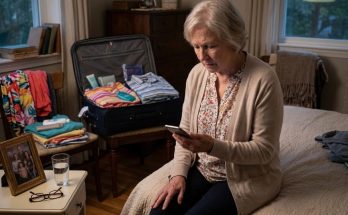
I used to believe that if I raised my children with love, they would remember it when I needed them.
After Walt died, I learned that love and obligation were not always the same thing.
The first week without him, I barely touched anything in our house.
His reading glasses stayed beside his chair.
His slippers remained near the bedroom door.
Even his old leather briefcase sat where he had left it, tucked into the front closet beneath a row of coats.
I couldn't bring myself to move any of it.
The house was quiet in a way I had never experienced before.
For forty years, there had always been something to hear.
The television murmuring in the evening.
Walt clearing his throat before he spoke.
The familiar squeak of the kitchen chair he refused to replace.
Now there was only the refrigerator humming and the occasional car passing outside.
I kept expecting him to walk through the door.
Then I would remember.
The funeral had been over for days, but I still found myself setting out two cups whenever I made coffee.
I stopped doing that after the third morning.
It seemed foolish to keep making the same mistake.
But grief makes a person do things she would never explain to anyone else.
Walt had been my husband for decades.
He knew the sound of my footsteps.
He knew when I was pretending to be fine.
And he knew exactly how frightened I could become when money entered a conversation.
That was why he had kept our financial situation private.
Two years before he became ill, he sold his transport business.
It had taken years of work to build it.
Long days.
Late nights.
Unexpected repairs.
Employees who depended on him to keep the business running.
When he finally sold it, I thought we would change everything about our lives.
A bigger house.
A newer car.
Perhaps a long trip somewhere neither of us had ever visited.
Walt had other ideas.
He wanted to keep our little house.
He wanted to keep driving our dependable sedan.
He still carried coupons in his wallet and compared grocery prices as if we were living on the same narrow budget we had known when the children were small.
At first, I argued with him.
"We don't have to live like this anymore."
He looked up from the newspaper.
"Why not?"
"Because you've worked your whole life. We can finally enjoy it."
"We are enjoying it."
He pointed toward the kitchen.
"We have food, a roof, and each other. What else do we need every day?"
I couldn't argue with that.
Not honestly.
The money from the sale was substantial.
Walt had made sure our future was secure, and after the sale, we no longer had the financial worries that had followed us through the early years of our marriage.
But we never told Michael, Stephanie, or Danny.
Walt believed that announcing our wealth would change the way our children treated us.
He didn't want their visits to become requests for help.
He didn't want every family gathering to turn into a discussion about money.
Most of all, he wanted to know whether they would love us without knowing what we could give them.
One evening, while he was sorting through a stack of grocery receipts, he explained it in a way I never forgot.
"Money has a way of showing you things about people, Dolores. Sometimes things you wish you didn't know."
I folded a receipt in half.
"They're our children."
"I know."
He took off his glasses and rubbed his eyes.
"That's exactly why I want to be sure."
I thought he was being too suspicious.
Michael was successful.
Stephanie had a comfortable home and a family of her own.
Danny struggled more than the other two, but he had always been generous with whatever little he possessed.
I believed Walt was worrying over something that might never happen.
I was wrong.
The funeral reception gave me the first reason to wonder.
Michael arrived in an expensive suit and spent most of the afternoon looking down at his phone.
People approached him to offer their condolences.
He thanked them politely, then returned to whatever was happening on his screen.
Stephanie stayed close to me whenever other relatives were watching.
She held my hand.
She cried against my shoulder.
She told people how much she would miss her father.
But when we were alone, her questions changed.
"Mom, did Dad leave any important documents?"
I looked at her.
"What sort of documents?"
"Insurance papers. Business papers. Things like that."
"I haven't gone through everything yet."
She nodded, but she didn't seem satisfied.
Later, she asked again.
I remember that because she was standing beside the refreshments table, holding a paper plate she hadn't used.
I had expected her to ask how I was sleeping.
Whether I was eating.
Whether I wanted someone to stay with me for a few nights.
Instead, she wanted to know about paperwork.
Danny was different.
He didn't ask about the business.
He didn't ask about accounts or insurance.
He didn't even ask whether his father had left him anything.
He spent much of the reception in the small kitchen behind the hall, washing dishes that other people had left piled beside the sink.
Nobody told him to do it.
He simply rolled up his sleeves and started.
I watched him from the doorway.
His shirt was wrinkled from work, and his hands looked rough from handling tools all day.
He had never been the child with the highest grades.
He had never worn the nicest clothes.
But there he stood, washing plates while his older brother checked his phone and his sister moved between groups of relatives.
I felt proud of him.
I also felt ashamed of myself.
Because I had spent years worrying that Danny would never be as successful as Michael.
I had worried about his education, his job, and the small apartment he shared with Kayla and their two boys.
I had measured his life by what he lacked.
That afternoon, I began to understand what I had overlooked.
Still, I wasn't ready to admit what I was seeing.
A mother can find an excuse for almost anything her children do.
I told myself Michael was busy.
I told myself Stephanie was frightened about the future.
I told myself Danny had always been the sort of person who liked keeping his hands occupied.
Then I went home alone.
Walt's chair waited in the living room.
His glasses waited beside it.
And for the first time, I wondered what would happen if I ever truly needed help.
Click here to continue reading: PART 2: I Sat at Our Old Kitchen Table and Decided to Ask Three Children the Same Difficult Question
The Promise My Husband Made About Money Came Back to Haunt Me When I Needed My Children Most
Part 1 of 20