The hospital called later that week.
The nurse who had been involved in Noah's care wanted to confirm a few details for the medical record.
I took the call at the kitchen table.
Daniel sat beside me.
The notebook was open between us.
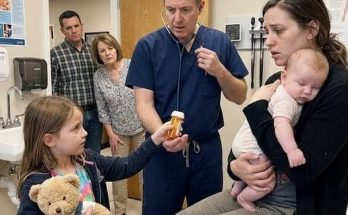
She asked us to confirm the medication Noah had been prescribed and what we had observed about the bottle when we arrived at the hospital.
I described the bottle and the fact that it appeared almost full despite the days when we believed Noah had been receiving his prescribed medicine.
I explained what Lily had told us.
I described the nighttime bottle Patricia had brought to the hospital in the paper bag.
I was careful to separate what I had seen myself from what Lily had reported.
The nurse thanked me for being precise.
She explained that the team needed accurate information about any possible exposure, even when they could not determine every detail afterward.
I asked whether the medical team had established exactly what had caused Noah's fever.
She told me that we should rely on the treating clinician's assessment and that we should not assume one event explained everything without evidence.
I appreciated her honesty.
I did not want a comforting guess.
I wanted the truth, even if the truth came with unanswered questions.
After the call, Daniel sat with his elbows on the table.
“I keep going back to that first night,” he said.
I knew which night he meant.
The night he held Noah while Patricia used the syringe.
The night Lily had watched from the kitchen doorway.
The night he had told our daughter to go back to bed.
“What do you remember?” I asked.
He looked at the notebook.
“Mom said you had been giving him medicine too often. She said she thought it was making him restless.”
“Did you ask what she meant?”
“No.”
“Did you look at the bottle?”
“I saw it.”
“Did you read the label?”
He shook his head.
I waited.
“I thought she knew what she was doing,” he said. “And I thought if I questioned her, she'd get angry.”
I felt something cold settle inside me.
“You were willing to let me be the one who was wrong because that was easier.”
He did not deny it.
“Yes.”
It was the first answer he had given me that did not contain a reason, a defense, or a request for understanding.
I looked out the kitchen window.
The small patch of grass near the fence needed cutting.
A toy truck Lily had left outside was lying on its side.
The ordinary details seemed almost insulting.
The world had continued to look ordinary while our family had been living inside a danger we did not understand.
“I need you to understand something,” I said.
He turned toward me.
“This was not only about Patricia's decision. You were there. You had a chance to ask a question. You had a chance to stop and check. You had a chance to listen to Lily afterward.”
“I know.”
“You don't get to call yourself a bystander.”
He swallowed.
“I wasn't.”
I had wanted him to say that for days.
Hearing it did not make the hurt smaller.
It made the shape of it clearer.
That afternoon, Daniel asked whether I would consider speaking with a family counselor.
He said he did not want us to keep having the same conversation until we both became too tired to continue.
He wanted help understanding why he had spent so long avoiding conflict with Patricia.
He also wanted to learn how to listen without immediately trying to defend himself.
I thought about it.
“I will consider it,” I said. “But I don't want counseling to become another way for you to ask me to forgive you faster.”
“It won't.”
“You can't promise what I will feel.”
He nodded.
“Then I promise I won't use it that way.”
We found a counselor who worked with families dealing with broken trust and difficult boundaries.
The first appointment was scheduled for the following week.
I did not believe a conversation with a stranger could undo what had happened.
But I believed there were things Daniel needed to face that I could not keep explaining to him.
I also needed somewhere to speak without managing everyone else's reactions.
Until then, we continued caring for Noah.
His days became less frightening.
He fed, slept, and woke in ways that gradually felt more familiar.
We kept following the care instructions and stayed in contact with his medical team when we had questions.
Every ordinary improvement brought relief.
Every small sound could still make me turn my head.
When Noah cried, I checked on him.
When his face flushed after a stretch of crying, I watched him more closely.
I reminded myself that concern was not the same as certainty.
I could notice something without deciding what it meant.
I could ask for help without being ashamed of asking.
The hardest part was learning that I could not make every risk disappear by watching harder.
I could only make responsible decisions with the information available to me.
One evening, Lily came into the living room carrying her teddy bear.
She had taken off its little denim overalls and was holding them by the straps.
“Can I ask something?”
“Always.”
“Do I have to tell the counselor what I saw?”
“Only if you want to talk about it. We won't make you tell the story over and over.”
“What if they don't believe me?”
I moved the folded laundry aside and made room for her.
“We will tell them what happened. And we will make sure you know you can speak honestly.”
She sat beside me.
“Will Daddy be there?”
“He may be, but you won't have to sit in a room and answer questions if you're uncomfortable. We'll talk with the counselor about what feels safe for you.”
She looked relieved.
Then she put the overalls back on the teddy bear.
One strap twisted around its shoulder.
She tried to straighten it, but her fingers were clumsy.
I helped her.
She hugged the bear tightly.
“I don't want Grandma to be all alone,” she said.
My heart hurt.
“You can care about Grandma and still tell the truth about what happened.”
“Even if she did something bad?”
“Yes.”
“Even if Daddy did something bad?”
I held her hand.
“Yes.”
She looked at me for a long time.
“Can people do bad things and still love you?”
I had to think before I answered.
“Yes. But love doesn't make a harmful choice safe. And loving someone doesn't mean you have to pretend it didn't happen.”
She leaned against my side.
I could see how hard she was working to fit these ideas into the world she knew.
For Lily, adults had always been the people who explained what was happening.
Now she had seen adults make decisions they could not defend.
She needed to know that the world could still make sense.
I could not promise her that no one would ever frighten or disappoint her again.
I could promise that she would not be asked to protect our pride by keeping quiet.
That night, Daniel and I sat at the kitchen table after the children were asleep.
He had printed the counseling appointment information.
He placed it beside the folder containing Noah's care instructions.
Two piles of paper.
One for our son's care.
One for the work our family still needed to do.
“I've been thinking about the way I talk about my mother,” Daniel said.
I waited.
“I always say she's strong. She raised three children. She knows how to handle things.”
“Those things may be true.”
“But I use them like they mean she can't be wrong.”
I nodded.
He looked at the folder.
“I did the same thing with you, but in reverse. When you worried, I called you anxious. That meant I didn't have to take the concern seriously.”
I did not answer immediately.
He was finally describing the pattern without making me drag it out of him.
“I started believing that if you sounded upset, your judgment was automatically less reliable,” he continued. “And if Mom sounded confident, hers was automatically better.”
“That made it easy to dismiss me.”
“Yes.”
He pressed his hands flat on the table.
“I don't know how I let myself do that.”
“You did it one small decision at a time.”
He looked at me.
“You kept telling me when something felt wrong. I kept choosing the explanation that let me avoid a fight.”
His voice broke slightly.
“I made you feel alone in our own home.”
I looked at the man I had married.
I remembered the early years, when he used to ask what I thought before making a decision.
I remembered how we used to disagree without turning it into a contest.
I remembered the first time Patricia criticized me for being too careful with a purchase for the baby.
Daniel had laughed and said his mother had raised three children.
I had laughed too, because I did not want to seem difficult.
That small moment had not caused what happened.
But it was one of the many times I had learned to swallow a concern to keep the room comfortable.
“I don't want to spend the rest of our marriage trying to convince you that my questions deserve answers,” I said.
“You shouldn't have to.”
“I don't want Lily learning that the loudest adult is automatically right.”
“She won't.”
“You can't guarantee that.”
He lowered his eyes.
“No. I can't. But I can stop teaching her that lesson.”
For once, he did not promise to make everything better.
He promised to change what he did.
I could work with that.
Not because I trusted him completely.
Because actions could be observed.
The next morning, he called the counselor to ask whether there was anything we should prepare for the first appointment.
He wrote down the answer.
He asked whether Lily's participation was necessary.
He made it clear that we did not want her pressured to recount a frightening experience.
When he finished, he showed me his notes.
I read them.
Then I handed them back.
“Thank you for checking.”
He nodded.
There was no grand speech.
No declaration that our family was healed.
Just a man learning to ask before assuming.
And a woman who was not ready to trust him the way she once had.
Both things could be true.
Click here to continue reading: PART 20: We Could Not Return to the Family We Had Before, So We Had to Decide What Safety, Honesty, and Forgiveness Would Mean Now
My Baby’s Fever Kept Rising While Everyone Told Me to Calm Down, Until My Daughter Asked the Doctor One Question
Part 19 of 20