
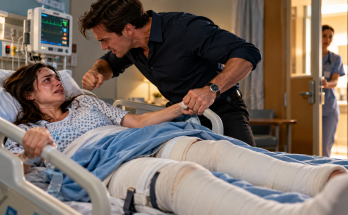
The door opened before Caleb's arm came down again.
A nurse stepped inside with a clipboard tucked against her chest.
She stopped when she saw us.
I was gripping the bedrail, my body bent forward as far as the casts allowed.
Caleb stood over me with one hand raised and the blanket twisted in the other.
The monitor was screaming.
For one second, nobody moved.
Then the nurse dropped her clipboard onto the cabinet and hurried toward the bed.
“Step away from her.”
Caleb lowered his arm.
“What's going on?” he asked.
His voice had changed.
It was no longer the angry voice he had used with me.
It was calmer.
Almost reasonable.
I noticed that immediately.
The nurse moved between us and reached for the call button.
“Rebecca, can you hear me?”
I nodded.
It hurt to do even that.
“Can you tell me where you're hurting?”
“My stomach,” I managed.
My voice sounded weak and unfamiliar.
The nurse looked at the monitor, then at the blanket hanging over the side of the bed.
“Did you fall?”
Caleb answered before I could.
“She got worked up. I was trying to help her sit up.”
The nurse did not look at him.
She kept her attention on me.
“Rebecca, did you fall out of bed?”
I shook my head.
“No.”
“Did anyone move you?”
I looked at Caleb.
He was standing a few feet away now, his hands resting at his sides.
His face had settled into an expression I knew well.
The expression he wore when he wanted other people to believe he was the reasonable one.
I had seen it at family gatherings.
I had seen it when he disagreed with a cashier.
I had seen it when he explained a problem in a way that made it sound as though someone else had caused it.
I had spent years accepting that version of him because arguing about it seemed exhausting.
But the nurse was looking at me.
She was waiting for my answer.
“He grabbed me,” I said.
Caleb turned sharply.
“Rebecca.”
The nurse raised one hand toward him without taking her eyes off me.
“Please remain where you are.”
I swallowed.
My stomach hurt.
My ribs hurt.
I was frightened that if I said the wrong thing, the situation would become worse when we were alone again.
But I was also frightened of what might happen if I said nothing.
“He tried to pull me out of bed.”
The nurse's expression changed.
She glanced at my casts and then at the warning notice attached to my chart.
“Did he hurt you?”
I could hear Caleb breathing behind her.
I could feel his attention on me.
I wanted to say that everything was fine.
The words almost came out automatically.
Instead, I looked at the bedrail and whispered, “He hit me.”
The nurse became very still.
Then she pressed the call button again.
“I'm getting help.”
Caleb stepped forward.
“This is ridiculous. She's confused because of the medication.”
The nurse finally turned toward him.
“You need to stay back.”
“I'm her husband.”
“And she's my patient.”
He stared at her as if he had never heard anyone speak to him that way.
I had heard him introduce himself as my husband countless times.
He used the words as though they gave him the right to answer questions for me, make decisions for me, and decide what I could tolerate.
Now the nurse had reminded him that the hospital had responsibilities of its own.
For the first time that afternoon, Caleb looked uncertain.
Another staff member appeared at the doorway.
The nurse spoke quickly, asking for assistance and explaining that I needed to be assessed.
She did not raise her voice.
She did not argue with Caleb.
She simply continued doing her job.
I watched her check my breathing and ask me to describe the pain.
When I tried to answer, my voice broke.
She told me to take my time.
Nobody had said that to me since the accident.
Take your time.
I wanted to cry because those three words were so ordinary.
They were also the opposite of everything Caleb had demanded from me.
A second nurse entered.
Then a doctor arrived.
The room filled with quiet instructions and careful movements.
Someone adjusted the bed.
Someone checked the monitor.
The doctor asked when the pain had begun and whether it was getting worse.
I answered as clearly as I could.
Caleb tried to interrupt twice.
Both times, someone asked him to wait.
I had never seen him wait when he believed he had the right to speak.
He looked from one person to another, searching for someone who would accept his explanation.
Nobody seemed interested in letting him take control of the conversation.
The doctor examined me and ordered further assessment.
I did not understand every instruction.
I only understood that the people around me were taking the pain seriously.
They were not telling me I was dramatic.
They were not asking what I had done to provoke him.
They were trying to find out whether I had suffered another injury.
That should have been normal.
At the time, it felt extraordinary.
While the medical staff worked, Caleb stood near the door.
His expensive cologne still lingered in the room.
I could smell it whenever I turned my head.
It reminded me that he had arrived looking polished and prepared.
He had brought paperwork.
He had talked about money.
He had expected me to leave.
He had not come to ask whether I was recovering.
He had come to make me obey.
I could no longer pretend otherwise.
When the doctor finished the first examination, a nurse pulled the blanket back into place.
She made sure my legs were supported.
Then she looked at me.
“Rebecca, I need you to tell us exactly what happened.”
Caleb opened his mouth.
The doctor raised a hand.
“We need to hear from the patient first.”
I stared at the white blanket.
My hands were still trembling.
I could feel the ring on my finger against the bedrail.
For years, I had treated silence as a way to keep our family together.
Now I understood that silence could also leave me alone with the person hurting me.
I looked at the nurse.
“My husband tried to drag me out of bed.”
She nodded.
“Go on.”
“I told him I couldn't stand.”
My throat tightened.
“He got angry.”
I paused to breathe.
“Then he hit me.”
Caleb shook his head.
“She is leaving out the context.”
The doctor turned toward him.
“You will have an opportunity to speak later. Right now, we are assessing her condition.”
I looked at Caleb.
He seemed offended.
Not frightened for me.
Not sorry.
Offended that other people had interrupted him.
That expression told me something I had spent years refusing to understand.
He believed his anger was more important than my pain.
The nurse asked another staff member to document my account.
She also asked that Caleb wait outside while they continued the assessment.
He protested.
He said he was my husband.
He said he had every right to remain.
He said I needed him to make decisions.
The nurse repeated the instruction.
He eventually stepped into the hallway.
Before he left, he looked at me.
It was not a long look.
He did not need to say anything.
I knew the message.
We would talk about this later.
For years, that promise of a later conversation had been enough to make me afraid.
It had meant that an argument was not finished when the words stopped.
It followed me into the kitchen, into the bedroom, and into the next morning.
I would spend hours trying to work out how to make things right.
This time, I could not follow him.
I could not get out of bed.
I could not go after him and apologize.
And for the first time, I realized that my inability to move might protect me from making the same mistake again.
The door closed behind him.
The room became quieter.
The nurse pulled her chair closer to my bed.
“You did the right thing by telling us.”
I looked at her.
I wanted to believe her.
But fear did not disappear simply because someone had offered me kindness.
“What happens now?” I asked.
“We're going to take care of your injuries first. Then we'll discuss what you need to feel safe.”
Safe.
I had not realized how badly I needed to hear that word.
I turned my head toward Emma's drawing.
The paper was still taped to the wall.
The corner had curled farther away from the paint.
I looked at the words beneath the little house.
COME HOME SOON, MOMMY.
I had spent three weeks thinking that home was the place where I needed to return.
Now I wondered whether home was still the place I had left.
Click here to continue reading: PART 6: The Questions Were Simple, but Answering Them Meant Admitting That the Man I Had Protected for Years Was the One I Feared
For Twenty-One Days, I Waited for My Husband to Visit With Flowers, Until I Finally Learned What He Thought My Life Was Worth
Part 5 of 20

One Comment on “PART 5 – The Nurse Who Walked Through That Door Saw More Than My Injuries, and for the First Time, Caleb Could Not Control the Room”